The top solutions for AI visibility and generative engine optimization (GEO) depend on the job. For a small team that needs to track AI answers and publish fixes, RankSpot is the practical pay-as-you-go pick. For enterprise-level analysis, look at Profound. If your team already runs SEO in a suite, SE Ranking or Semrush may be simpler. A cheap entry plan only helps if it covers the prompts and engines your buyers use.
What is a generative engine optimization tool?
A GEO tool helps you see whether AI answers mention your brand, which pages they cite, and where you need better content or third-party mentions. Here, GEO means generative engine optimization, not geographic information systems, GPS or surveying gear.
The term comes from a research paper by Princeton and IIT Delhi researchers, accepted to KDD 2024. In their tests, adding citations, quotations and statistics to a page lifted its visibility in generative answers by up to 40%. Results varied by domain, so treat that as a ceiling from one study, not a promise.
A buyer might ask, “What software can automate onboarding for a five-person team?” A rank tracker shows where your page lands in search results. A GEO tracker samples the answer from ChatGPT, Perplexity or another engine and records mentions and citations. Some generative engine optimization software helps you write or publish a page that addresses the question.
This traffic is worth measuring. Adobe data reported by TechCrunch shows AI traffic to US retail sites rose 393% year over year in Q1 2026, and those visitors converted better than other traffic. A brand mention without a link can build awareness; a linked citation may send a visit. To see whether either leads to customers, compare changes in your Search Console and analytics data.
The three types of GEO software
You can group generative engine optimization tools by the work they do: monitoring answers, adding AI data to an SEO suite, or helping you produce content. Some products cover more than one job.
Type | Main job | Best fit | Typical trade-off |
|---|---|---|---|
AI visibility tracking and citation analysis | Monitor prompts, brands, answers and cited sources | Teams asking “Are we showing up?” | Some stop at measurement |
SEO suites with AI visibility | Connect AI answer data with existing keyword and site work | Teams already paying for SEO data | AI limits can depend on an add-on or plan |
Content optimization and creation | Turn query and answer gaps into drafts or improved pages | Teams with a publishing bottleneck | Writing features do not guarantee AI citations |
RankSpot combines tracking with publishing; Goodie includes a writer; Frase includes AI visibility. Compare the plan you can afford with the steps your team needs to complete.
Top solutions for AI visibility and generative engine optimization compared
The prices refer to the GEO or AI visibility offering, which may differ from a full SEO suite. “Annual” means the monthly figure requires annual billing. Engine lists describe entry-plan coverage or a choice of engines; higher tiers may cover more. Prices were checked on each vendor’s pricing page in November 2026.
Tool | Type | Entry-plan engines or selection | Citation/source data | Creates or publishes content | Starting price | Trial or free access |
|---|---|---|---|---|---|---|
RankSpot | Tracking + execution | ChatGPT, Perplexity, Gemini, Google AI (Overviews/Mode) | Citation gaps | Writes and publishes to CMS | $0.004/check; $3/article | $1 free credit |
Profound | Enterprise analytics | Up to 10, incl. ChatGPT, Perplexity, Gemini, Claude, AI Overviews, AI Mode | Citations, sentiment, prompt analysis | AI Marketer content agents | Custom pricing (Enterprise only) | Demo only |
Peec AI | Tracking | Choose 3 of 8, incl. ChatGPT, Perplexity, Gemini, AI Overviews, AI Mode | Cited-source analysis | No | $95/mo | Free trial |
Otterly.ai | Tracking | Choose 3 of 7, incl. ChatGPT, Perplexity, Gemini, AI Overviews, AI Mode, Copilot, Claude | Citation source tracking | Recommendations only | $29/mo | Free trial |
Scrunch AI | Tracking | 8 listed engines; Claude as add-on | Citations and sources | No | $250/mo | 7-day free trial |
AthenaHQ | Tracking + actions | Free: 5; Starter: 11 listed engines | Citation insights with action checklists | Content agent on Enterprise | Free; Starter $295/mo | Free plan |
Goodie | Tracking + content | Core: ChatGPT, AI Overviews, AI Mode, Perplexity, Copilot | Source and visibility analysis | AEO Content Writer | $295/mo | 7-day free trial |
SE Ranking / SE Visible | SEO suite / standalone tracking | ChatGPT, Gemini, AI Overviews, AI Mode, Copilot | AI citations alongside SEO | No direct CMS publishing | SE Visible $89/mo ($71 annual) | 14-day free trial |
Semrush AI Visibility Toolkit | SEO suite add-on | ChatGPT, Google AI Mode and other platforms | AI mentions and prompt insights | Separate content tools in ecosystem | $99/mo per domain | No free trial |
Ahrefs Brand Radar | SEO suite add-on | Google, ChatGPT, Gemini, Perplexity, Copilot, Claude | Citation and brand research | No | Brand Radar AI from $199/mo; custom prompts from $50/mo | No free trial |
Writesonic GEO | Content + tracking | Starter: ChatGPT, Gemini, AI Overviews | AI visibility and source insights | AI writing | $79/mo annual | 7-day free trial |
Frase | Content + tracking | Starter: ChatGPT, Google AI | AI visibility | Writes and publishes to WordPress, Webflow, Sanity, Wix | $49/mo, or $39/mo annual | 7-day free trial |
Compare the plan-specific prompt, run and engine allowances alongside the price. A low sticker price can hide a small prompt cap.
AI visibility tracking and citation analysis tools
Use these tools to see which buyer questions surface your brand, competitors and cited pages. The seven options range from pay-per-check monitoring to enterprise analysis.
1. RankSpot: best for founders who need to track and act
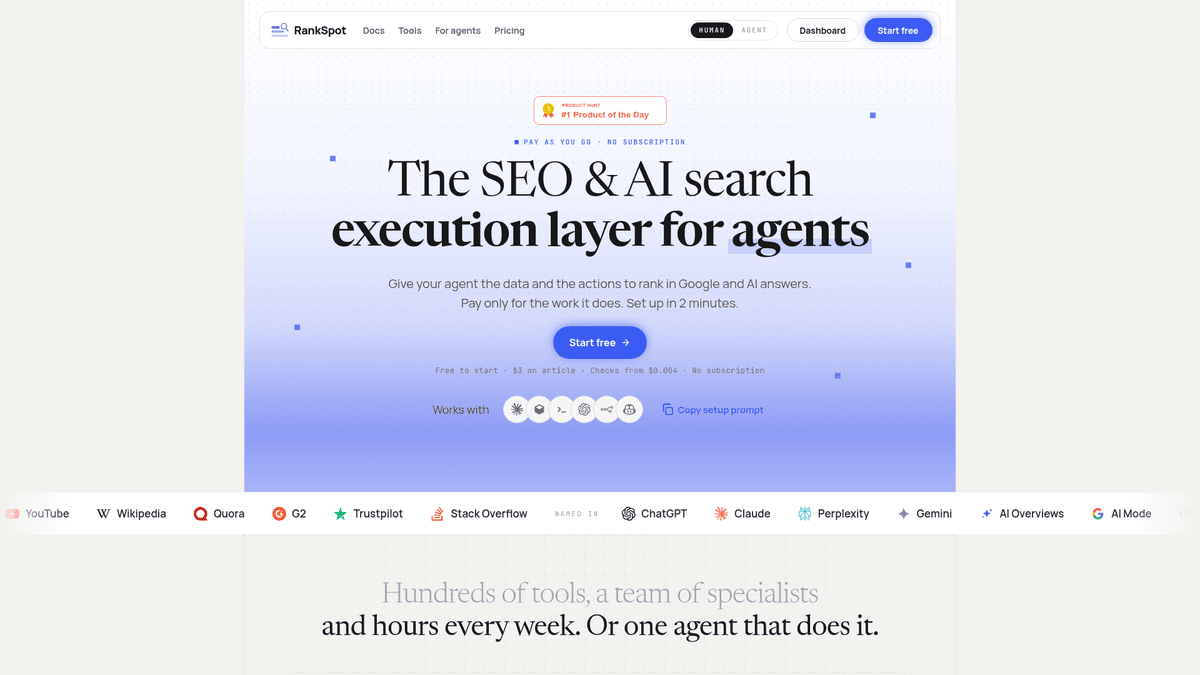
RankSpot monitors ChatGPT, Perplexity, Gemini and Google AI (AI Overviews and AI Mode counted as one engine). A check is one prompt on one engine, at $0.004. There is no fixed subscription: you get $1 in free credit, can top up from $10, and pay $3 per article when you create one.
After you find a gap, you can identify cited sources, research keywords and competitors, write an SEO/GEO-focused article and publish it to WordPress, Webflow, Shopify or Ghost. RankSpot keeps your brand, keywords, citations, articles and open tasks in the workspace. You or an AI agent connecting over MCP can resume the work without rebuilding context. Claude or ChatGPT can serve as an agent interface, but RankSpot does not track Claude answers.
One person can own both reporting and publishing here. Larger companies should note the absence of enterprise SSO and Profound-style multi-brand reporting. An agency can use a workspace per brand, though it will not get a formal roll-up dashboard.
Verdict: A fit for a founder who needs prompt monitoring, citation-gap research and publishing without multiple monthly subscriptions.
2. Profound: best for enterprise AI intelligence
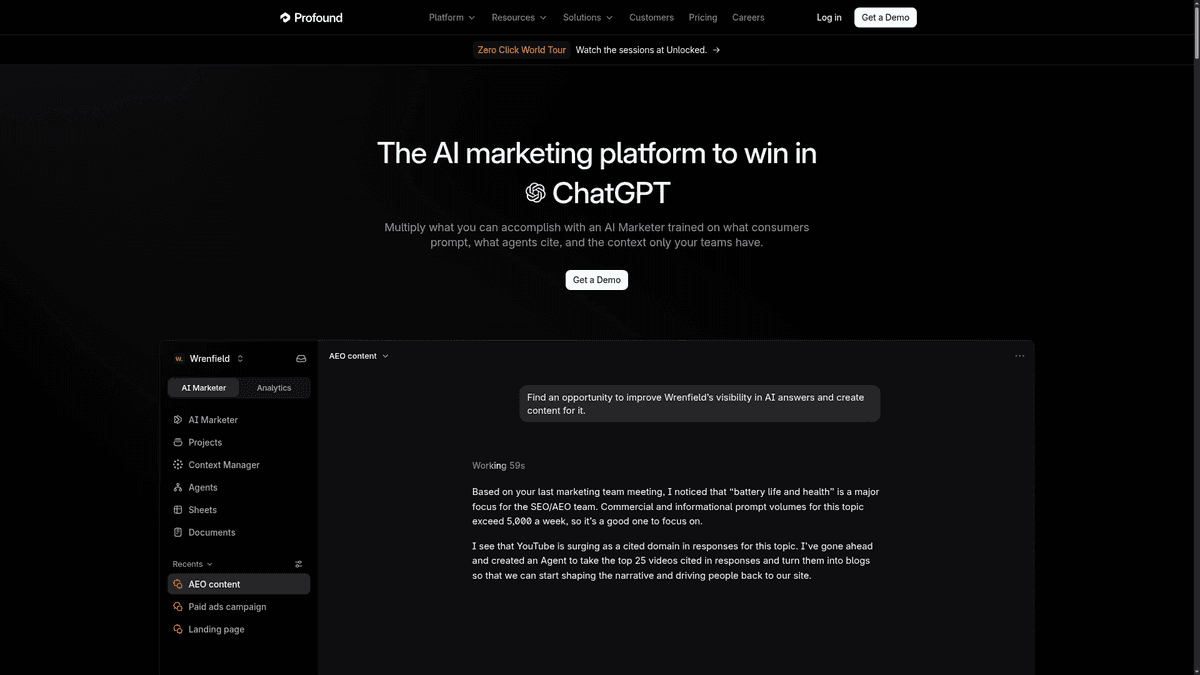
Profound is built for teams that need deep prompt and citation analysis across markets, brands and engines. It retired its self-serve Starter and Growth plans in September 2026, so Enterprise with custom pricing is now the only option. The way in is a sales demo, not a self-serve trial.
Enterprise tracks up to 10 answer engines, including ChatGPT, Perplexity, Gemini, Claude, Google AI Overviews, AI Mode and DeepSeek. You get daily tracking, unlimited seats, SSO/SAML and SOC 2 compliance, plus Agent Analytics for AI crawler traffic. Its AI Marketer agents can draft content, but Profound is built around analysis rather than a solo founder’s write-and-publish loop.
If you are considering it alongside a leaner setup, compare Profound alternatives by the reporting and execution work your team actually needs.
Verdict: Profound fits teams that need brand coverage, multi-team analysis and advanced reporting enough to request a custom quote.
3. Peec AI: best for focused prompt monitoring
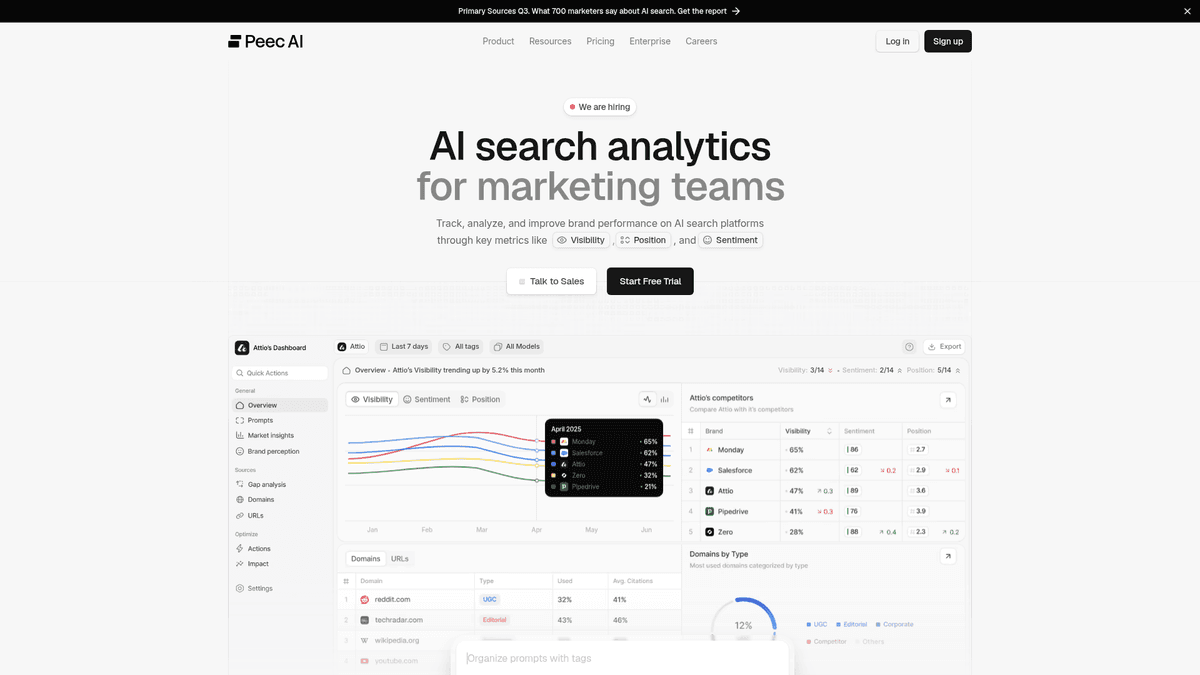
Peec AI starts at $95/month for 50 prompts. On its published plans you choose three engines from a list that includes ChatGPT, Perplexity, Gemini, Google AI Overviews and Google AI Mode. Pro is $245/month for 150 prompts; Advanced is $495/month for 350. A fourth engine costs extra, from $30/month on Starter. Enterprise pricing is custom, and a free trial is available.
Peec works well for a tight set of high-intent questions and clear mention and source comparisons. If you need four engines, budget for the add-on. Peec surfaces opportunities, but your team still needs a CMS publishing process. You can weigh other setups in these Peec AI alternatives.
Verdict: Peec suits a small, defined prompt set. Four-engine coverage costs more than the entry price suggests.
4. Otterly.ai: best for starting with a narrow watchlist
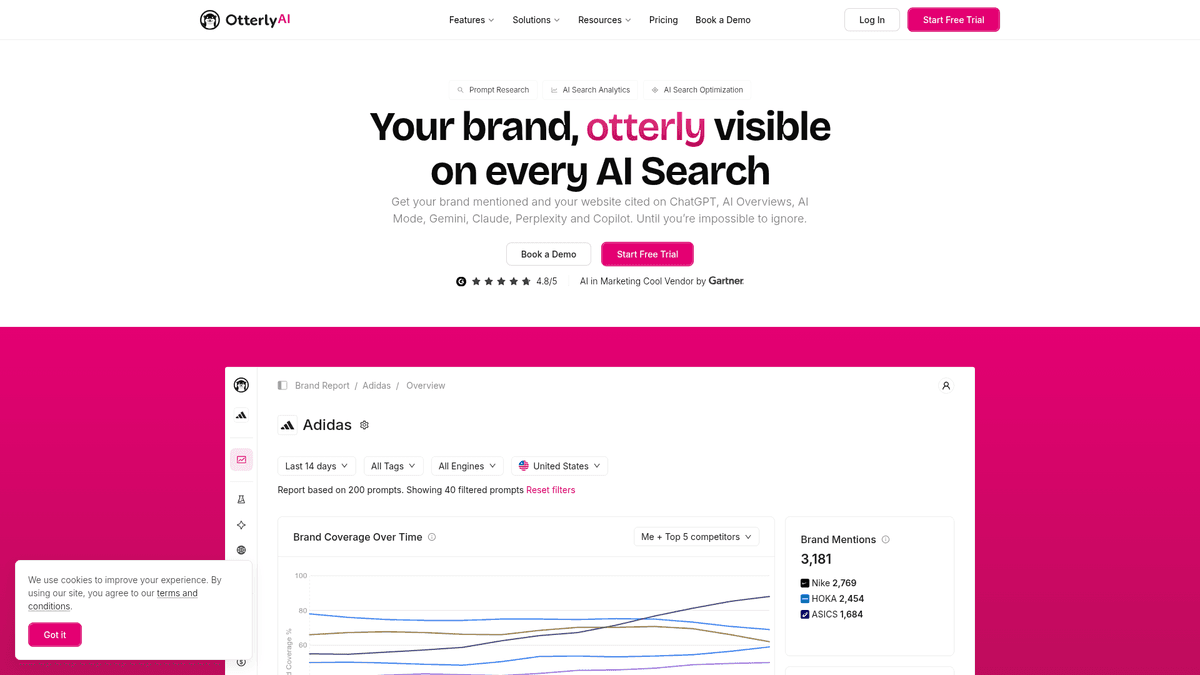
Otterly.ai Lite costs $29/month for 20 prompts (2,000 credits). Standard is $189/month for 160 prompts, and Premium is $489/month for 535. Annual billing takes 15% off. Every plan picks three of seven engines: ChatGPT, Google AI Overviews, Perplexity, Copilot, Google AI Mode, Gemini and Claude. A Claude answer uses three credits; every other engine uses one. There is a free trial.
The $29 plan lets you start small and see citation sources. API and MCP access start on Standard. Work out how many credits your question list would use before comparing it with pay-per-check pricing. You will also need a way to publish missing pages. For wider coverage, consider these Otterly.ai alternatives.
Verdict: Start with Otterly for a narrow pilot if 20 prompts on three engines covers your intended schedule.
5. Scrunch AI: best for multi-engine brand analysis
Scrunch Core costs $250/month for 15,000 AI responses a month. It lists ChatGPT, Perplexity, Gemini, Google AI Overviews, Google AI Mode, Microsoft Copilot, Grok and Meta AI. Claude is an add-on, not part of Core. Enterprise pricing is custom and billed yearly. Core comes with a 7-day free trial.
Scrunch lets your team compare brand and source appearances across several assistants. You will need people ready to turn those findings into site changes. If your buyers use Claude, budget for the add-on rather than treating it as part of Core.
Verdict: Scrunch covers many engines and shows source context. You will still need a content production budget.
6. AthenaHQ: best for teams that want action suggestions
AthenaHQ offers an Essential free plan with 300 credits and five listed engines: ChatGPT, Perplexity, Google AI Overviews, Gemini and Copilot. Its Starter plan costs $295/month (annual billing takes 17% off), provides 3,600 credits and expands coverage to eleven engines, including Claude and Google AI Mode. Enterprise is custom and adds content creation workflows and an optimization agent.
AthenaHQ’s weekly Insights attach an action checklist to each finding, so you know what to fix next. A busy multi-engine schedule can use up the fixed credit allowance. Below Enterprise, publishing to your CMS is still your job.
Verdict: The free plan lets you test whether its action suggestions help; the paid plan needs to fit your check volume.
7. Goodie: best for AEO teams that also need a writer
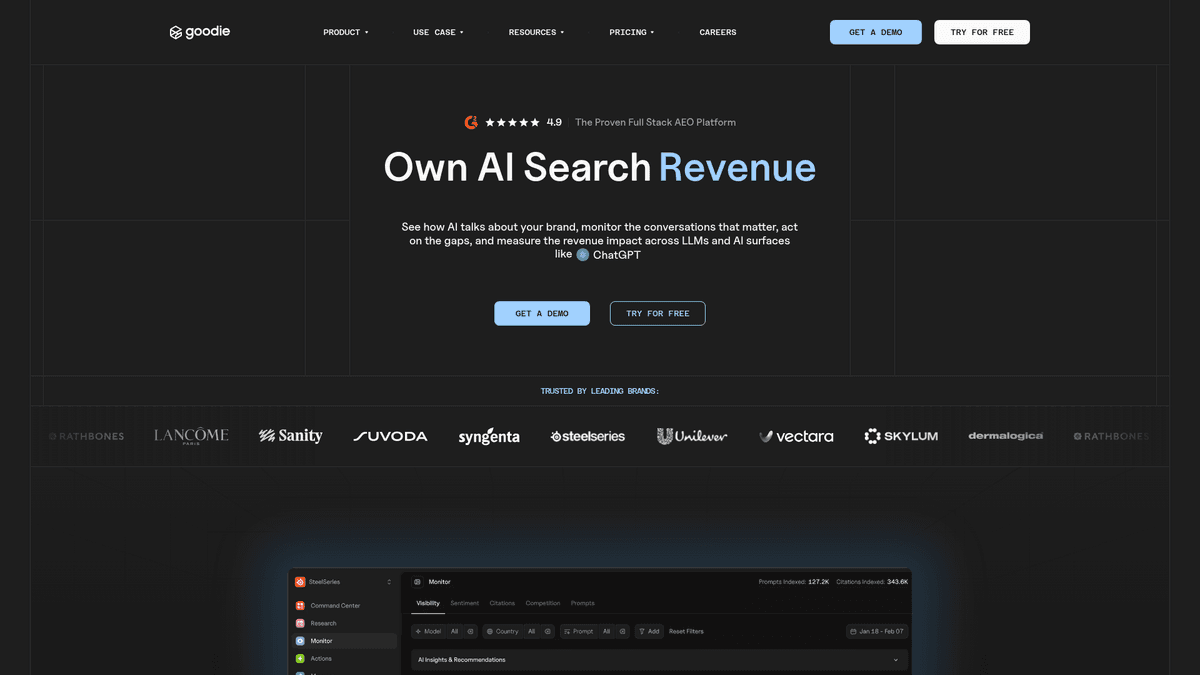
Goodie Core is $295/month, with 110 prompts and five listed engines: ChatGPT, Google AI Overviews, Perplexity, Google AI Mode and Copilot. Annual billing advertises two months free, and Core has a 7-day free trial. Pro is $999/month for 250 prompts and adds Gemini, Alexa and Sparky. Enterprise pricing is custom.
Goodie connects visibility findings to content opportunities and an AEO Content Writer included on Core. If your team already produces pages, you can turn an observed gap into a draft in the same product. Gemini is not on Core’s listed coverage. You will still need traditional keyword and backlink research if those are part of your process.
Verdict: Goodie fits an AEO content team with a few hundred dollars a month to spend. A modest prompt watchlist may not justify it.
SEO suites with AI visibility features
If you already pay for SEO research, a suite can put AI answers beside your keyword and site data. Price the AI offering separately from the base SEO subscription.
8. SE Ranking and SE Visible: best for an existing SEO workflow
SE Visible is the standalone AI visibility offering: Basic costs $89/month, or $71/month billed annually, with 75 prompts tracked daily. Its listed coverage includes ChatGPT, Google AI Overviews, Google AI Mode, Gemini and Copilot. Core is $189/month with 200 prompts; Agency is $399/month with 1,000 prompts and adds Claude. There is a 14-day free trial.
SE Ranking is a separate SEO subscription, with Core at $129/month or $103.20/month billed annually, also with a 14-day free trial. It includes 25 daily AI visibility prompts across five engines alongside broader SEO work. Do not add the two starting prices together as though both products were mandatory. Compare the standalone plan with the SEO subscription according to whether you need the ranking and site tools. The SE Ranking alternatives page gives more context on the SEO side.
Verdict: Buy SE Visible for dedicated AI reporting, or SE Ranking when you also need its wider SEO suite.
9. Semrush AI Visibility Toolkit: best for Semrush users
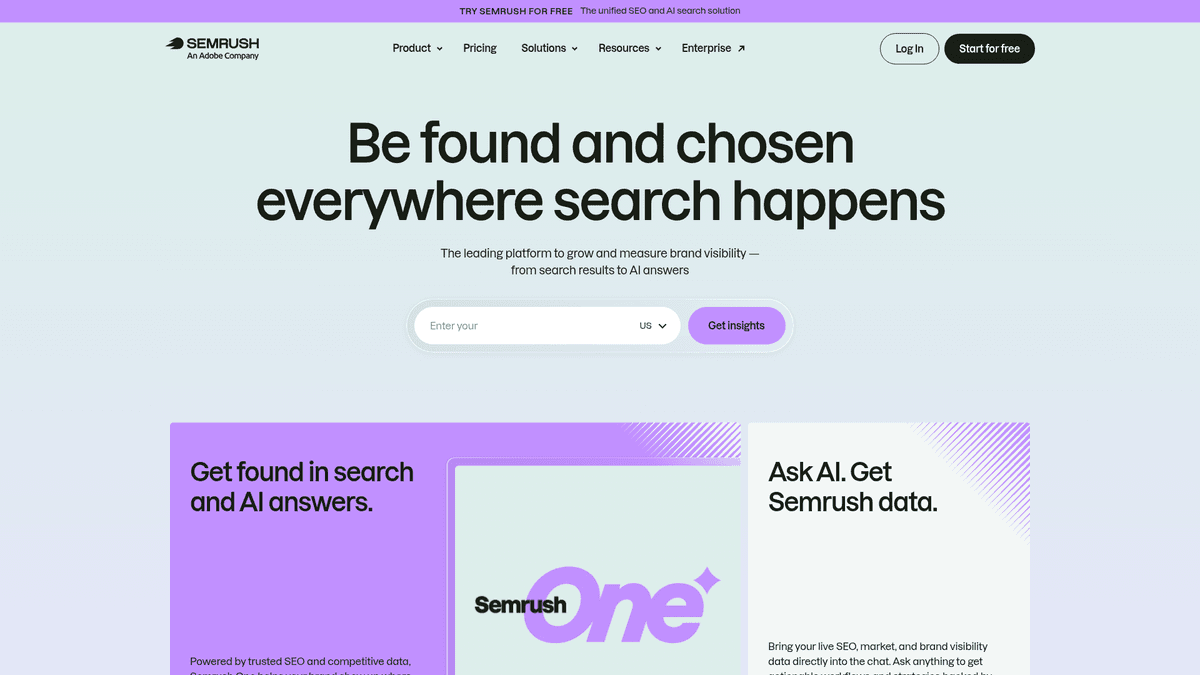
Semrush sells its AI Visibility Toolkit at $99/month per domain, with 25 Prompt Tracking prompts included. Another 50 prompts cost $60/month, and each extra brand domain is another $99/month. Prompt Tracking covers platforms including ChatGPT and Google AI Mode. The toolkit has no free trial.
You can connect the questions buyers ask in AI with work your SEO team already does in the Semrush ecosystem. An agency with several brands or a team with more than 25 key questions needs to budget for expansion. The $99 price does not include Semrush’s content creation or publishing products.
Verdict: Semrush users can add AI tracking without changing their main workspace, though multiple domains and extra prompts add up quickly.
10. Ahrefs Brand Radar: best for source research alongside SEO data
Ahrefs lists its Brand Radar AI add-on from $199/month for researching any brand across its prompt database. Tracking your own prompts is a separate purchase: Basic costs $50/month for 2,500 checks, Growth $100/month for 7,000, and Scale $250/month for 25,000. One check is one prompt on one platform. Covered platforms are Google, ChatGPT, Gemini, Perplexity, Copilot and Claude.
The $50 custom-prompt package does not include Brand Radar AI research, and the $199 add-on does not include unlimited custom checks. Brand Radar fits teams that already use Ahrefs for links and search research. Ahrefs does not offer a free trial, and you will still need to turn any source gap into a published page yourself.
Verdict: Ahrefs teams get useful citation research here, with brand research and custom tracking priced separately.
Content creation and optimization tools
If you have identified a visibility gap but struggle to produce a better page, start here. Both tools include AI monitoring, with fewer engines on their entry plans than some dedicated trackers.
11. Writesonic GEO: best for a writing-led GEO process
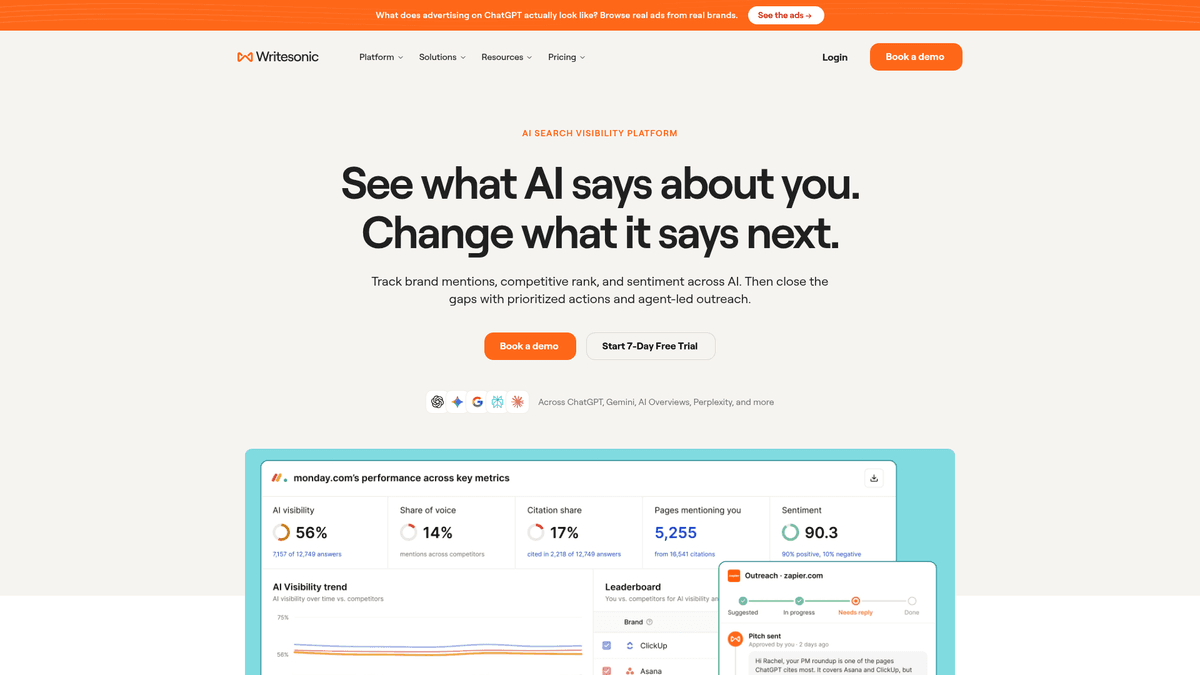
Writesonic Starter costs $79/month billed annually for 50 prompts and tracks ChatGPT, Gemini and Google AI Overviews. Basic is $199/month annually for 100 prompts, Growth $399/month annually for 200, and Enterprise pricing is custom with coverage expanded to eight platforms. Paid plans start with a 7-day free trial.
With writing and AI visibility together, a small marketing team can move from a topic to a draft. Self-serve plans do not list Perplexity, so they will not cover a four-engine monitoring plan. If writing is your priority, compare the Writesonic alternatives along with their monitoring allowances.
Verdict: Writesonic helps when drafting slows your team down. Its engine list on self-serve plans is narrow.
12. Frase: best for optimizing existing content
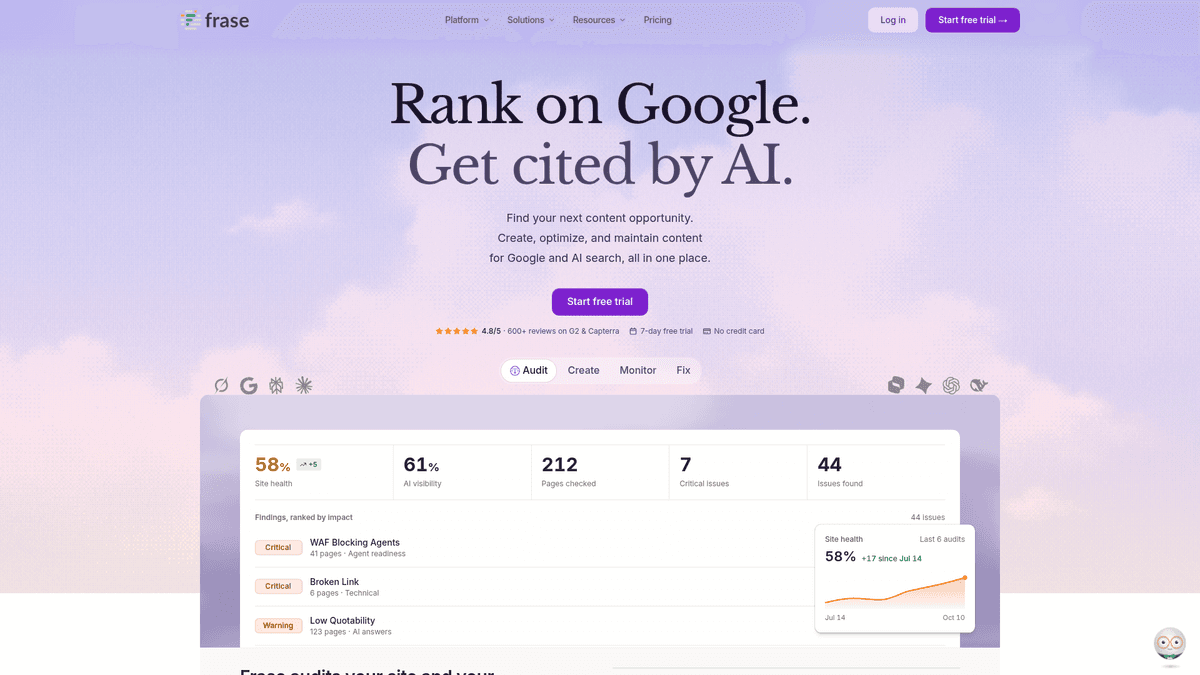
Frase Starter is $49/month or $39/month billed yearly, with 10 articles and 20 tracked AI prompts on ChatGPT and Google AI. Professional costs $129/month, or $103/month yearly, with 50 prompts and Perplexity added. Scale costs $299/month, or $239/month yearly, with 75 prompts plus Claude and Gemini. Every plan has a 7-day free trial with no credit card.
Frase is useful when you need research, page improvement and writing in the same routine as basic AI monitoring. It publishes to WordPress, Webflow, Sanity and Wix. Keep the product’s writing models separate from its tracked engines; access to an AI model for drafting does not mean the tool monitors your brand in that model’s answers. See Frase alternatives if content workflow matters more to you than broad monitoring.
Verdict: Frase works well for a content-first routine; its entry plan monitors only ChatGPT and Google AI.
What does GEO tracking actually cost?
At 50 prompts on four engines every day for a 30-day month, you run 6,000 engine checks. At RankSpot’s $0.004 per check, that is $24 in checks. Any articles you choose to generate are separate at $3 each.
Scenario | Calculation | What you pay for |
|---|---|---|
Small pilot | 10 prompts × 2 engines × 30 days = 600 checks | RankSpot checks: $2.40 |
Full daily watchlist | 50 prompts × 4 engines × 30 days = 6,000 checks | RankSpot checks: $24 |
One-time baseline | 50 prompts × 4 engines = 200 checks | RankSpot checks: $0.80 |
Compare subscription allowances with those 6,000 checks. Peec’s $95 entry plan offers 50 prompts on three chosen engines. Semrush’s $99 Toolkit includes 25 tracked prompts per domain. Otterly’s $29 Lite plan covers 20 prompts on three engines. Those plans serve different schedules from 50 prompts checked daily across four engines, and each vendor defines its prompts, checks or credits differently.
The $1 RankSpot credit covers 250 checks at the stated per-check rate. For a new brand, that is enough for a baseline of 50 prompts across four engines, with 50 checks left over. If you add writing, outreach or other actions, budget those separately rather than calling the whole operation $24.
How to choose the right GEO platform
Choose a tool that shows where you appear, why a page gets cited, and what your team can improve next. Your budget needs to cover the engines your buyers use and the content work you can ship.
Name the question you need answered. If you only need a weekly visibility trend, a tracker is enough. If the real problem is that a competitor’s guide keeps getting cited, prioritize source data and a way to update your page. If you cannot ship content after finding a gap, a better chart will not solve the bottleneck.
Build a small prompt set first. Include category comparisons, “best for” questions, alternatives and buyer objections. Write down the exact wording and intended customer segment. Ten buyer questions you care about are more useful than hundreds of random prompts.
Pick the engines deliberately. Google AI Overviews and AI Mode may be separately itemized by one vendor and grouped by another. A plan that mentions Claude in an enterprise tier does not monitor Claude on its starter tier. If your audience uses Perplexity, confirm that your affordable plan includes it.
Calculate effective coverage. Multiply prompts by engines by frequency. Ask whether the plan bills each answer, pools credits or caps custom prompts. A 50-prompt limit and a 50-check limit are very different.
Decide who will make the fix. Founders may want monitoring and CMS publication together. A staffed SEO team might prefer deep enterprise analytics and its own editors. Teams already subscribed to a suite should compare the add-on with a separate AI visibility tracking tool. If search fundamentals are the bigger gap, start with the best SEO tools for your workflow.
A 30-day GEO workflow for a small team
Build a narrow baseline, address a source gap you can influence and repeat the same questions. Thirty days gives you a monitoring routine; an AI citation may take longer.
Days 1–3: Choose prompts and log the baseline. Write 20 to 50 questions buyers ask before purchase. Separate branded questions from unbranded comparisons. Record mentions, linked citations, cited competitors and the exact engine for each result. Save the initial answers: AI responses can vary from run to run.
Days 4–10: Sort the citation gaps. For each missing answer, ask whether an AI engine cites an editorial page, a company page, a comparison, a community discussion or a directory. An absent product page calls for a different fix from an outdated comparison page. Prioritize the questions where you can offer a clearer answer and genuine firsthand product information.
Days 11–20: Publish the useful fix. For an existing page, put the answer where a reader can find it quickly, update specifics and make the explanation easy to quote accurately. Specific statistics and sourced quotes help, which matches what the GEO research found. For a new page, cover the buying question with evidence, limitations and a clear comparison. If another site owns the citation, earn relevant mentions through legitimate outreach rather than trying to manufacture a quote.
Days 21–30: Recheck the same prompt set. Compare answers by engine, not just a blended “visibility score.” Log newly cited URLs, mention wording and any AI-referred visits you can identify. Keep pages that answer a real buyer question fresh; do not rewrite everything because one run gave a different answer.
This process matters because a mention and a visit are separate outcomes:
"Users clicked a traditional search-result link on 8% of visits where an AI summary appeared, compared with 15% of visits without one." - Pew Research Center
Pew observed that pattern in its browsing sample; it does not prove an AI summary alone caused the difference. Track your own citations and conversions rather than treating a visibility score as revenue.
Which GEO tool should you pick?
For a founder, the best GEO setup is the one you can afford to run and act on each month. Choose RankSpot if you want pay-per-check monitoring across its four tracked engines, citation-gap research and a path to publish the resulting page. Choose Profound when enterprise reporting is the real requirement; choose SE Ranking, Semrush or Ahrefs when your existing SEO stack makes the add-on easier to operate.
Start with buyer questions that could change a purchase decision. RankSpot’s $1 credit lets you run a baseline; from there, fix one worthwhile page and measure the same prompts again. Your data, published work and next tasks stay in the same workspace.