Peec AI is one of the first tools many teams try when they want to track brand mentions in ChatGPT, Perplexity, and Google AI results. I get why. It is focused, clean, and easy to understand.
But after reviewing the space more closely, I also see why people start looking for a Peec AI alternative. The big reasons are usually the same: price feels steep for small teams, prompt limits show up fast, and monitoring alone does not help you actually fix weak visibility. If you still need keyword research, content production, publishing, and GEO execution, you end up stitching together multiple tools anyway.
So I tested eight Peec AI competitors and grouped them by who they are really best for: founders, lean teams, agencies, and enterprise buyers.
My quick take on Peec AI
If you are reading this because you want a fast Peec AI review, here is the short version:
Peec AI is a solid tracking product. It is especially attractive for agencies that want unlimited seats and broad country/language coverage. But it is still mostly a monitoring layer. That matters because most founders do not have a “tracking problem.” They have an execution problem.
They do not need one more dashboard. They need a system that helps them find the right topics, publish consistently, improve AI citations, and turn visibility data into traffic and pipeline.
That is the lens I used for this comparison.
How I chose these Peec AI alternatives
I looked at each tool through five filters:
Platform coverage
Does it track only ChatGPT, or also Perplexity, Gemini, Copilot, AI Overviews, and other engines?Depth of tracking
Can it go beyond simple prompt monitoring into citations, share of voice, topic discovery, and competitor analysis?Execution layer
Can it help you act on what you learn through content, SEO workflows, direct publishing, or optimization?Pricing reality
Is it usable for founders and small teams, or is it really built for enterprise procurement?Use-case fit
Is it better for agencies, in-house marketers, ecommerce, content teams, or technical operators?
That gives a much clearer view than just comparing prompt counts.
Comparison table: the best Peec AI alternatives I tested
Tool | Best for | Key feature | Starting price |
|---|---|---|---|
RankSpot | Founders and lean teams who need tracking plus execution | Fully automated SEO + GEO pipeline with publishing | Free trial, then paid plans |
Profound | Enterprise AI analytics teams | Front-end AI monitoring and shopping visibility | $99/mo billed yearly |
Otterly AI | Budget-conscious teams | Low-cost multi-engine tracking | $29/mo |
Scrunch AI | Enterprise brands | Persona modeling and optimization workflows | $250/mo |
AthenaHQ | Mid-market teams | Citation-focused workflows and optimization | $95/mo annual |
Semrush AI Toolkit | Teams already using Semrush | AI visibility inside a full SEO suite | $199/mo |
Ahrefs Brand Radar | Research-heavy SEO teams | Large AI query dataset with brand/citation analysis | $50/mo |
Rankscale | Teams wanting simple cross-engine scoring | Lightweight AI visibility score tracking | Custom / varies by plan |
What actually matters when choosing a Peec AI competitor
Before the list, here is the decision framework I would use.
If you just want monitoring
A standalone AI visibility tracker is fine. Peec AI, Otterly, Rankscale, and similar tools can do the job.
If you want to improve visibility, not just watch it
You need more than monitoring. You need keyword discovery, competitor analysis, content briefs, article production, internal linking, publishing, and ideally some way to understand where AI systems get their information from.
That is why many teams eventually move toward platforms that combine tracking with execution.
If budget matters
The cheapest tools can help validate whether AI visibility matters for your category. But if you end up buying one tool for tracking, another for keyword research, another for writing, another for publishing, and another for design, your “cheap stack” gets expensive fast.
If you are already paying for an SEO suite
It can make sense to keep AI tracking inside that ecosystem. Semrush and Ahrefs are obvious examples.
1. RankSpot - best for founders who want tracking plus execution
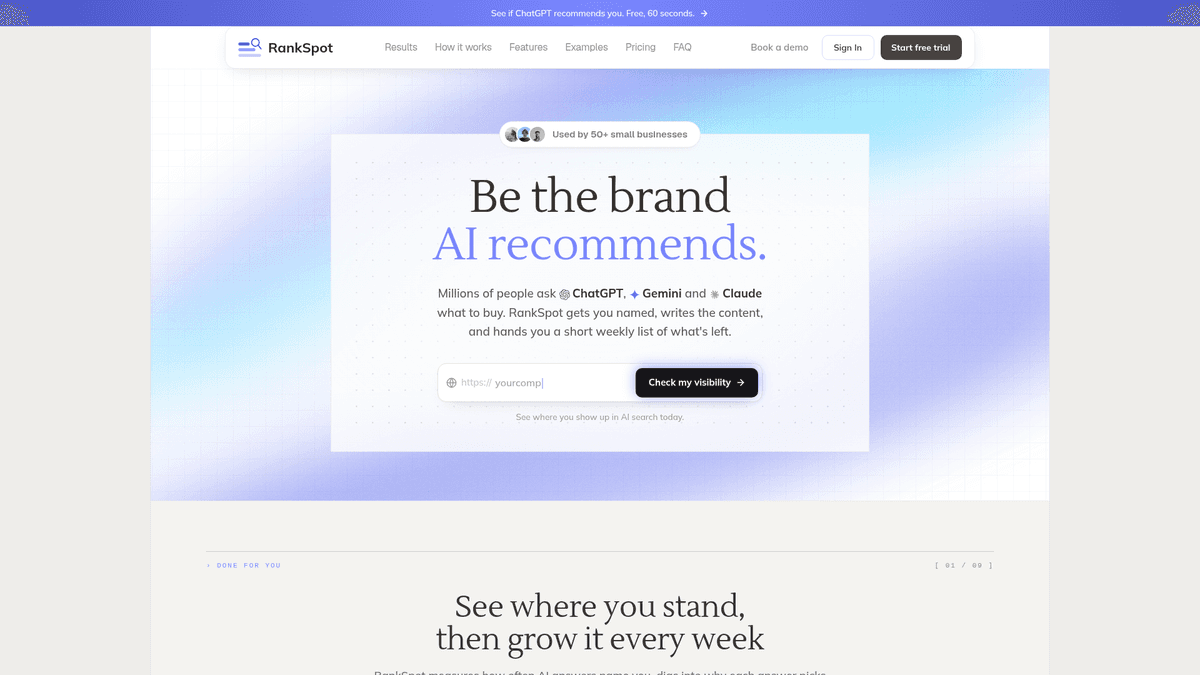
If I were a founder choosing from these Peec AI alternatives, this is where I would start.
The reason is simple: RankSpot is built for the real bottleneck. Most small teams do not fail at AI visibility because they cannot measure it. They fail because they do not publish enough high-intent, well-structured content consistently enough to earn citations in the first place.
RankSpot solves that by automating the full SEO and GEO workflow end to end. You connect your site, it learns your niche and competitors, builds a content plan, finds keyword opportunities, writes long-form articles, adds internal links, creates images, formats the post properly, and publishes directly to your CMS. It is designed to help teams appear in Google and in AI answers from ChatGPT, Claude, and Gemini without hiring an agency or spending hours every week managing content ops.
That is also why it fits naturally if you are comparing tools in the broader AI visibility tools category. It is not just a dashboard. It is a growth system.
What stood out most to me is the workflow compression. Instead of using separate tools for research, writing, formatting, publishing, and tracking, RankSpot rolls them together. For a founder, that can easily save 40+ hours a month. It also supports direct publishing to WordPress, Webflow, Wix, Shopify, Framer, Ghost, and more, which removes one of the biggest reasons content calendars stall.
Pros
Combines SEO, GEO, writing, image generation, and publishing in one platform
Helps you execute, not just measure
Strong fit for small teams without dedicated SEO hires
Built for high-intent keyword discovery and competitor targeting
Supports 100+ languages
Includes Reddit and forum opportunity discovery
First 3 articles free, no credit card
Cons
Smaller raw research dataset than some enterprise-focused analytics platforms
Less suited to huge procurement-heavy organizations that want custom BI-style reporting first
Best value comes when you want content production too, not just prompt tracking
Pricing
Low-friction trial with the first 3 articles free
Paid plans scale with usage and publishing needs
2. Profound - best for enterprise analytics and AI shopping visibility
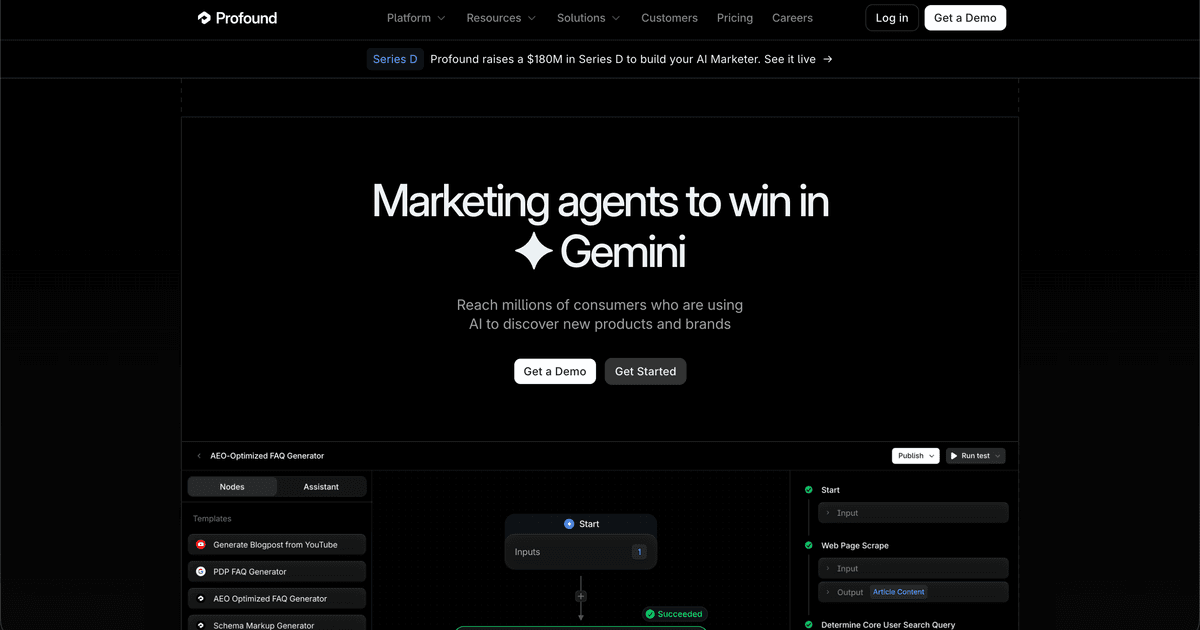
Profound is one of the strongest enterprise-grade Peec AI competitors if your team cares deeply about monitoring and reporting across consumer AI interfaces.
Its positioning is more advanced than basic prompt tracking. It focuses on how brands appear in front-end AI experiences, and it offers things that matter for larger companies, like prompt volume intelligence, shopping visibility, and more enterprise-oriented reporting.
Where Profound beats many lighter tools is depth around market intelligence. If your stakeholders want trend views, executive reporting, or visibility into how products show up in shopping-style AI experiences, Profound makes sense. It also feels like a better fit for brands that already have SEO, content, and analytics resources internally.
That said, it is not the tool I would recommend first to most startups. It gets expensive as soon as you need broader coverage, and it still assumes you have a team that can take insights and turn them into action. If that sounds like you, good option. If not, I would look at a more execution-driven platform.
If you want a deeper side-by-side on this category, our guide to Profound alternatives breaks that market down further.
Pros
Strong enterprise reporting
Useful prompt volume and shopping visibility features
Good fit for large brands with in-house teams
Better market intelligence than many lightweight trackers
Cons
Can get expensive quickly
More useful for teams with existing SEO/content operations
Less founder-friendly than simpler or more automated tools
Pricing
Starts at $99/mo billed yearly
Higher-value plans step up quickly in price
3. Otterly AI - best budget Peec AI alternative
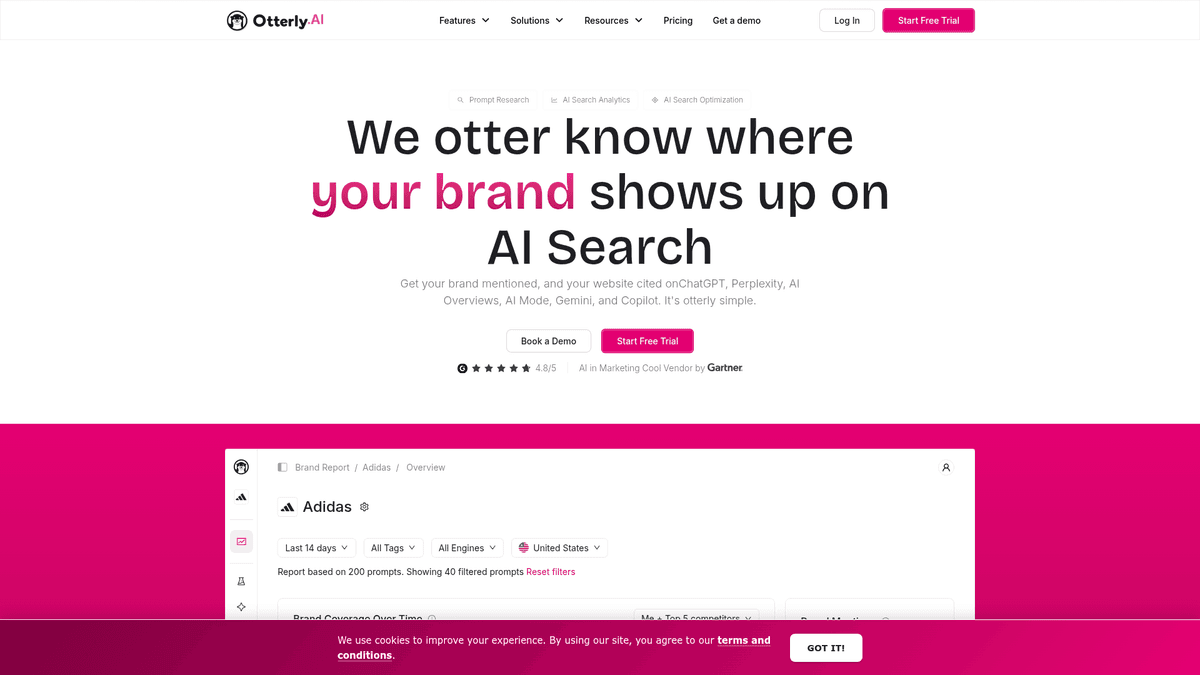
If your main goal is to validate whether AI visibility tracking matters for your brand without spending much, Otterly AI is one of the easiest options to justify.
The appeal is obvious. Entry pricing is low, the product is simple, and it covers several of the major engines people care about. That makes it a credible Peec AI alternative for solo marketers, tiny SaaS teams, and agencies testing the waters.
I liked Otterly most for one use case: “I want to monitor a few core prompts, see if we appear, and avoid a big contract.” For that, it is strong.
Where it falls short is the same place many low-cost trackers fall short: it is still mostly a visibility layer. If the report says you are missing in AI answers, you still need another process to decide what to publish and where to focus. For some teams that is fine. For others, that means more tools and more manual work.
Pros
Very affordable entry point
Multi-engine coverage at low cost
Good for testing the category before making a larger bet
Agency-friendly enough for lightweight client reporting
Cons
Limited execution help
Add-ons can complicate total cost
Better for monitoring than for strategy or publishing
Pricing
Starts at $29/mo
Higher plans increase prompt limits and reporting features
4. Scrunch AI - best for enterprise teams that want optimization workflows
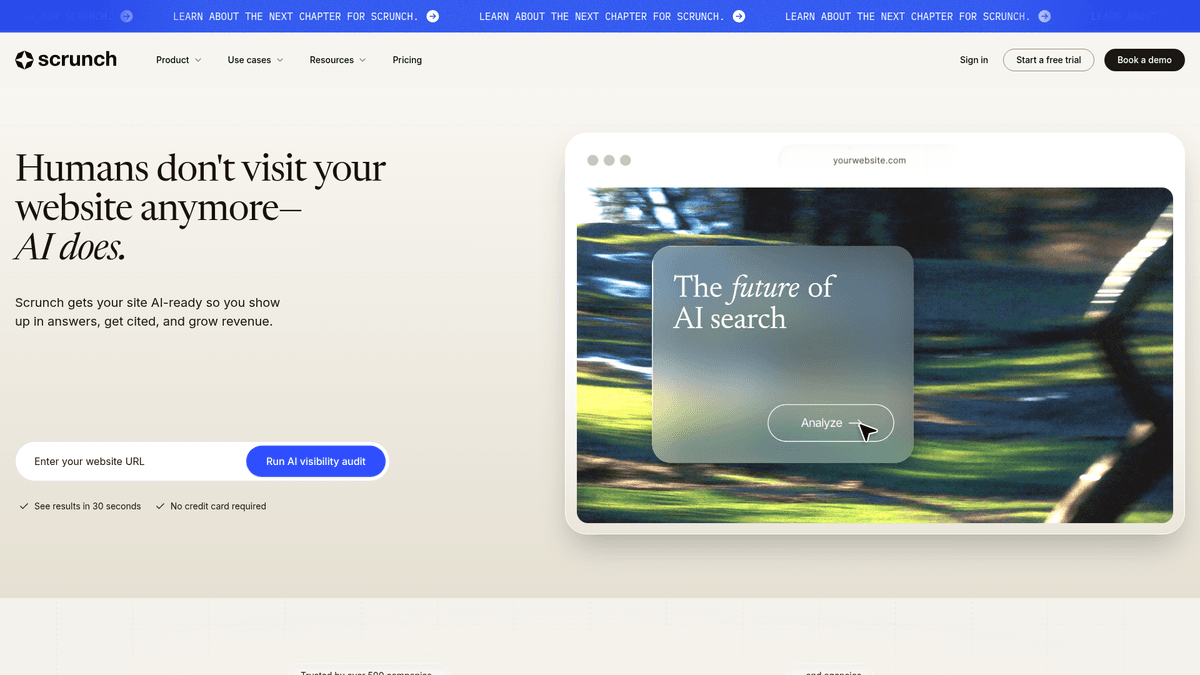
Scrunch AI sits in the enterprise camp. It is not just trying to show rankings or mentions. It is trying to help brands understand visibility across personas, funnel stages, and AI surfaces.
That makes it interesting if your company has different buyer types and messaging paths. A technical product selling to CTOs, finance leaders, and operators may get value from persona-specific analysis that a simpler tracker cannot provide.
I also like that Scrunch goes beyond pure monitoring into audits and optimization guidance. This is closer to what larger companies need because enterprise teams rarely want a dashboard with no next step. They want a platform that points toward action.
Still, for smaller teams it will probably feel heavy. The price is higher, and the feature set makes the most sense when multiple stakeholders are using the platform.
Pros
Strong persona and funnel analysis
Better optimization layer than many tracking-first tools
Good fit for larger in-house teams
Site audits and broader workflow features
Cons
Expensive for early-stage companies
More complexity than most founders need
Best features may require enterprise conversations
Pricing
Core plan around $250/mo
Enterprise pricing available
5. AthenaHQ - best for citation-focused mid-market teams
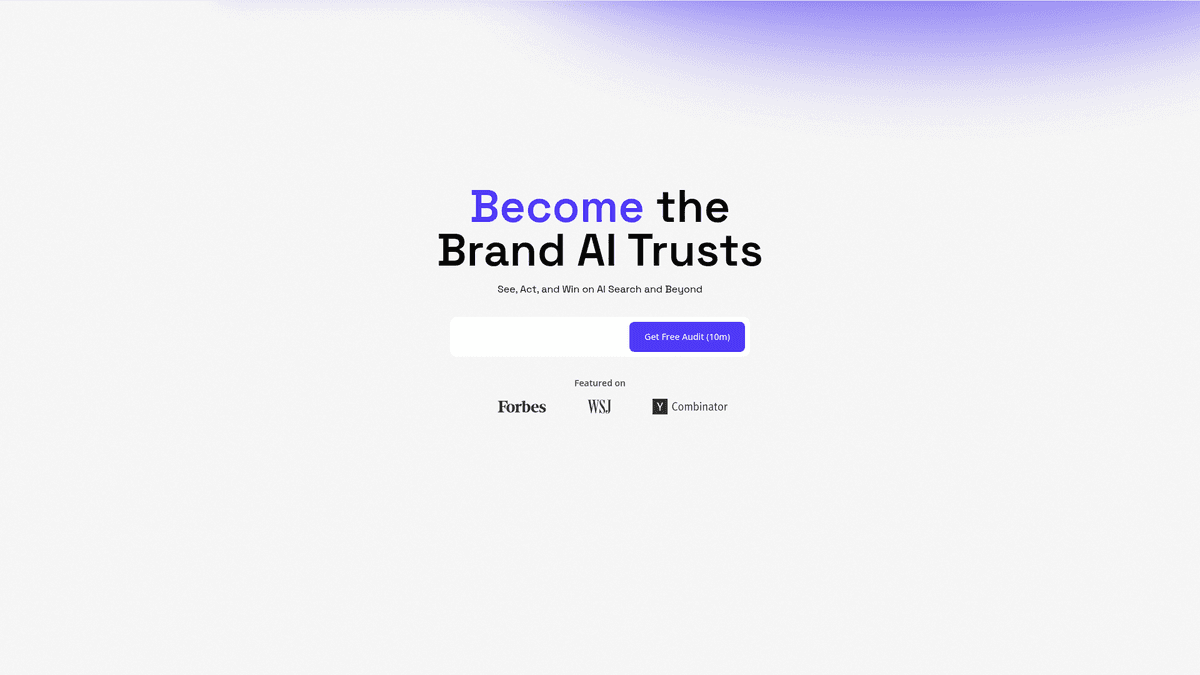
AthenaHQ is a good middle ground between lightweight prompt trackers and full enterprise platforms. It feels especially useful for teams that care about citation mechanics: where AI engines are pulling from, what sources shape recommendations, and how to improve that footprint.
That matters more than many teams realize. In AI search, it is not enough to ask, “Did my brand get mentioned?” You also want to know, “Which sites are influencing that answer?” and “What content patterns keep getting cited?” Athena is strong on that kind of question.
I also see Athena as a smart fit for mid-market brands that want more than Peec gives them, but are not ready for a large enterprise stack. It has enough structure to support strategy, while still being approachable.
Pros
Strong citation-centric positioning
Broader optimization angle than basic trackers
Good fit for mid-market brands
More strategic than many simple prompt tools
Cons
Not the cheapest option
Some advanced capabilities are better suited to larger teams
Can still require supporting tools for full content execution
Pricing
Self-serve starts around $95/mo annual
Enterprise/custom plans available
6. Semrush AI Toolkit - best if you already live in Semrush
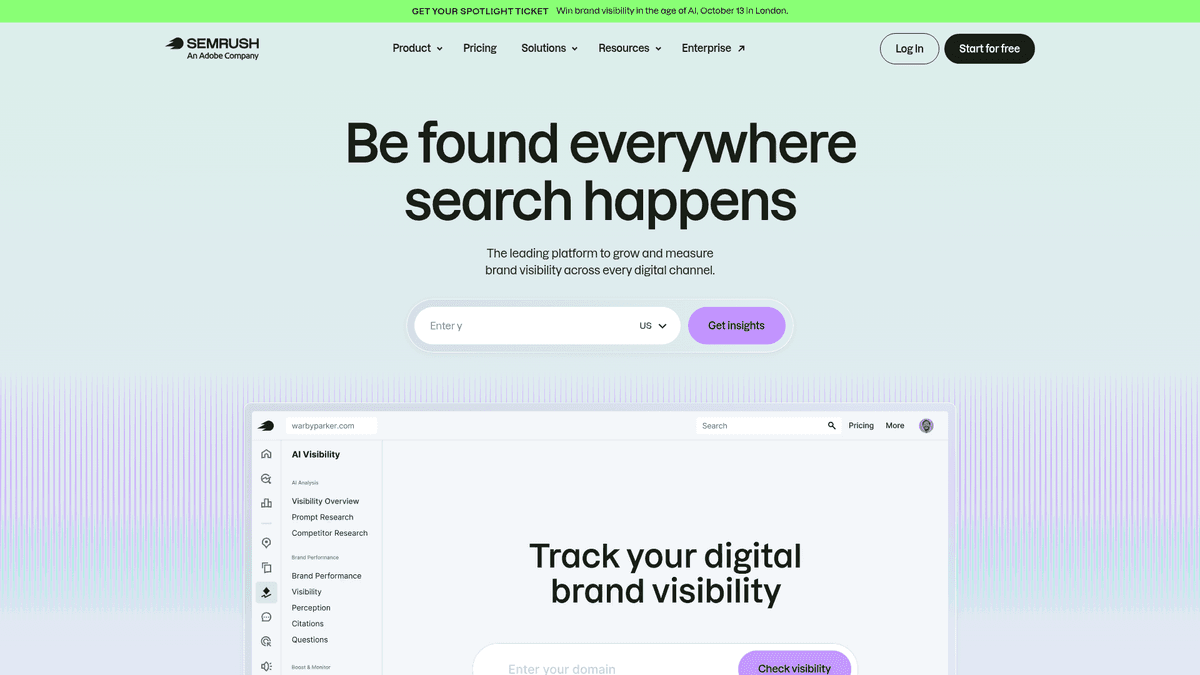
Semrush’s AI visibility features make the most sense if you are already a Semrush customer.
In that scenario, the value proposition is simple: keep traditional SEO and AI visibility in one system. That means one login, one reporting environment, one dataset family, and fewer workflow handoffs between tools. If you are already using Semrush for rank tracking, keyword research, and audits, adding AI tracking there is convenient.
I would not call it the cleanest choice for someone starting from zero purely to replace Peec AI. But I would call it practical for marketing teams who already trust Semrush and do not want another vendor.
The downside is the usual suite trade-off. You gain breadth, but not always the tightest AI-specific experience. That is fine if your broader SEO stack matters more than pure GEO specialization.
Pros
Great if you already use Semrush
Combines SEO and AI visibility in one place
Good reporting and audit ecosystem
Reduces tool sprawl
Cons
Less focused than dedicated GEO tools
Can feel expensive if AI tracking is your only need
Better for existing Semrush users than fresh buyers
Pricing
Starts around $199/mo depending on plan and toolkit setup
7. Ahrefs Brand Radar - best for research-heavy teams
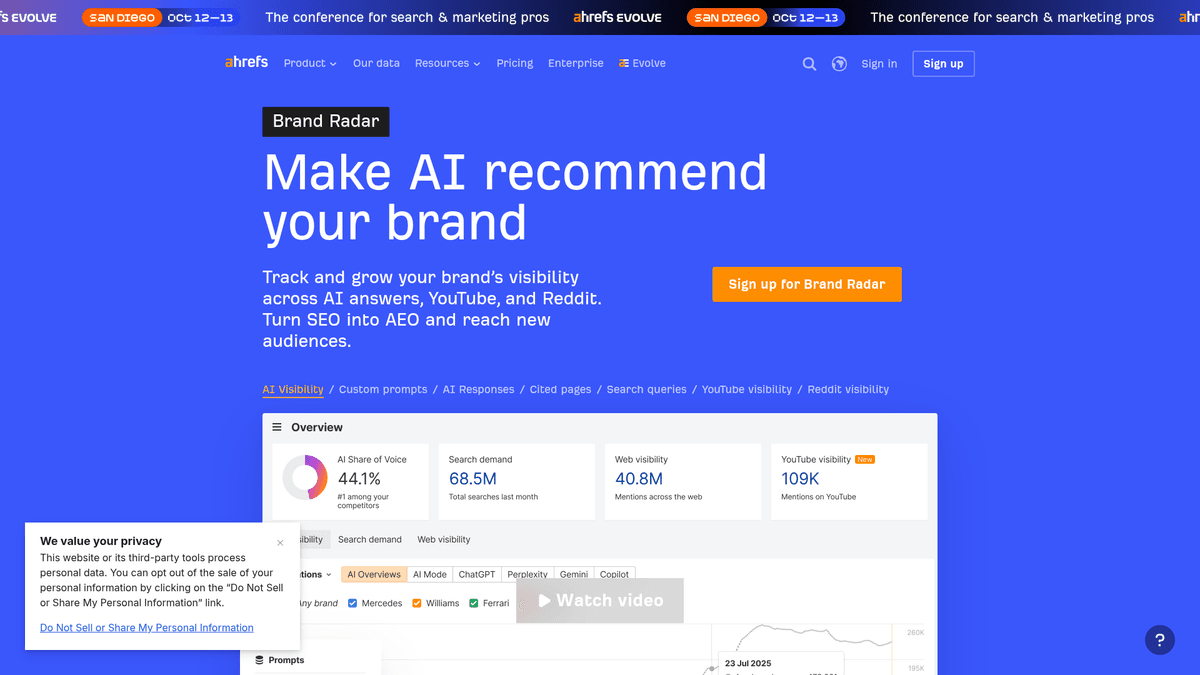
Ahrefs Brand Radar takes a different angle from many Peec alternatives. It is not just about tracking prompts you manually set up. It is more of a research engine tied to the Ahrefs worldview: large-scale data, market analysis, entity visibility, and citation discovery.
That makes it compelling for SEOs, analysts, and competitive intelligence teams. If you want to look across topics, compare entities, or understand how AI answers map back to broader search behavior, Brand Radar is impressive.
I would especially recommend it to teams that already trust Ahrefs and want AI visibility connected to their existing SEO workflow. That “one stack” advantage is real. It is easier to go from insight to action when keyword research, backlink data, and AI visibility sit close together.
For early-stage founders, though, it may still leave a gap. Like Peec AI, it is strongest on the research side. You may still need another system to actually produce and publish the content needed to improve results.
Pros
Strong research and competitive analysis
Good fit for existing Ahrefs users
Useful citation and entity-level exploration
Better strategic depth than many simple trackers
Cons
More research-oriented than execution-oriented
Can be overkill for tiny teams
Still may require separate content production workflows
Pricing
Entry plans start around $50/mo
Full multi-index setups can cost much more
8. Rankscale - best for simple cross-engine scoring
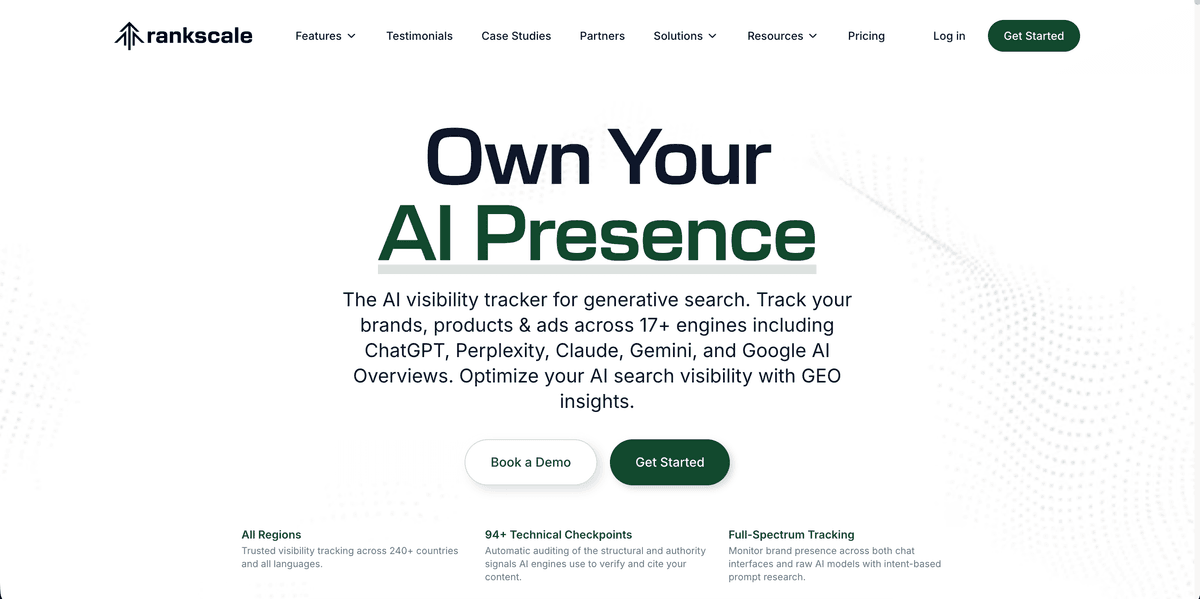
Rankscale is one of the simpler entries in this category. I see it as a tool for teams that want straightforward AI visibility scoring across multiple engines without a lot of complexity.
That can be valuable. Not every company wants an all-in-one platform. Some just want to benchmark brand presence, compare prompts, and keep tabs on changes over time.
The risk with this type of tool is that it can flatten the category into a score without giving enough context on why that score is moving. That does not make it bad. It just means you should buy it with the right expectations.
If your main goal is quick monitoring across engines, Rankscale can fit. If your goal is to improve output, grow content, and publish daily, it will likely need to sit alongside something else.
Pros
Simple cross-engine visibility tracking
Easier to understand than heavier enterprise tools
Useful for benchmarking and monitoring
Cons
Less complete execution layer
May offer less context than deeper research platforms
Better as part of a stack than as your only growth tool
Pricing
Pricing varies by plan and sales motion
Check current vendor pricing directly
What these tools get right - and what most teams still miss
After testing all eight, here is the pattern I kept seeing.
Most AI visibility products are good at showing the symptom:
you are not being mentioned
competitors are cited more often
your share of voice is weak
certain prompts are dominated by review sites or bigger brands
But the real business problem is operational:
what content should you create next?
which competitor keywords should you target?
how do you publish often enough to matter?
how do you turn AI visibility into pipeline, not just screenshots?
That is why founder-led teams often get more value from execution-first systems than from analytics-first dashboards.
A practical buyer’s guide: which Peec AI alternative should you pick?
If you want the shortest possible answer, use this.
Pick RankSpot if...
You are a founder or small team that needs results, not just reporting
You want one platform for research, writing, images, internal links, and publishing
You care about both Google traffic and being cited in AI answers
You want daily publishing without hiring an agency
Pick Profound or Scrunch if...
You are buying for an enterprise team
Multiple stakeholders need analytics, segmentation, and reporting
You already have people to handle content strategy and execution
Pick Otterly AI if...
Your budget is tight
You want to test AI visibility tracking before making a larger investment
You only need lightweight monitoring
Pick Semrush or Ahrefs if...
You are already committed to one of those ecosystems
You want AI tracking inside your SEO stack
You do not mind using additional workflows for content production
Pick AthenaHQ or Rankscale if...
You want a more focused angle like citations or cross-engine scoring
You are somewhere between simple monitoring and full enterprise tooling
My overall verdict
If your main question is, “What is the best Peec AI alternative for a founder or lean operator?” my answer is RankSpot.
Not because it has the fanciest dashboard. Not because it claims the biggest dataset. But because it solves the full problem. It helps you go from idea to published article to AI-ready visibility without juggling five subscriptions and a content manager.
If your main question is, “Which platform is best for enterprise AI visibility analytics?” then I would look hardest at Profound, Scrunch, and Ahrefs Brand Radar depending on your workflow and budget.
And if your main question is simply, “Is there a cheaper option than Peec AI?” then Otterly AI is the easiest place to start.
For teams that are still researching adjacent tools, you may also want to read our breakdown of PromptWatch alternatives, since the overlap in buyer intent is pretty strong.
Why RankSpot is the one I would actually use
There is a difference between a tool I would demo and a tool I would actually run.
I would demo many of the tools above.
I would run RankSpot if I were trying to grow a startup blog with limited time.
That is because RankSpot does the part founders usually postpone:
finds high-intent opportunities
tracks what competitors are winning with
writes long-form SEO articles
structures them properly for search and AI answers
adds internal links and visuals
publishes directly to the blog
helps discover Reddit and forum conversations where buyers are already asking questions
That is a much more practical growth engine than a dashboard alone. It also means you can replace a patchwork of SEO, writing, editing, and publishing tools with one system.
If you want to test that workflow yourself, RankSpot lets you start with your first 3 articles free, with no credit card.
FAQ
How much does Peec AI cost for agencies?
Peec AI pricing changes over time, but its plans are generally positioned above entry-level tools and can feel expensive for small agencies once you need more prompts or advanced model coverage. Its big advantage is unlimited seats, which can make it attractive for larger agency teams that mainly need monitoring.