AI visibility means one simple thing: when someone asks ChatGPT, Perplexity, Gemini, or Google AI Overviews/AI Mode for a recommendation, does your brand show up? That is now a separate problem from classic rank tracking. You can rank well in Google and still be absent from AI answers. If you are a founder or lean operator, that is a real risk because more buyers are getting shortlist recommendations directly from AI instead of clicking ten blue links.
I tested eight tools with a simple goal: figure out which ones are actually useful if you want to track mentions, sources, competitors, and changes across the major AI platforms without wasting time or buying an enterprise platform too early. I looked at platform coverage, prompt tracking depth, source and citation tracking, competitor comparison, workflow fit, and pricing transparency. I also cared about something many roundups skip: can a small team actually act on the data?
If that sounds close to your problem, this guide should save you a lot of trial-and-error.
How I judged these AI visibility tools
Most founders do not need another dashboard. They need a search visibility tool that answers a few practical questions:
Where does my brand appear in AI answers?
Which prompts trigger those mentions?
Which competitors show up instead?
What sources are the models citing?
What should I publish next to increase visibility?
So I scored each tool on five areas:
1. Platforms tracked
At minimum, I wanted coverage for ChatGPT, Perplexity, and Google AI surfaces. Bonus points if a tool also covered Gemini, Claude, Copilot, or Google AI Overviews.
2. Prompt tracking depth
Some tools only show brand mention snapshots. Better tools show prompt-level data, categories, or intent buckets so you can see where you win and lose.
3. Citation and source tracking
This is the heart of any useful ai visibility tool. If the platform cannot tell you which pages, domains, or sources AI engines cite, it is hard to turn the data into action.
4. Competitor comparison
Good ai search visibility tools make it easy to benchmark your share of voice against competitors, not just monitor your own brand.
5. Price and workflow fit
A tool can be powerful and still be wrong for a startup. I paid attention to whether each platform fits founders, agencies, in-house growth teams, or larger enterprise setups.
“ChatGPT weekly active users surpassed 400 million in February, up 33% from 300 million in December.” - Reuters
That growth is why this category matters. AI answers are now a discovery layer of their own.
Quick comparison table
Tool | Best for | Platforms tracked | Starting price |
|---|---|---|---|
RankSpot | Founders and small teams who want tracking plus execution | AI answer visibility workflows plus SEO/GEO publishing support | Free trial available, first 3 articles free |
Promptwatch | Teams that want broad monitoring and crawler-style visibility | Broad AI platform tracking | Contact sales / custom |
Peec AI | Agencies and small teams that want reporting | ChatGPT, Perplexity, Google AI surfaces, optional extras | €89/month |
Profound | Enterprise teams that need deep analytics | ChatGPT, Perplexity, Google AI Mode, Gemini, Copilot, Meta AI, Grok, DeepSeek, Claude, Google AI Overviews | $99/month starter, enterprise plans available |
Otterly AI | Budget-conscious teams | Core AI engines with optional add-ons | $29/month |
Scrunch AI | Teams focused on AI crawler access and technical fixes | Multiple AI platforms with technical workflow angle | $100/month |
Semrush AI Toolkit | Existing Semrush customers | Major AI engines inside Semrush ecosystem | Add-on / enterprise-style pricing |
Ahrefs Brand Radar | Existing Ahrefs customers | Major AI visibility tracking inside Ahrefs ecosystem | Varies by Ahrefs plan |
What matters more than “mentions”
A lot of people start with a chatgpt visibility tracker mindset: “just tell me if I appear.” That is useful, but it is not enough.
The real value comes from connecting visibility data to execution:
new content ideas
comparison pages
product pages worth improving
Reddit and forum conversations worth joining
internal links and topical clusters
competitor pages already being cited
That is where RankSpot has a different angle from most seo visibility tools. Instead of stopping at monitoring, it helps turn visibility gaps into articles, images, formatting, publishing, and distribution. If you are trying to do all of this with a tiny team, that workflow matters more than another report.
If you want a companion read focused specifically on one vendor category, see our guide to Promptwatch alternatives, especially if you are comparing monitoring-only tools with more execution-focused platforms.
1. RankSpot - best for founders who want AI visibility tracking plus content execution
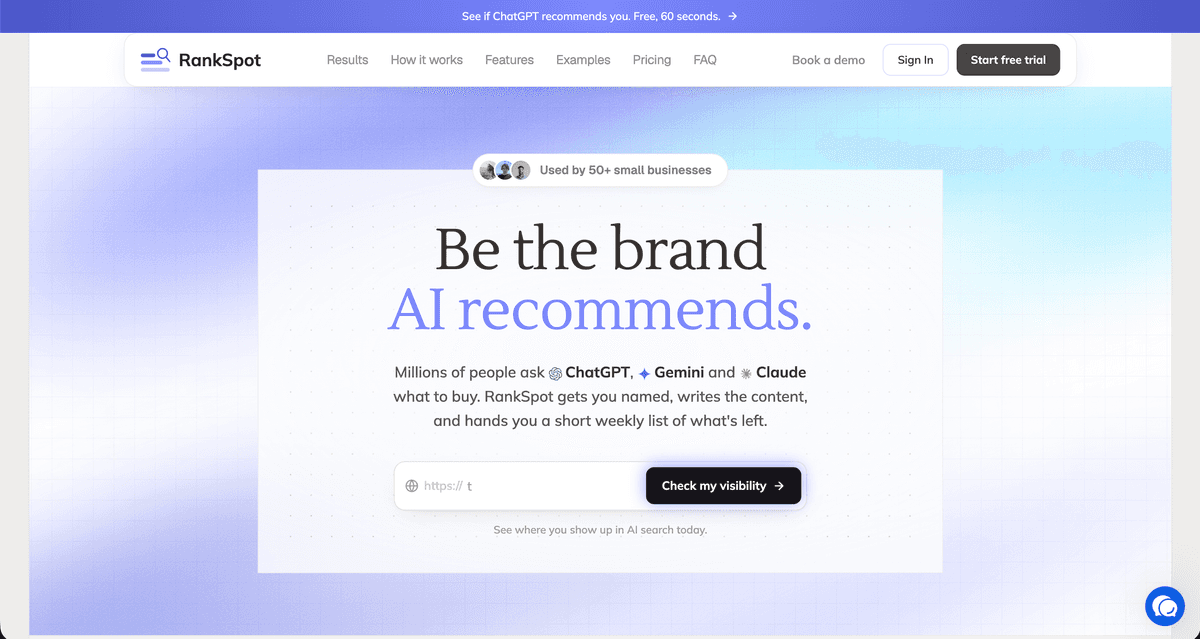
RankSpot is the tool I would pick if you are a founder, indie hacker, SaaS operator, or small e-commerce team that wants to improve AI visibility but does not have time to run separate tools for keyword research, writing, design, and publishing.
What stands out is that RankSpot is not just an ai search visibility tool. It acts more like an automated SEO and GEO pipeline. You give it your site, niche, and competitors. It learns the space, builds a content plan, finds high-intent keywords, writes long-form content, creates on-brand visuals, formats the post, adds structure, and can publish directly to your CMS. That matters because most AI visibility gains come from consistently publishing the kind of pages AI systems cite.
For small teams, that is the difference between knowing what to do and actually doing it. RankSpot also helps with Reddit and forum discovery, which is useful because modern AI discovery does not happen only on your site.
If you are trying to build a repeatable growth engine, this pairs especially well with a broader SEO automation workflow rather than treating visibility tracking as a standalone task.
Pros
Best fit for founders and lean teams
Full workflow from research to writing to publishing
Built for both classic SEO and AI answer optimization
Finds high-intent and competitor-driven opportunities
Supports WordPress, Webflow, Wix, Shopify, Framer, Ghost, and more
Saves a lot of manual work across research, drafting, formatting, and publishing
Includes Reddit/forum opportunity discovery
Supports 100+ languages
Cons
If you only want raw enterprise analytics and nothing else, it may be more workflow-oriented than you need
Teams that want highly granular multi-model analytics dashboards above all else may still compare it with enterprise-first platforms
Best value shows up when you use the full pipeline, not just one feature
Pricing
First 3 articles free
No credit card required to start
Paid plans scale with publishing needs
2. Promptwatch - best for teams focused on monitoring breadth and AI crawler behavior
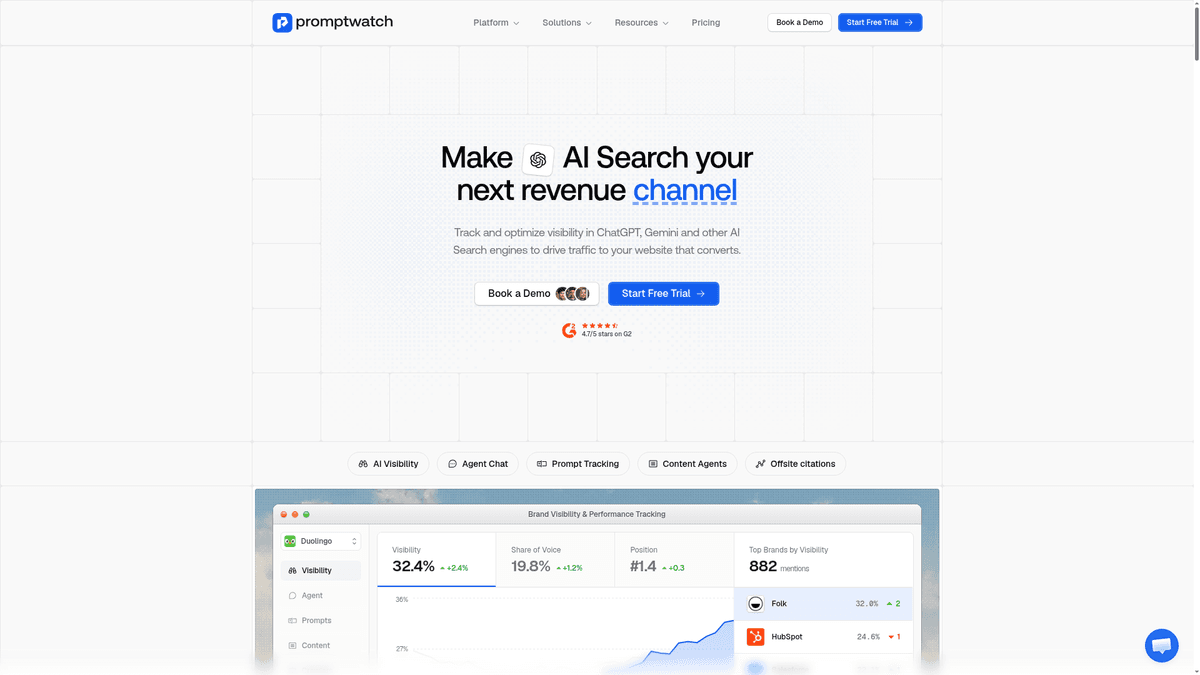
Promptwatch is one of the names that comes up often when people want broad AI visibility monitoring without immediately moving into content generation. Its appeal is straightforward: broad platform coverage, tracking over time, and useful visibility into how AI systems interact with prompts and site data.
Where it tends to be strongest is for teams that want a monitoring layer and are comfortable handling execution elsewhere. If your team already has content ops, technical SEO, and publishing workflows in place, that can be fine.
The tradeoff is that many smaller teams will still need a second system to act on the insights. That usually means more handoffs, more tools, and more delay between “we found the gap” and “we published the page.”
Pros
Strong fit for monitoring-first teams
Good choice if you care about broad AI platform coverage
Useful for teams that want crawler and prompt behavior visibility
Works well alongside an existing SEO stack
Cons
More monitoring-oriented than execution-oriented
Small teams may still need separate writing and publishing tools
Value depends on whether you already have content systems in place
Pricing
Usually positioned as a custom or sales-led product
Best to verify current plan structure directly with vendor
3. Peec AI - best for agencies and prompt-level reporting
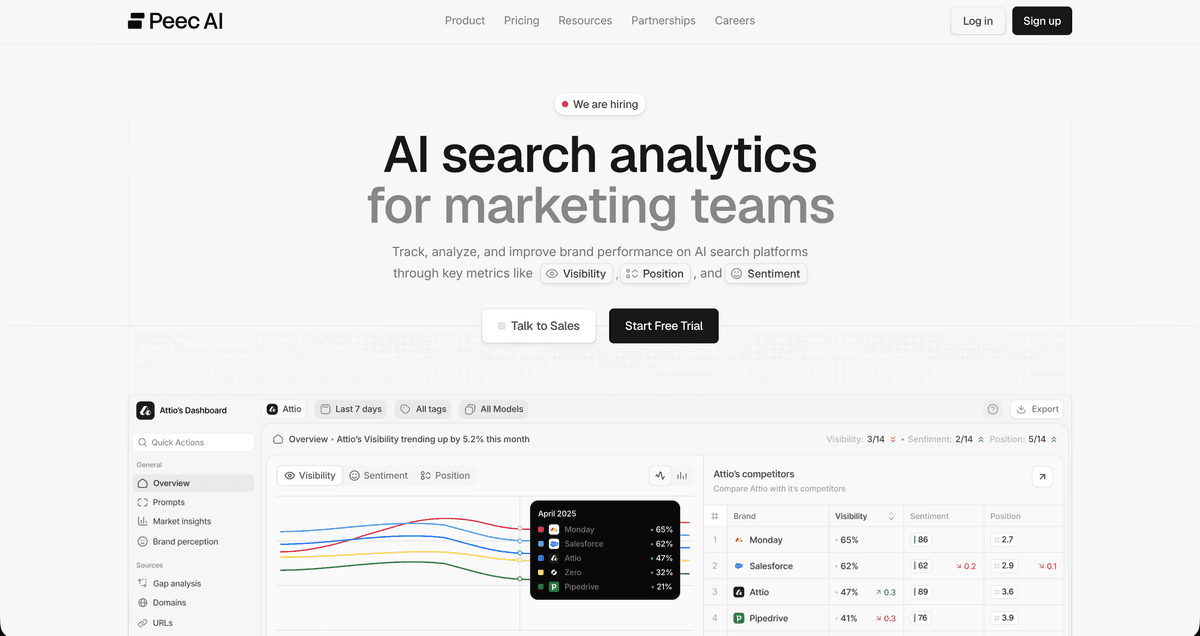
Peec AI is a solid option if your main goal is reporting. I can see why agencies like it. The interface is built around tracking brand visibility, comparing prompts, and showing competitor positioning in a cleaner way than some heavier enterprise platforms.
It is especially useful when you want client-facing reports or a lighter-weight workflow for prompt-level monitoring. If you run multiple brands and need a repeatable view across them, that reporting angle helps.
The main limitation is that Peec is more of a pure ai visibility tool than an end-to-end growth system. You can see what is happening, but you still need another process to create the pages, comparisons, and supporting assets that improve results.
Pros
Good agency fit
Helpful prompt-level reporting
Competitor comparison is easy to understand
Lower barrier than enterprise platforms
Cons
More reporting than execution
Smaller teams may outgrow it if they want deeper workflows
Some platform coverage may require add-ons
Pricing
Starts at €89/month
Higher usage and extra engines increase cost
4. Profound - best for enterprise AI search analytics
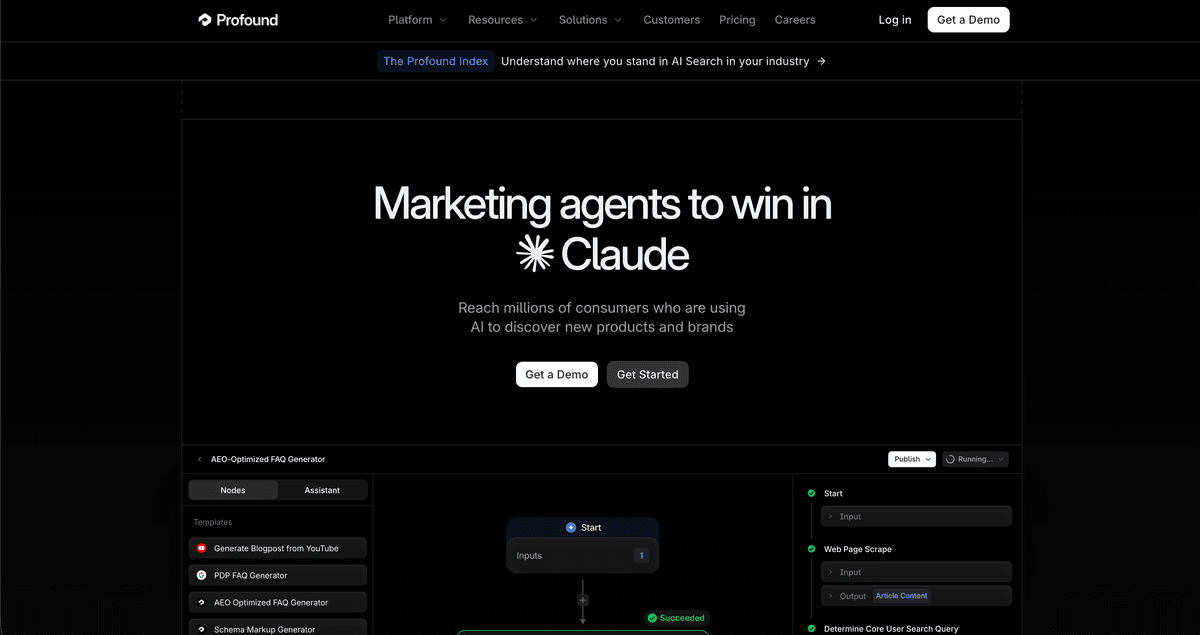
Profound is the most enterprise-oriented product in this group. If you want deep AI search analytics, large platform coverage, security features, and specialized modules like prompt volumes or agent analytics, it is one of the strongest options in the market.
Its coverage is broad: ChatGPT, Perplexity, Google AI Mode, Gemini, Copilot, Meta AI, Grok, DeepSeek, Claude, and Google AI Overviews. That alone makes it a serious contender for larger organizations that need a more complete monitoring layer.
I would not call it the easiest starting point for most early-stage teams, though. It makes the most sense when you already have budget, internal stakeholders, and a reason to care about segmentation, compliance, and deep reporting slices.
Pros
Broadest platform coverage in this list
Strong enterprise reporting depth
Good fit for compliance and larger teams
Includes advanced modules beyond basic mention tracking
Cons
Can be too much for founders just getting started
Workflow and price fit are better for larger organizations
Smaller teams may pay for depth they will not use
Pricing
Starter plan from $99/month
Enterprise pricing is custom
Verify current packaging directly, since this category changes fast
5. Otterly AI - best budget entry point
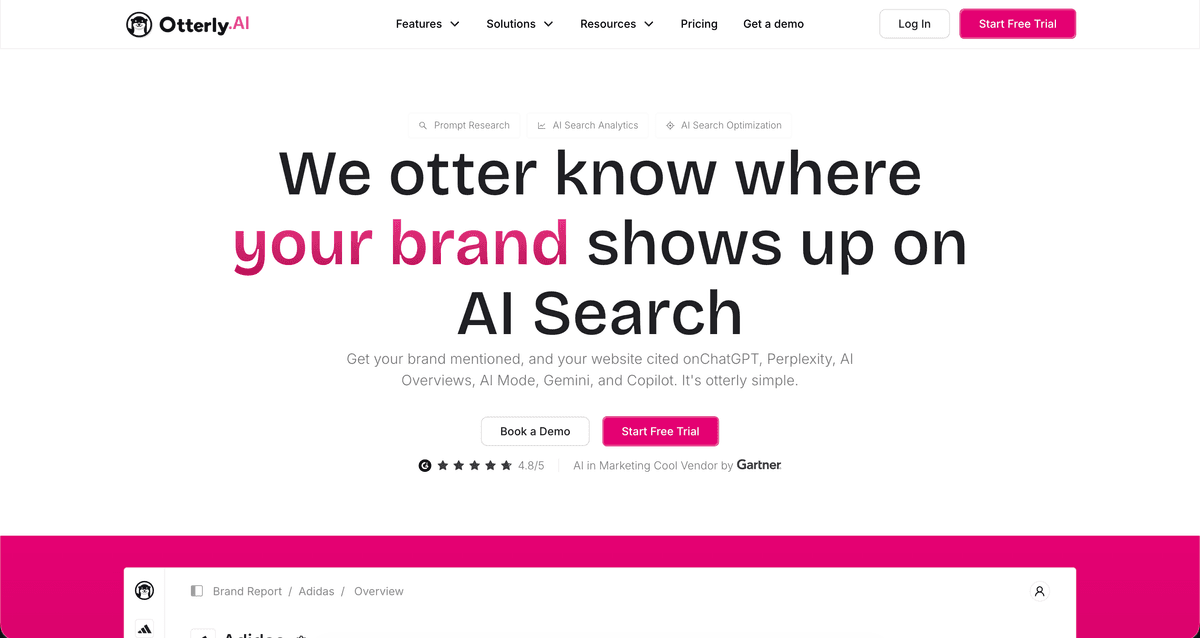
Otterly AI is the budget-friendly option in the group. If you are just getting started and want a simpler ai search visibility tool without enterprise pricing, it is easy to understand why people try it first.
The product focuses on core monitoring across major engines with lighter recommendations. That makes it a reasonable first tool for startups that want proof this channel matters before investing more heavily.
The downside is that simpler tools often become limiting once you want deeper source analysis, stronger competitor workflows, or built-in execution support.
Pros
Low entry price
Good for testing the category
Straightforward setup for smaller teams
Better than manual checking across AI tools
Cons
More limited depth than mid-market or enterprise tools
Add-ons can expand cost
You may outgrow it quickly if AI search becomes a serious channel
Pricing
Starts around $29/month
Extra platform coverage may cost more
6. Scrunch AI - best for technical AI visibility and crawler access
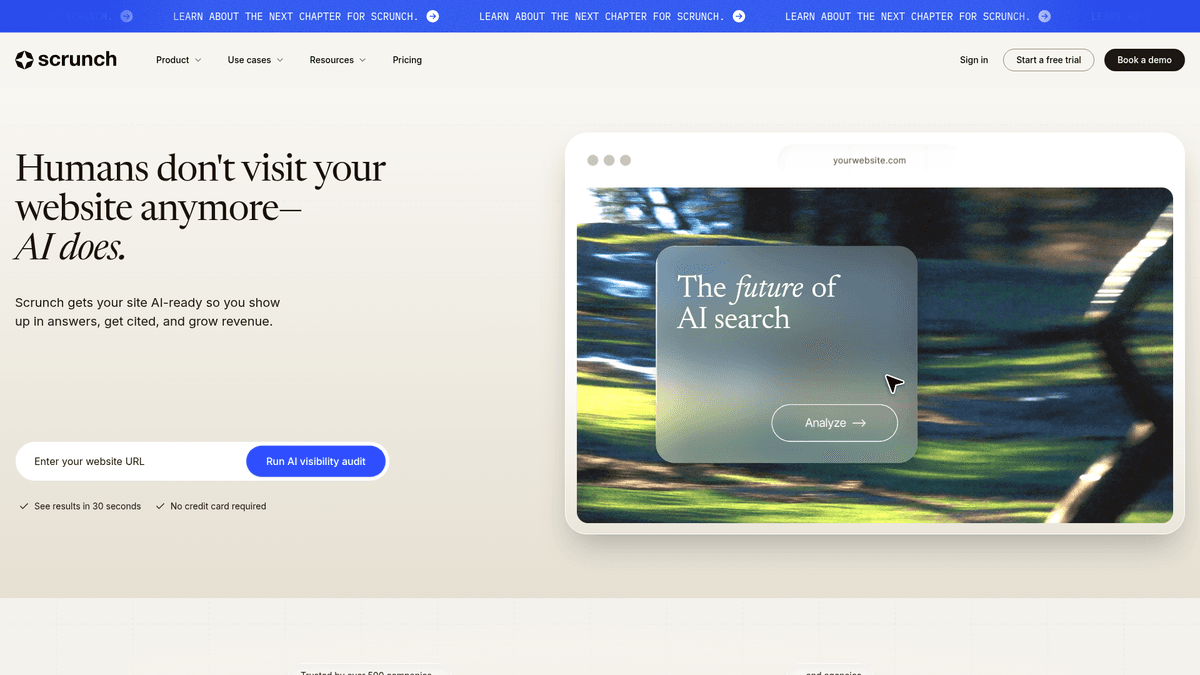
Scrunch AI takes a more technical angle. It is less about glossy reporting and more about helping teams understand whether AI bots can access, interpret, and use their site well. If you suspect your issue is not “we need more content” but “our current site is hard for AI systems to crawl or retrieve from,” this kind of tooling can be useful.
That makes Scrunch a good fit for technically minded teams and smaller sites that want to improve AI crawler experience without going all the way into enterprise technical platforms.
But if your real bottleneck is content velocity, topic targeting, or publishing consistency, crawler-focused tooling will only solve part of the problem.
Pros
Good for technical AI visibility work
Useful if crawlability and retrievability are your main problems
Helpful for teams that want site-level fixes
Cons
Less useful if your main problem is content production
May feel narrow for growth teams focused on demand capture
Value is strongest when technical issues are the actual bottleneck
Pricing
Starts around $100/month for entry plan
Larger plans rise quickly
7. Semrush AI Toolkit - best for teams already inside Semrush
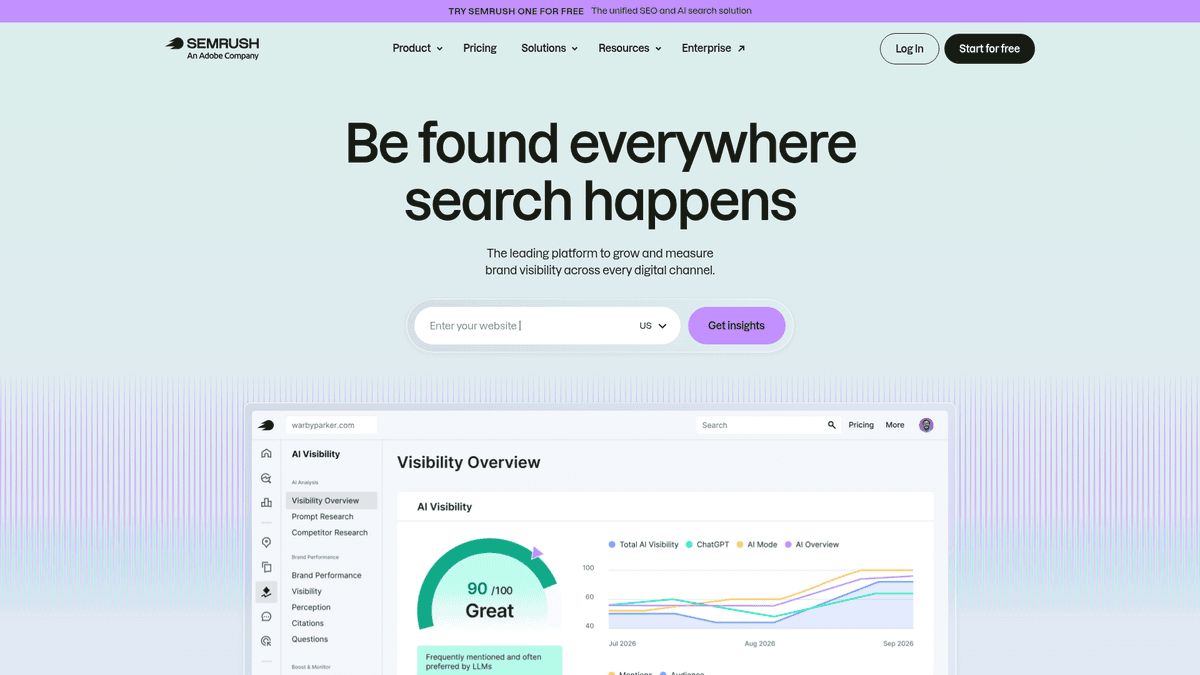
Semrush has the obvious advantage of being part of a much larger SEO stack. If your team already lives in Semrush for keyword tracking, competitor research, and technical SEO, adding AI visibility features can be convenient.
That “single ecosystem” benefit is real. Your team avoids another vendor, another workflow, and another billing line. For bigger organizations, that simplicity can matter more than having the most specialized tool.
Still, the toolkit makes the most sense if you are already committed to Semrush. If not, you may end up paying for a broad suite when what you really need is a more focused solution plus publishing support.
Pros
Strong choice for existing Semrush users
Convenient if you want SEO and AI visibility in one stack
Useful brand and competitor context inside the same platform
Cons
Best fit depends on already using Semrush
Add-on pricing can get expensive
More suite-oriented than founder-friendly
Pricing
Typically sold as an add-on or enterprise package
Verify current pricing directly with Semrush
8. Ahrefs Brand Radar - best for teams already inside Ahrefs
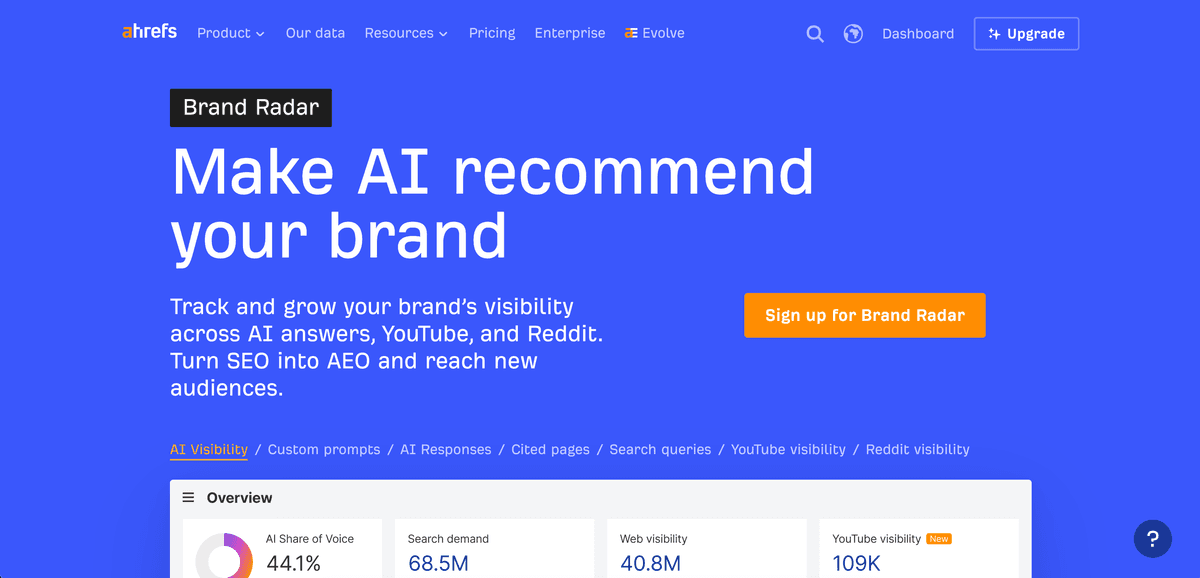
Ahrefs Brand Radar is the Ahrefs version of the same idea: if your team already trusts Ahrefs for links, keywords, and content research, AI visibility inside that ecosystem is a natural extension.
The biggest benefit is correlation. You can look at backlinks, topical authority, branded presence, and AI mentions in a more connected way. For established SEO teams, that can be useful.
The main caveat is similar to Semrush. If you are not already an Ahrefs shop, Brand Radar is less compelling as a standalone reason to buy into the ecosystem. And like other monitoring-heavy products, it still leaves execution to your team.
Pros
Great for existing Ahrefs users
Useful link between authority signals and AI citations
Familiar UI for SEO teams
Cons
Harder to justify if you do not already use Ahrefs
Less suited to founders who want done-for-you execution
Publishing and content production still need other tools
Pricing
Depends on Ahrefs plan and packaging
Check current Brand Radar availability directly
My overall take after testing all 8
The biggest split in this market is not really “which dashboard is prettiest.” It is this:
Monitoring-first tools tell you where you appear.
Execution-first tools help you improve where you appear.
That is why the best choice depends on your team setup.
If you already have:
a content strategist
a writer
a designer
a CMS workflow
technical SEO help
…then a monitoring-heavy platform can work well.
If you do not have all that, then buying a pure monitoring product often creates another backlog. You learn that your competitor is getting cited more often in ChatGPT, but nothing ships next week to change that.
That is where RankSpot stands out for founders. It is one of the few options that connects ai visibility goals to an actual publishing engine.
Why Reddit and forums matter more than most teams think
One thing I kept coming back to while evaluating these platforms is that AI answers often pull from the broader web, not just polished brand sites.
That includes:
forums
Reddit threads
community discussions
comparison pages
niche blog posts
This is one reason pure on-site SEO is no longer enough. You also need topic coverage, clear comparisons, and real participation in places where buyers ask questions.
If you want to build that system, studying competitor keyword research is still one of the fastest ways to find pages worth publishing first.
“Reddit accounted for 40.1% of citations in AI search results in Semrush’s analysis of roughly 150,000 citations.” - Integrate.io citing Semrush analysis
That stat is a good reminder that a search visibility tool should help you think beyond rankings.
Which one should you pick?
Here is the short version.
Pick RankSpot if:
You are a founder or lean team
You want AI visibility plus actual publishing output
You need one platform to replace several disconnected tools
You care about both Google traffic and AI answer citations
Pick Promptwatch if:
You mainly want monitoring breadth
You already have content and SEO execution covered elsewhere
You care about tracking and crawler visibility more than publishing
Pick Peec AI if:
You are an agency or consultant
You want cleaner reporting and prompt-level comparisons
You can execute on insights outside the platform
Pick Profound if:
You are an enterprise team
You need broad model coverage and deeper analytics
Budget is less important than reporting depth and governance
Pick Otterly AI if:
You want a cheap way to start
You mainly need basic monitoring
You are okay upgrading later if the channel proves valuable
Pick Scrunch AI if:
Your main issue is crawlability or AI bot access
You want a more technical workflow
Your site architecture is likely the blocker
Pick Semrush AI Toolkit if:
You already use Semrush heavily
You prefer one suite over a specialized point solution
Pick Ahrefs Brand Radar if:
You already use Ahrefs heavily
You want AI visibility data inside your current SEO stack
The practical playbook I would use as a founder
If I were starting from scratch today, I would do this:
1. Track only the platforms that matter first
Do not try to monitor everything on day one. Start with:
ChatGPT
Perplexity
Google AI Overviews / AI Mode
That is usually enough to see the pattern.
2. Focus on prompts with buying intent
Track prompts like:
best tools for X
alternatives to Y
X vs Y
top software for Z
how to solve problem A
These are the prompts that turn visibility into pipeline.
3. Look at citations, not just mentions
A mention without a citation source is harder to learn from. Source tracking helps you understand what types of pages the model trusts.
4. Publish pages designed to be cited
That means:
comparison pages
category roundups
concise how-to posts
glossary/explainer pages
product-led educational content
5. Keep shipping every week
The teams that win in AI answers usually are not the teams with the fanciest dashboard. They are the teams that publish useful, structured content consistently.
That is the core reason RankSpot is so useful for smaller companies. It removes the bottleneck between strategy and shipping. Instead of spending 40+ hours each month researching, drafting, editing, formatting, sourcing visuals, and publishing, you can turn the whole pipeline into a repeatable system.
Final verdict
If you only want monitoring, there are several solid ai visibility tools in this category. Promptwatch, Peec AI, Profound, Otterly, Scrunch, Semrush, and Ahrefs all have valid use cases.
But if you are a founder or small team trying to actually grow from AI search, I would not optimize for monitoring alone. I would optimize for execution.
That is why RankSpot is my top pick.
It helps you do the whole job:
find the right topics
prioritize high-intent and competitor keywords
write SEO and GEO-ready articles
generate unique visuals
format properly
publish directly
improve your odds of being cited in AI answers
If you want to test that workflow without friction, RankSpot lets you start with your first 3 articles free and no credit card. For most small teams, that is a much better place to begin than buying another dashboard and hoping someone has time to use it.
FAQ
What are the best AI visibility tracking tools?
The best options depend on your team size and workflow. RankSpot is best for founders and small teams that want tracking plus content execution, while Profound, Promptwatch, Peec AI, Otterly, Scrunch, Semrush AI Toolkit, and Ahrefs Brand Radar each fit different monitoring and reporting needs.
Is Google AI Mode better than perplexity?
They serve slightly different use cases. Perplexity is often stronger for transparent source-driven research, while Google AI Mode has the advantage of Google’s search ecosystem and can influence visibility inside Google’s own answer experiences.
What are the top 3 AI right now?
For visibility tracking, the three most important platforms to watch first are usually ChatGPT, Perplexity, and Google AI Overviews / AI Mode. They cover a big share of buyer research behavior and give you a practical starting point without spreading yourself too thin.
How to track visibility across AI platforms?
Use an AI visibility tool that tracks prompt-level mentions, citations, competitors, and source pages across multiple platforms. The most useful setup also connects those insights to action, such as creating new pages, improving cited content, and publishing consistently.
How to stop AI from tracking you?
That is a different problem from brand visibility monitoring. If you want to reduce AI crawler access, you usually need to review your robots.txt, bot controls, platform policies, and server-level protections, though enforcement varies by platform and is not always perfect.
What are the 5 major AI platforms?
The five major platforms most teams care about today are ChatGPT, Perplexity, Google AI Overviews / AI Mode, Gemini, and Claude. Some larger brands also monitor Copilot, Meta AI, and newer engines depending on audience behavior.