Start with the questions buyers ask ChatGPT about your category. Track the answers by engine and date. RankSpot is a low-commitment option for a founder at $0.004 per prompt-engine check; Profound suits enterprise teams; SE Visible and Semrush suit teams working inside an SEO suite.
A monthly price tells you little until you know how many prompts run, on how many engines, and how often. Each answer may consume a check or credit. Budget for the prompt set you intend to keep watching.
Quick picks for different teams
Your choice depends on your prompt count, the assistants your buyers use, and what you plan to do with the results.
Situation | Starting point | Reason | Trade-off |
|---|---|---|---|
Small team testing AI visibility | RankSpot | $4 per 1,000 prompt-engine checks, no subscription | No Claude or enterprise multi-brand reporting |
Enterprise brand program | Profound | Broad answer-engine intelligence and enterprise workflows | Custom pricing and a larger commitment |
SEO suite already in use | SE Visible or Semrush | AI tracking alongside existing SEO processes | Plan rules and total stack costs need attention |
What LLM tracking measures, and what it does not
LLM visibility tracking records whether an AI assistant names your brand or cites your website in response to a buyer's prompt. You repeat the prompt on selected engines and compare the saved answers over time. Traditional rank tracking follows a web page's position in search results; an AI citation measures something different.
For a wider look at the category, see AI visibility tools and what they measure, or the broader GEO tools comparison if you also need content and optimization features. Here the focus is the individual prompt run and its cost.
LLMOps serves a different job. LangSmith and Langfuse-style observability helps builders debug traces, latency and costs in their own AI applications. It cannot tell a marketer whether a shopper sees their brand in an outside assistant's recommendation. Use an LLM visibility tool for those outside answers.
Five signals matter more than a single visibility score:
Mention rate: the share of tracked answers that name your brand. Divide answers containing a mention by all comparable answers.
Position in the answer: whether you appear first, last or only in a footnote. This is an answer-order measure, not a guaranteed click-through ranking.
Cited URLs: which pages the assistant links to. A mention without a link can still help awareness; a citation points to a concrete page you can improve.
Competitor share of voice: the frequency with which rivals appear in the same prompt set. Keep the prompt set stable before comparing trends.
Sentiment or framing: whether the answer describes your product accurately and favorably. This is useful when a tool offers it, but a model-assigned sentiment label should not replace reading the actual response.
Say a buyer asks, “Which inventory app works for a two-person Shopify store?” Save the prompt, engine, date, full answer, named brands and linked sources. If the assistant mentions your competitor and cites an outdated comparison page, you have a specific source to investigate rather than a vague score to improve.
How an LLM prompt becomes a billable check
One check means one prompt run on one engine once. Run 50 prompts across four engines daily for 30 days and you get 50 × 4 × 30 = 6,000 checks. A per-prompt plan, a per-answer plan and a monthly credit pool can produce different bills for that workload.
Vendors can collect answers through APIs or through an app or search front end. An API response may lack the retrieval, citations or interface behavior of the consumer search product. For buying decisions, look at the raw result, the saved source URLs and the way the vendor identifies each engine.
Expect different answers between runs. Retrieval sources, model versions, location, personalization and question wording can affect the output. Daily runs give you more observations than weekly runs, but neither reproduces every buyer's answer. Hold your prompts, engines and location steady. Read trends across a group of prompts before reacting to one omission.
"In a study of AI brand recommendations, the same list appeared fewer than 1 in 100 times." - SparkToro
Google describes query fan-out in AI Mode as running related searches across subtopics. That is one reason a cited page may differ from the page you expected for the literal wording of a prompt.
Cost per 1,000 checks means the monthly entry price divided by available prompt-engine runs in a 30-day month, multiplied by 1,000. Credits do not necessarily buy one response each. “n/a” marks plans without enough published inputs for the calculation. Prices keep the vendor's currency, were checked on each vendor’s pricing page in November 2026, and exclude taxes, discounts and add-ons.
10 LLM tracking tools compared
RankSpot charges per check, making occasional use easy to budget. A subscription can yield a lower effective price when you use its full allocation. Unused prompts raise your actual unit cost.
Tool | Engines on entry offering | Entry prompts | Run frequency | Citation URLs | Price model / starting price | Cost / 1,000 checks |
|---|---|---|---|---|---|---|
RankSpot | ChatGPT, Perplexity, Gemini, Google AI (Overviews + Mode) | Pay per check | On demand or scheduled | Yes | $0.004/check; $1 free credit | $4 |
Profound | Up to 10, incl. ChatGPT, Perplexity, Claude, Gemini | Custom | Daily | Yes | Custom pricing (Enterprise only) | n/a |
Peec AI | Choose 3 of 8 | 50 | Daily | Yes | $95/mo | ~$21.11* |
OtterlyAI | Choose 3 of 7 | 20 | Daily | Yes | $29/mo (2,000 credits) | ~$14.50* |
Scrunch AI | 8 engines; Claude as add-on | Response-based | Not published for Core | Yes | $250/mo; 15,000 responses | ~$16.67* |
Rankscale | 17+ app engines and API models | Credit-based | Set by usage | Yes | $99/mo (1,200 credits) | ~$20.63* |
LLM Pulse | ChatGPT, Perplexity, Gemini, AI Mode, AI Overviews | 50 | Weekly (€49) or daily (€79) | Yes | From €49/mo | ~€10.53* (daily) |
Topify | ChatGPT, Perplexity, Gemini, AI Overviews | 50 | Daily | Yes | $99/mo | ~$16.50* |
SE Visible | ChatGPT, Gemini, AI Overviews, AI Mode, Copilot | 75 | Daily | Yes | $89/mo ($71 annual) | ~$6.31* |
Semrush AI Visibility Toolkit | ChatGPT, Google AI Mode and others | 25 | Daily | Yes | $99/mo per domain | n/a |
*Full-use calculations. Peec: $95 ÷ (50 × 3 × 30) × 1,000. OtterlyAI: one credit is one prompt on one engine, so 2,000 credits buy 2,000 checks: $29 ÷ 2,000 × 1,000 (Claude uses three credits per answer). Scrunch: $250 ÷ 15,000 responses × 1,000. Rankscale: app engines such as ChatGPT and AI Mode cost 0.25 credits, so 1,200 credits buy 4,800 app-engine answers: $99 ÷ 4,800 × 1,000; API models cost 1–4 credits and raise that figure. LLM Pulse daily Starter: €79 ÷ (50 × 5 × 30) × 1,000. Topify: $99 ÷ (50 × 4 × 30) × 1,000. SE Visible publishes about 11,250 monthly answers for Basic: $71 annual price ÷ 11,250 × 1,000. These are theoretical full-use costs, not marginal prices for buying another check. Semrush does not publish a complete engine list for the toolkit, so no check count can be derived.
The 10 tools: where each fits
These tools inspect AI answers. If you mainly need traffic from AI crawlers, you need a different kind of report. For answer tracking, weigh collection cost against the detail you get and the work you can do with it.
1. RankSpot: pay only for the checks you run
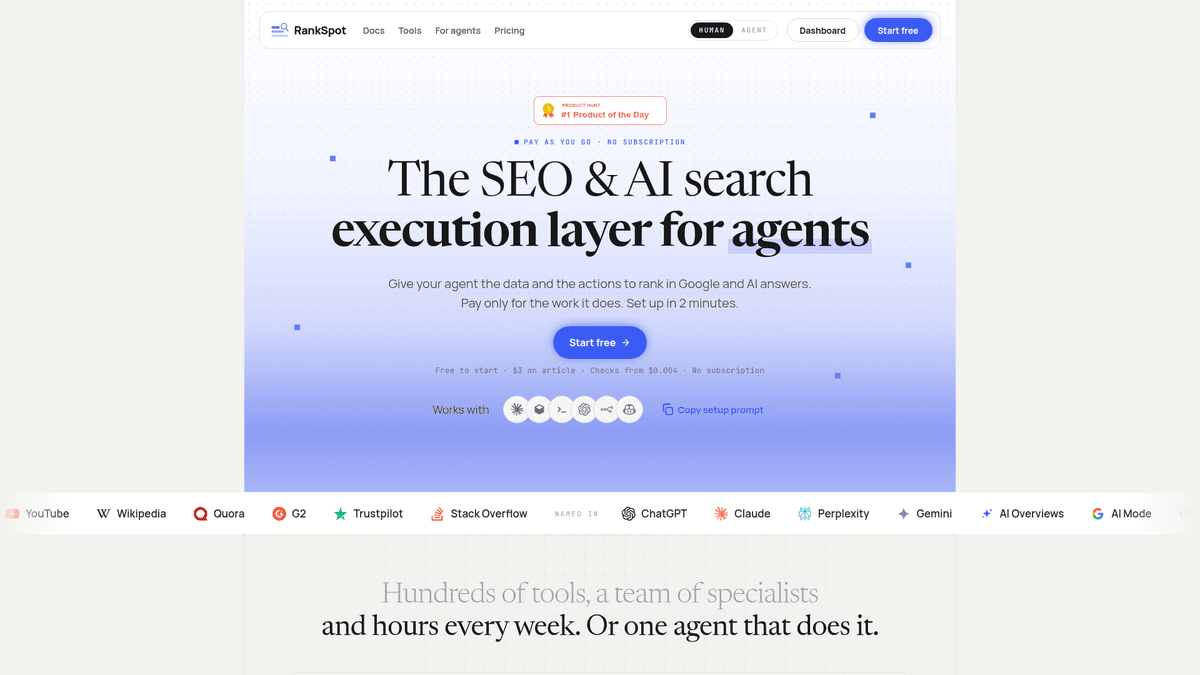
RankSpot suits a founder or small team with a focused question set and no appetite for another subscription. One prompt on one engine costs $0.004, or $4 for 1,000 checks. You get $1 in free credit, and top-ups start at $10. If you check 50 prompts daily across four engines for 30 days, you spend about $24 for 6,000 checks. You are paying for that workload, not buying a monthly bundle.
It tracks ChatGPT, Perplexity, Gemini and Google AI, with AI Overviews and AI Mode counted together as one engine. You can inspect competitor mentions and cited sources, use fan-out queries to explore related questions, and move from a finding to writing and publishing an article. MCP access lets an AI agent use the tracking and publishing workflow. At $3 per article, writing is a separate action, not part of the per-check cost.
RankSpot does not track Claude or provide enterprise multi-brand reporting. It also makes no claim to sentiment scoring or alerts. It fits teams that want to run checks when needed and publish a response to a missing citation.
2. Profound: enterprise visibility intelligence
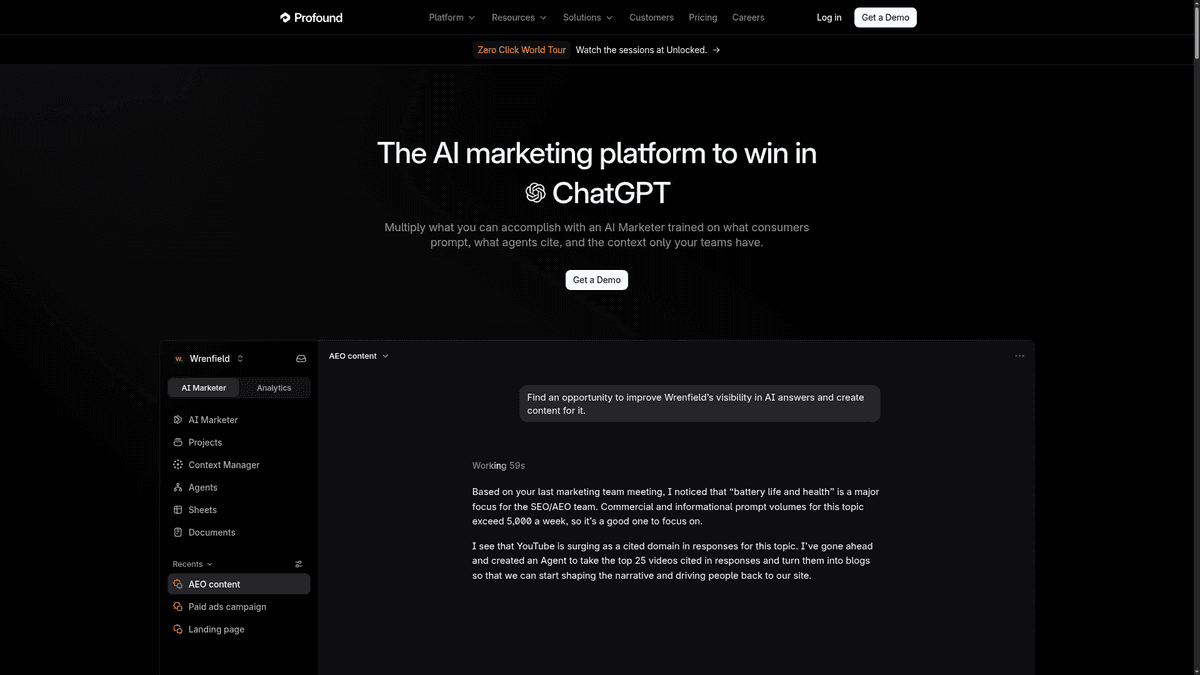
Profound is built for brands running an ongoing AI search program across teams. Enterprise tracks up to 10 answer engines, including ChatGPT, Claude, Perplexity, Gemini, Google AI Mode and AI Overviews, with daily runs. Its answer-engine and prompt intelligence lets teams inspect brand appearances and the sources behind answers.
Profound retired its self-serve plans in September 2026, so Enterprise with custom pricing is the only option and a demo is the way in. There is no public allocation we can map to prompt × engine × run for a per-1,000-check figure. A founder also has to account for procurement and setup; an enterprise team that needs broad coverage may find that worthwhile. See Profound alternatives for lighter options.
3. Peec AI: a fixed daily prompt set for marketing teams
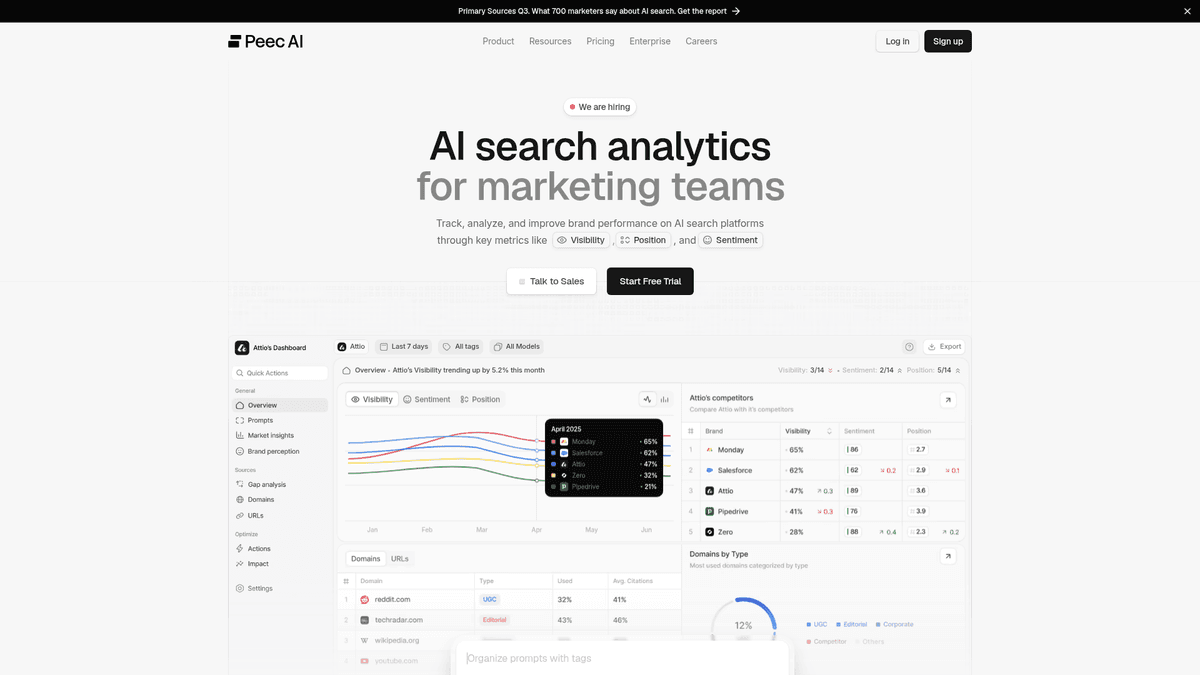
Peec AI's Starter plan costs $95 per month for 50 prompts, three chosen models and daily runs. Pro is $245 for 150 prompts, and there is a free trial. It presents brand visibility, competitor comparisons and sources in a dashboard suited to content and marketing teams. For a full 50 × 3 × 30 workload, the illustrative cost is about $21.11 per 1,000 checks.
Starter lets you choose three models, so decide which assistants your buyers use before setting up prompts. A fourth model costs from $30 a month. Peec fits a team that wants a regular dashboard and expects to use its allocation.
If you are comparing replacement options, see Peec AI alternatives.
4. OtterlyAI: daily monitoring with credit rules
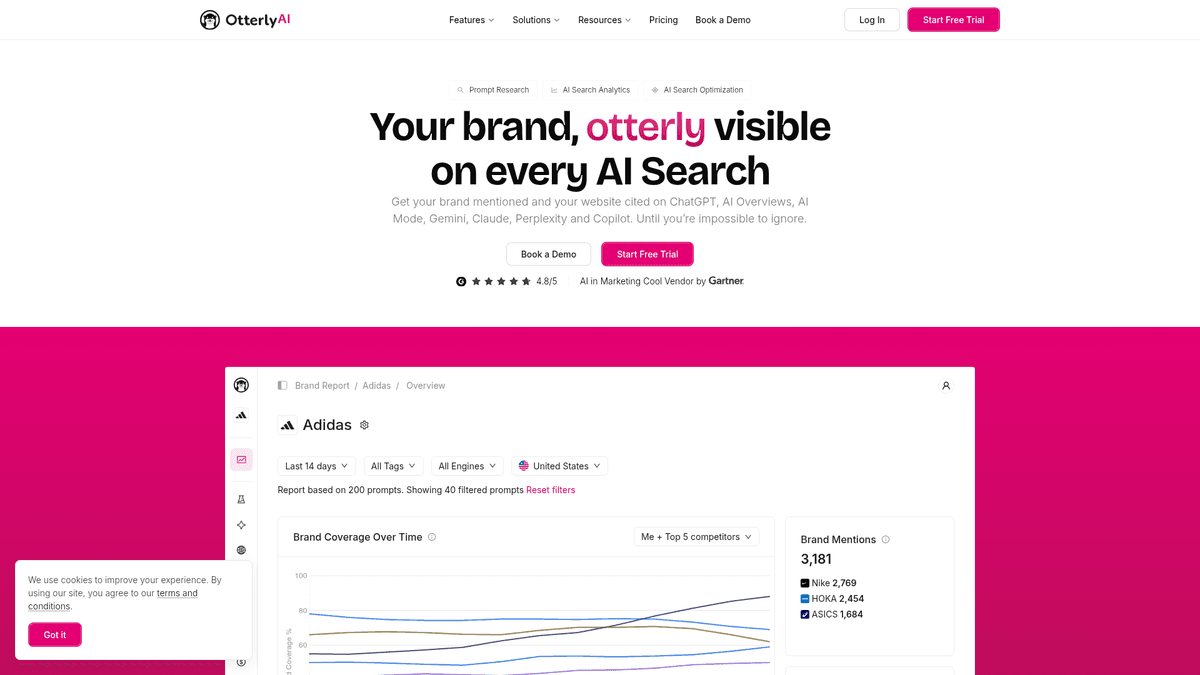
OtterlyAI Lite costs $29 a month for 20 prompts, 2,000 monthly credits, daily tracking and a choice of three of seven engines: ChatGPT, Google AI Overviews, Perplexity, Microsoft Copilot, Google AI Mode, Gemini and Claude. Citation source tracking and brand visibility analysis are included, and there is a free trial.
One credit is one prompt checked once on one engine, and a Claude answer counts as three. The $29 entry price works for a small, stable prompt set at about $14.50 per 1,000 checks. API and MCP access start on the $189 Standard plan. Compare wider setups in these OtterlyAI alternatives.
5. Scrunch AI: monitoring plus agent-facing site work
Scrunch AI suits teams working on how agents access their sites as well as how their brands appear in answers. Core costs $250 a month for 15,000 AI responses across ChatGPT, Perplexity, Gemini, Google AI Overviews, AI Mode, Copilot, Grok and Meta AI, with a 7-day free trial. Claude is an add-on.
At full use, that is about $16.67 per 1,000 responses. Scrunch does not publish a Core run cadence, so plan how you will spread those responses across prompts and engines. A founder doing a weekly brand audit may have little use for the broader platform.
6. Rankscale: credit-based engine flexibility
Rankscale offers app-engine answers and API-model options with different credit consumption. An app-engine answer such as ChatGPT, Gemini or Google AI Mode costs 0.25 credits, while API-model answers cost 1 to 4 credits. Pro costs $99 a month for 1,200 credits, with a 7-day trial; Pro+ is $229 for 3,000.
On app engines alone, Pro buys 4,800 answers, or about $20.63 per 1,000. An agency or analyst can mix in API models, but each one shrinks the allowance. Calculate against the prompts and engines you intend to run.
7. LLM Pulse: weekly or daily cadence by choice
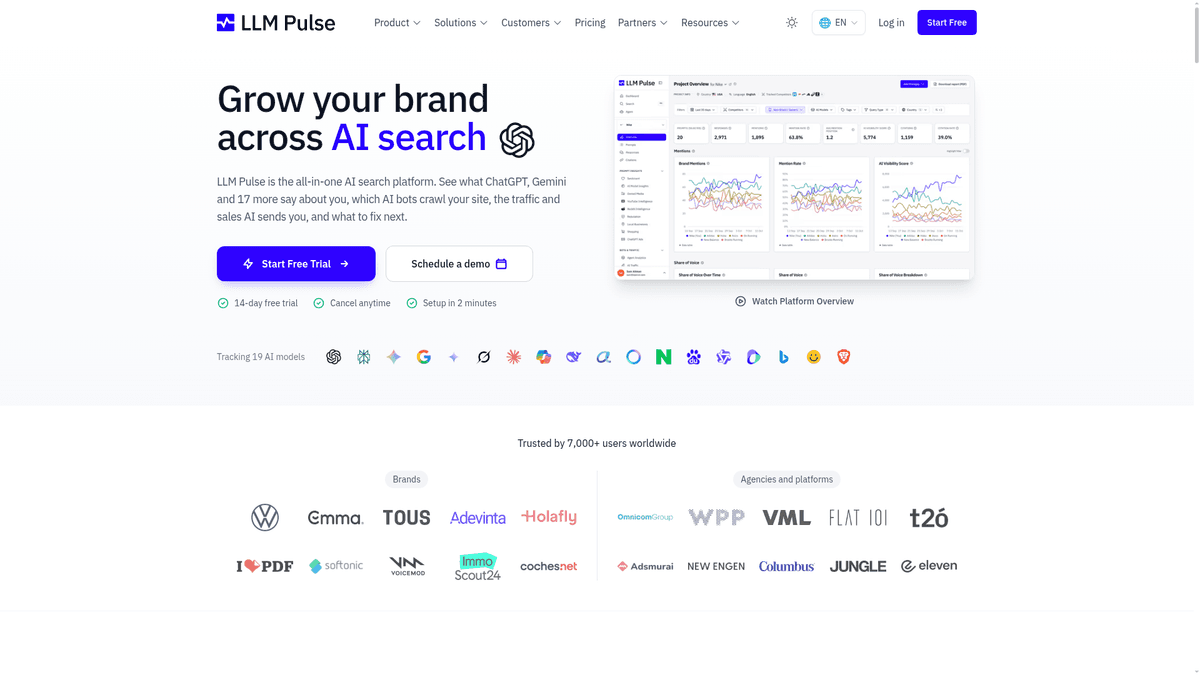
LLM Pulse prices by cadence. Starter covers 50 prompts for €49 a month with weekly runs, or €79 a month with daily runs. Every plan tracks ChatGPT, Perplexity, Gemini, Google AI Mode and AI Overviews, and extra models cost from €8 each per month. A 14-day free trial is available on weekly plans, with a card required.
Daily Starter works out to about €10.53 per 1,000 checks at full use. Weekly data is cheaper but may leave you waiting during a launch or a brand issue. Use it if one of those rhythms suits your work.
There is a separate LLM Pulse alternatives breakdown for teams weighing that cadence against other products.
8. Topify: daily tracking alongside content work
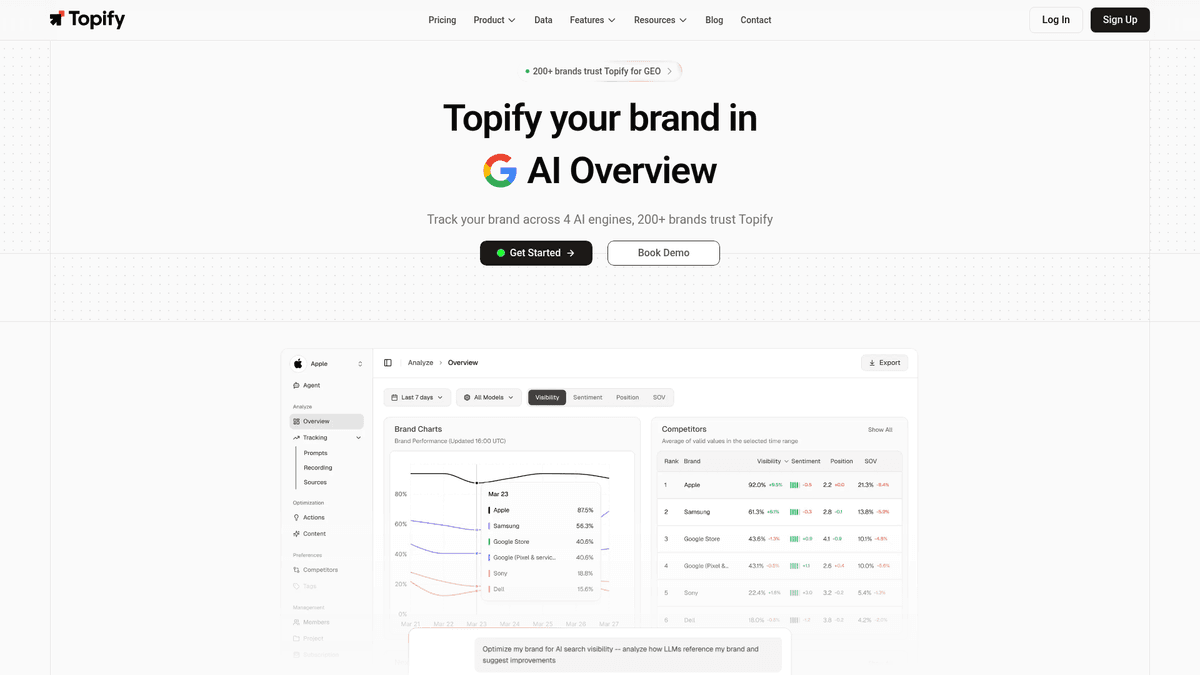
Topify's Starter plan costs $99 per month for 50 prompts tracked daily across ChatGPT, Perplexity, Google AI Overviews and Gemini, and every plan has a free trial with no card required. It combines monitoring of mentions, citations and competitors with article generation. On a full-use assumption of 50 × 4 × 30 runs, that is about $16.50 per 1,000 checks.
Standard is $199 for 100 daily prompts. Credits and content use can change the bill. Topify makes sense if you need a fixed monitoring dashboard plus content production; a founder running a handful of checks may leave much of the bundle unused.
9. SE Visible: a high-volume daily baseline
SE Visible, from SE Ranking, costs $89 a month, or $71 billed annually, for 75 prompts tracked daily and roughly 11,250 AI answers a month across ChatGPT, Gemini, AI Overviews, AI Mode and Copilot. There is a 14-day free trial. At full use on annual billing, that works out to approximately $6.31 per 1,000 answers.
An SEO team with a steady prompt list can build daily history here. The attractive effective unit cost assumes full use of the included volume. The monthly answer count is the vendor's estimate; it says nothing about how consistent those answers will be.
For the broader suite decision, read SE Ranking alternatives.
10. Semrush AI Visibility Toolkit: AI monitoring in an SEO workflow
Semrush offers AI brand performance, competitor and prompt research in an existing SEO environment. The AI Visibility Toolkit costs $99 a month per domain with 25 tracked prompts; 50 more prompts cost $60 a month, and there is no free trial. That is useful for a team already sharing SEO reports and workflows in Semrush.
Semrush names ChatGPT and Google AI Mode among the tracked platforms but does not publish a full engine list, so we cannot derive a per-check cost. If you only need prompt monitoring, the wider suite may be an expensive way to get it.
Can you track LLM visibility for free?
Yes. For a small prompt set, a spreadsheet makes a useful first LLM visibility checker. You will do the collection yourself, and you cannot infer a population-wide “AI rank” from it. You can, however, preserve the answers your own questions received on specific dates.
Write 10 to 20 real buyer prompts, split between category discovery, comparisons and objections. Avoid only asking branded questions, which inflate apparent visibility.
Run each prompt in the AI search products your buyers use. Record the date, engine, prompt wording, answer text, your mention, competitor mentions and every cited URL.
Repeat on the same schedule, using the same region and account conditions where possible. Count mention rate as mentions divided by total comparable runs; count citation rate separately.
Group results by buyer intent. If a purchase question repeatedly cites a third-party page that omits you, decide whether to improve your own relevant page or pursue an accurate mention from that source.
RankSpot's $1 free credit covers 250 checks at the stated check price. OtterlyAI, Topify, Peec AI and SE Visible offer free trials, and LLM Pulse has a 14-day trial on weekly plans. Use that time to look at the raw answers and citation URLs before paying for a recurring prompt set.
How to choose without buying unused checks
Budget the workload first. Twenty buyer questions on three engines, run weekly, produce about 240 checks in a four-week period. Run those same questions daily and you reach 1,800 checks in 30 days. Changing cadence can move your bill more than adding a few prompts.
Then make four decisions:
Engine coverage: Which assistants do your customers actually consult? If Claude matters, RankSpot is not the right tracker for that engine; OtterlyAI's selectable Claude coverage or Profound's Enterprise plan may fit better.
Collection method: Does the result include source URLs and reflect an app answer or an API model response? Read several raw answers before trusting a summary score.
Prompt allowance: Does “50 prompts” mean 50 per engine, 50 total across engines or a credit pool consumed at different rates? Use the plan's published definition before comparing costs.
Next action: Will you only report mentions, or will you update a page, publish a comparison, or work on a cited source? A tracker earns its keep when the answer changes your work.
Start with a few questions tied to a sale instead of hundreds of loose variations. Run a baseline and note the sources that appear again and again. Then improve one relevant page or source relationship at a time, using the answers themselves rather than chasing a fluctuating score.
Bottom line
If you need prompt-level visibility without another subscription, try RankSpot: checks cost $4 per 1,000, you start with $1 in credit, and you can write and publish after spotting a missing citation. Profound fits an enterprise intelligence program; SE Visible suits teams that will use a large daily allocation. Pick the buyer questions you can act on and start there.
FAQ
What is LLM tracking?
LLM tracking means running the same buyer prompts on AI assistants such as ChatGPT, Perplexity and Gemini on a schedule, then recording whether each answer mentions your brand, which competitors appear and which URLs get cited.
Can you track Claude?
Some tools can. OtterlyAI lets you select Claude (at three credits per answer), Rankscale offers Claude API models, Scrunch sells it as an add-on, and Profound includes it on Enterprise. RankSpot does not track Claude; it covers ChatGPT, Perplexity, Gemini and Google AI.
How often should prompts run?
Daily runs suit launches, fast-moving categories and competitive buyer questions. Weekly runs are enough for a stable baseline and cost far less. Whichever you pick, keep the cadence fixed so trends stay comparable.
Are there free LLM tracking tools?
Free options are mostly trials and credits: RankSpot’s $1 credit covers 250 checks, and several vendors offer 7- to 14-day trials. A manual spreadsheet of 10–20 prompts is the only truly free ongoing method.
How is LLM tracking different from rank tracking?
Rank tracking records a page’s position in a list of search results. LLM tracking records whether an AI answer names or cites you at all, and that answer can change from one run to the next. You need repeated runs and mention rates, not a single position.