I tested 8 Promptwatch alternatives for AI visibility tracking (here’s what I found)
If you’re searching for Promptwatch alternatives, you’re probably in one of two camps.
Either Promptwatch looks solid but the pricing and prompt caps feel tight for your stage, or you want something that does more than just track mentions in ChatGPT, Perplexity, Gemini, and Google AI results. That was my starting point too.
I spent time reviewing the main options founders and lean teams keep comparing in 2026. I focused on what actually matters in practice: engine coverage, citation tracking, competitor comparisons, prompt depth, reporting, pricing transparency, and whether the product helps you act on visibility data instead of just staring at dashboards.
A quick note before we dive in: this isn’t a generic Promptwatch review. It’s a practical buyer’s guide for people trying to decide what to use instead. I also looked at Promptwatch pricing as the benchmark, since most comparison decisions start there.
For context, Promptwatch’s public plans position it as a serious AI visibility platform, with strong crawler-log and agent analytics features. But many early-stage teams still want one of three things:
lower starting cost
broader workflow coverage
easier execution after tracking reveals opportunities
That’s where the alternatives below start to separate.
How I chose these Promptwatch alternatives
I used a simple filter.
A tool had to help with at least one of these jobs well:
Track visibility across major AI answer engines
Show citations, mentions, or prompt-level presence
Compare your brand against competitors
Give enough pricing clarity to make a realistic buying decision
I also gave extra credit to platforms that help with execution, not just monitoring. That matters because tracking alone rarely moves the ranking. Once you know where your brand is missing, you still need keyword research, content planning, writing, internal linking, publishing, and iteration.
That’s exactly why many small teams end up stitching together five different tools when they only wanted one.
“80% of consumers now rely on AI-generated results for at least 40% of their searches.” - Bain & Company
That stat is the real reason this category matters now. If your brand is not showing up in AI answers, you are not just missing impressions. You are missing consideration.
If you want a broader view of the market beyond this list, our guide to AI tools for SEO is a useful read.
Quick comparison table
Tool | Best for | Key feature | Starting price |
|---|---|---|---|
RankSpot | Founders who want tracking plus execution | AI visibility + keyword research + content generation + publishing | Free trial, then paid plans |
Peec AI | Agencies and client reporting | Prompt-level competitor comparison and reporting | Custom / contact sales |
Profound | Large enterprises | Deep AI search analytics and enterprise workflows | From $99/month |
Otterly AI | Budget-conscious teams | Simple monitoring with low entry pricing | From $29/month |
Scrunch AI | Technical and enterprise teams | Agent experience and brand monitoring | Custom / higher-tier pricing |
AthenaHQ | Mid-market brands | Citation tracking with recommendations | Custom / contact sales |
LLMrefs | Lightweight monitoring | Simple rank-style prompt tracking | Lower-cost entry |
Rankscale | Teams wanting broad engine scoring | AI visibility scoring across engines | From around $20/month |
What to look for before you switch
Before picking a Promptwatch alternative, check these four things:
1. Engine coverage
Some tools say they support “AI visibility” but only track a narrow set of engines in self-serve plans. If ChatGPT, Google AI Overviews, Gemini, Perplexity, and AI Mode matter to your buyers, make sure those are included on your actual plan.
2. Prompt limits and pricing math
A low sticker price can be misleading if you only get 10 to 20 prompts, or if key models cost extra. That is often where the real cost jumps.
3. Actionability
Can the tool tell you why you are not being cited? Can it turn that into a plan? Can it help you publish the content that closes the gap?
4. Workflow fit
Founders usually do not need another dashboard. They need fewer manual steps. The best tools reduce work, not just add reporting.
1. RankSpot - best if you want tracking and execution in one place
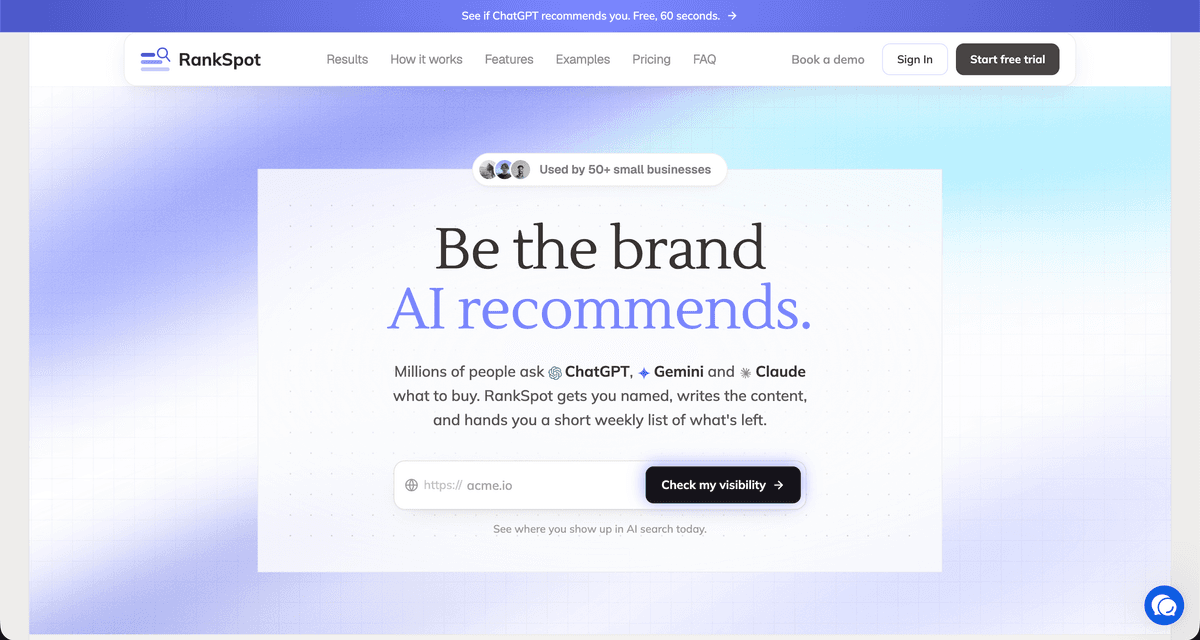
If I were a founder choosing one platform from scratch, RankSpot would be the most practical pick.
The reason is simple. Most AI visibility tools stop at measurement. RankSpot connects the full chain: research, planning, writing, GEO optimization, internal links, images, and direct publishing. So instead of seeing that your brand is weak in AI answers and then opening six more tools, you can move straight into execution.
That makes it a very different kind of Promptwatch alternative. Promptwatch is stronger if your main need is dedicated tracking and crawler/agent analytics. RankSpot is stronger if your real problem is “we know we should do SEO and GEO, but we do not have time to run the machine.”
It is especially good for indie founders, SaaS teams, and small e-commerce brands that want steady output without hiring an agency. The platform learns from your site, identifies high-intent and competitor keyword opportunities, creates a content plan, writes long-form posts, optimizes them for Google and AI answer engines, generates visuals, and publishes to your CMS.
That last part matters more than it sounds. For most small teams, the bottleneck is not ideas. It is consistent execution.
Pros
Handles the full SEO/GEO workflow end to end
Strong fit for founders and lean teams with no in-house content operation
Built for AI answer visibility, not only classic search
Finds high-intent keyword opportunities and competitor-led targets
Supports direct publishing to WordPress, Webflow, Wix, Shopify, Framer, Ghost, and more
Saves serious time by removing manual research, writing, formatting, and publishing
Supports 100+ languages
Includes on-brand image generation and built-in on-page SEO structure
Helps surface Reddit and forum demand signals
Cons
Not as specialized as Promptwatch if your top priority is deep agent analytics or crawler-log analysis
Less ideal for very large enterprises that need heavy custom reporting or compliance workflows
Best value comes when you want output, not just monitoring
Pricing
Low-friction trial with the first 3 articles free and no credit card
Paid plans scale based on usage and publishing needs
Best for
Founders and operators who do not just want to measure AI visibility. They want to improve it fast.
If that sounds like you, the bigger win is usually not another dashboard. It is an automated publishing engine. You can also pair this with our guide to SEO automation tools if you’re comparing broader workflow options.
2. Peec AI - best for agency reporting and prompt-level competitor comparisons
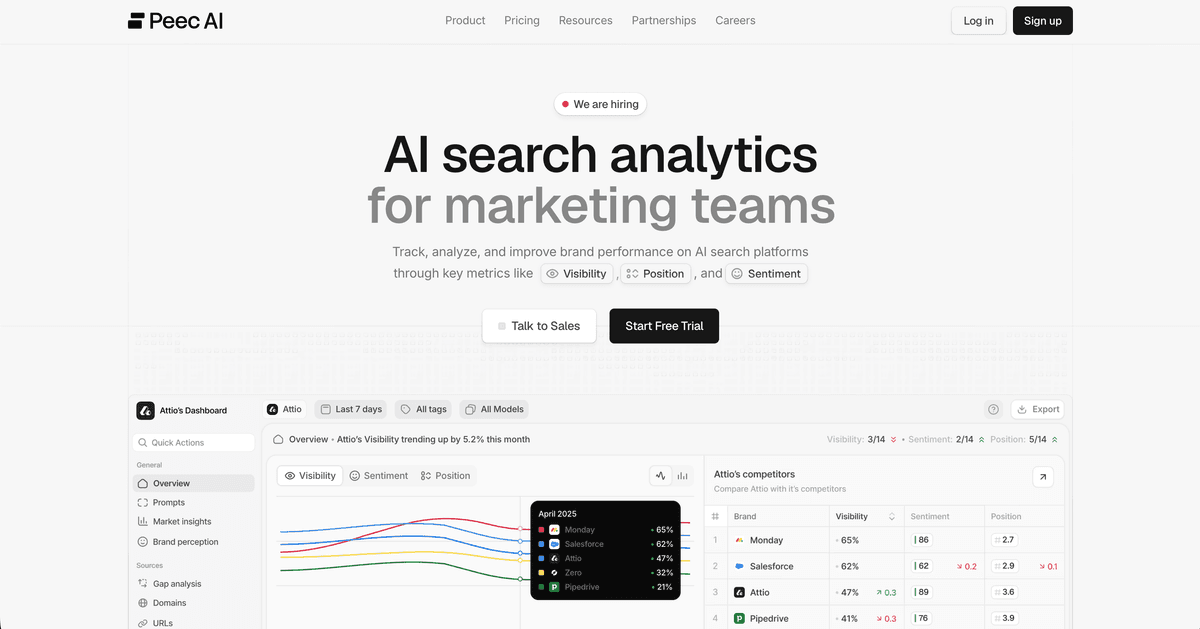
Peec AI is one of the names that comes up most often when people compare AI visibility tools. It has a clean reporting angle and tends to resonate with agencies that need to show side-by-side performance across prompts and competitors.
The appeal is straightforward: if your clients care about whether their brand appears in AI-generated answers versus named competitors, a prompt-level comparison workflow is useful. It turns abstract visibility into a reporting artifact clients can understand.
Where I would be careful is fit. If you are a solo founder or small operator, tools built around agency reporting can feel like overkill. They are strongest when multiple accounts, benchmarks, and recurring presentation layers matter.
Pros
Good fit for agencies
Useful competitor comparison workflows
Reporting is easier to explain to clients than raw technical data
Clear value if you sell AI visibility services
Cons
Usually not the cheapest route for smaller teams
Better for reporting than execution
Less compelling if you need content creation and publishing in the same stack
Pricing
Typically custom or sales-led
Expect pricing to make more sense for agencies than solo operators
Best for
Agencies, consultants, and service businesses that need to package AI visibility into client deliverables.
3. Profound - best for enterprise AI search analytics
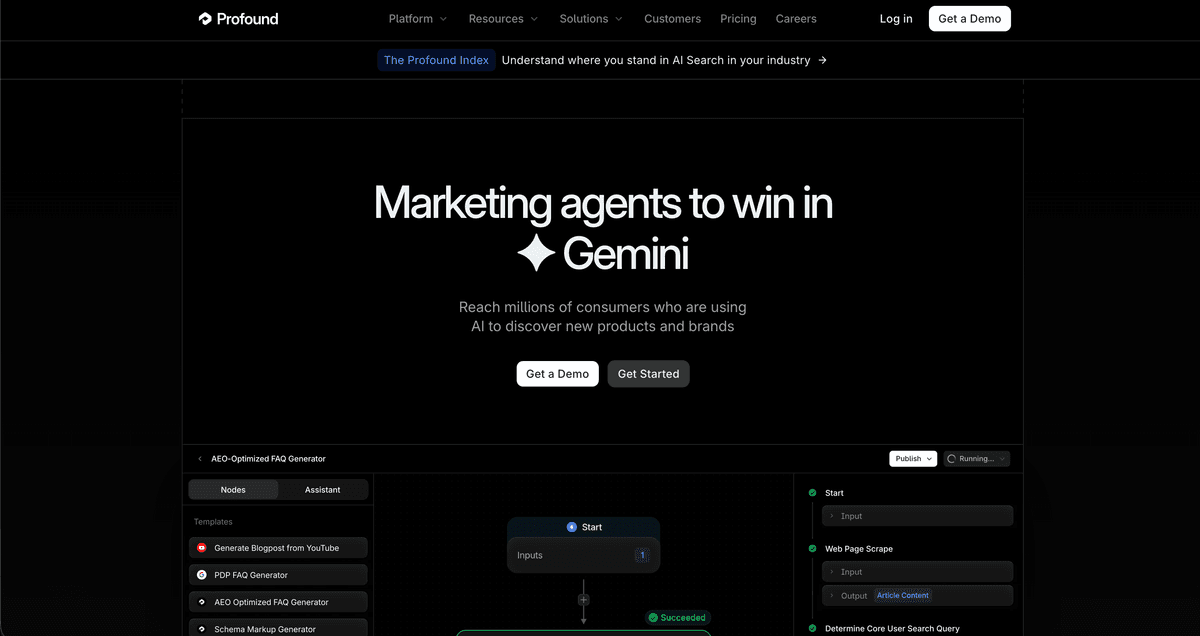
Profound is the enterprise-heavy option on this list.
If you want depth, polish, and a product built for bigger organizations, it stands out. It is designed for companies that need serious monitoring across AI search, stronger governance, and more advanced analytics than a typical startup tool provides.
It also tends to come up in larger brand conversations because it pushes beyond simple mention tracking. You get a more mature analytics story and stronger alignment with enterprise buying expectations.
That said, the trade-off is obvious: cost and complexity. If you are a founder trying to get traction with a small budget, this is probably too much tool.
Pros
Strong enterprise positioning
Deeper analytics than most lower-cost options
Better fit for teams with formal reporting and stakeholder requirements
Well suited to large brands monitoring AI search at scale
Cons
Expensive compared with self-serve alternatives
More than most small teams actually need
Lower ROI if you are still proving the channel internally
Pricing
Public entry plan starts around $99/month
Broader coverage and fuller usage usually push you into much higher tiers
Best for
Large companies, funded scale-ups, and enterprise marketing teams.
4. Otterly AI - best budget entry point
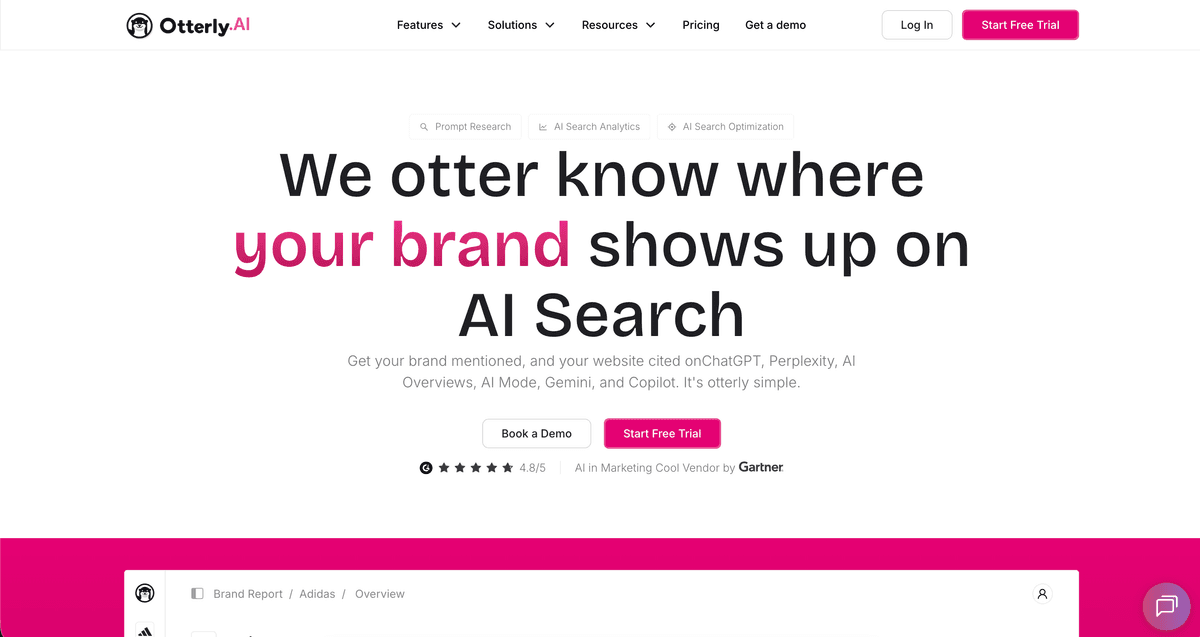
Otterly AI keeps showing up in these conversations for one reason: it is one of the easiest low-cost ways to get started.
If you just want a basic pulse on how your brand appears in AI answers, it is a reasonable entry point. The interface is generally simple, and the starting plan is much easier to justify if you are testing the category for the first time.
But low-cost does not always mean low-friction forever. Once you need more prompts, more engines, or more advanced capabilities, the economics can change fast. So Otterly makes the most sense when you are still validating use cases rather than building a full AI visibility program.
Pros
Low entry price
Simple to understand
Good for early experimentation
Often a sensible first step for small teams
Cons
Lower prompt caps on cheaper plans
Some important engines or features may require upgrades or add-ons
Limited compared with more execution-focused platforms
Easier to outgrow than some alternatives
Pricing
Starts around $29/month
Real cost depends on prompt volume and engine needs
Best for
Small teams that want basic monitoring without a big initial commitment.
5. Scrunch AI - best for technical brand presence and agent experience
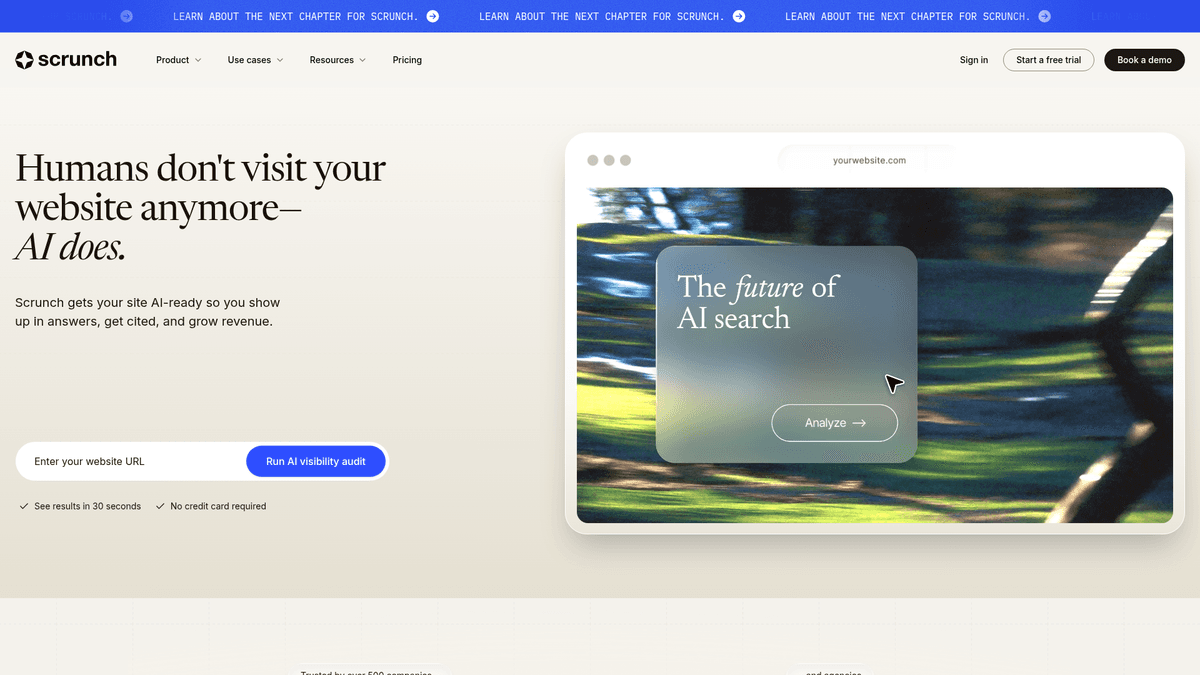
Scrunch AI has a more technical feel than some of the others. It leans into monitoring how brands are represented and understood in AI environments, and it tends to appeal to teams thinking about structured presence, discoverability, and accuracy in how their company is described.
That can be useful if your brand has a complex product, operates in a technical market, or cares deeply about misinformation and representation in AI-generated responses. It is less about “did I get a mention?” and more about “how is the agent understanding and presenting us?”
The issue for smaller buyers is predictability. Products with a more enterprise or technical angle often require more sales involvement, more setup, and more budget than a startup expects.
Pros
Good for technical AI visibility use cases
Helpful for teams focused on agent understanding and representation
Stronger strategic fit for complex brands
Cons
Not ideal if you want cheap and simple
More technical than many founders need
Usually a less direct route to publishing content improvements
Pricing
Often sales-led or custom
Better matched to funded teams than bootstrapped operators
Best for
Technical marketing teams, larger B2B companies, and brands with complex positioning.
6. AthenaHQ - best mid-market option for recommendations plus tracking
AthenaHQ sits in a useful middle ground.
It is often a better fit than enterprise platforms for mid-market teams, but it still goes further than the bare-bones monitoring tools. The value proposition usually centers on citation tracking plus recommendations, which is exactly the direction many teams want: not only “what happened,” but “what should we do next?”
That makes it more operationally useful than some dashboards. For marketing teams that already have content resources in-house, recommendation-led products can be a good compromise between full-service execution and lightweight monitoring.
Pros
Balanced feature set
Better actionability than simple mention tracking alone
Good fit for in-house marketers with some content capability
Solid mid-market positioning
Cons
Still may require separate tools for content production and publishing
Pricing is often less transparent than self-serve tools
Not the simplest option for solo founders
Pricing
Usually custom or contact sales
Best evaluated in a demo if you are a mid-market buyer
Best for
In-house marketing teams that want guidance and visibility data without going full enterprise.
7. LLMrefs - best lightweight option for simple prompt tracking
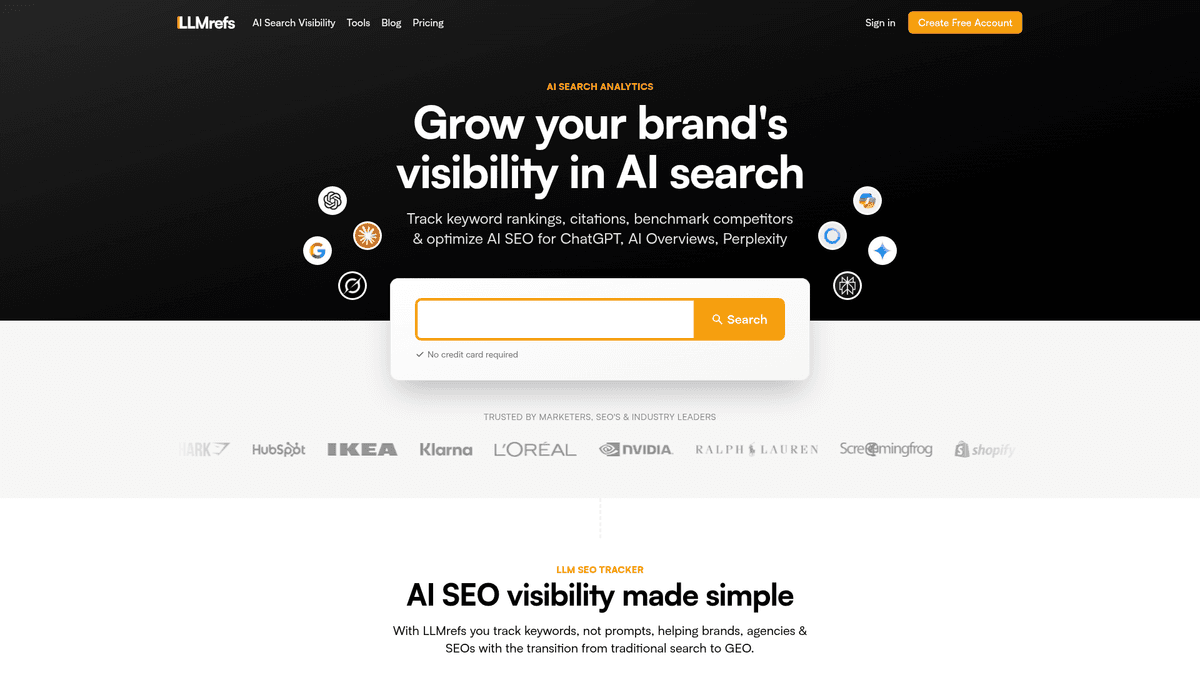
LLMrefs is one of the lighter-weight tools in this space. Think of it as a simpler, more focused product for teams that want to watch prompt-level visibility without committing to a broad platform.
That can be a feature, not a bug. A lot of buyers do not need a huge operating system. They just want to know whether they are appearing, where competitors are ahead, and whether progress is moving in the right direction.
The downside is that lightweight tools usually stay lightweight. If you need strategy, writing, optimization, internal linking, and publishing help, you will still need other products around it.
Pros
Simple and focused
Lower-friction option for testing AI visibility monitoring
Good for teams that do not want enterprise complexity
Cons
Narrower workflow coverage
Likely requires other tools for execution
Less suitable for teams building a complete SEO/GEO motion
Pricing
Lower-cost entry compared with larger platforms
Best for smaller tracking needs
Best for
Startups that want basic prompt tracking without buying a bigger platform.
8. Rankscale - best for broad engine coverage and scoring
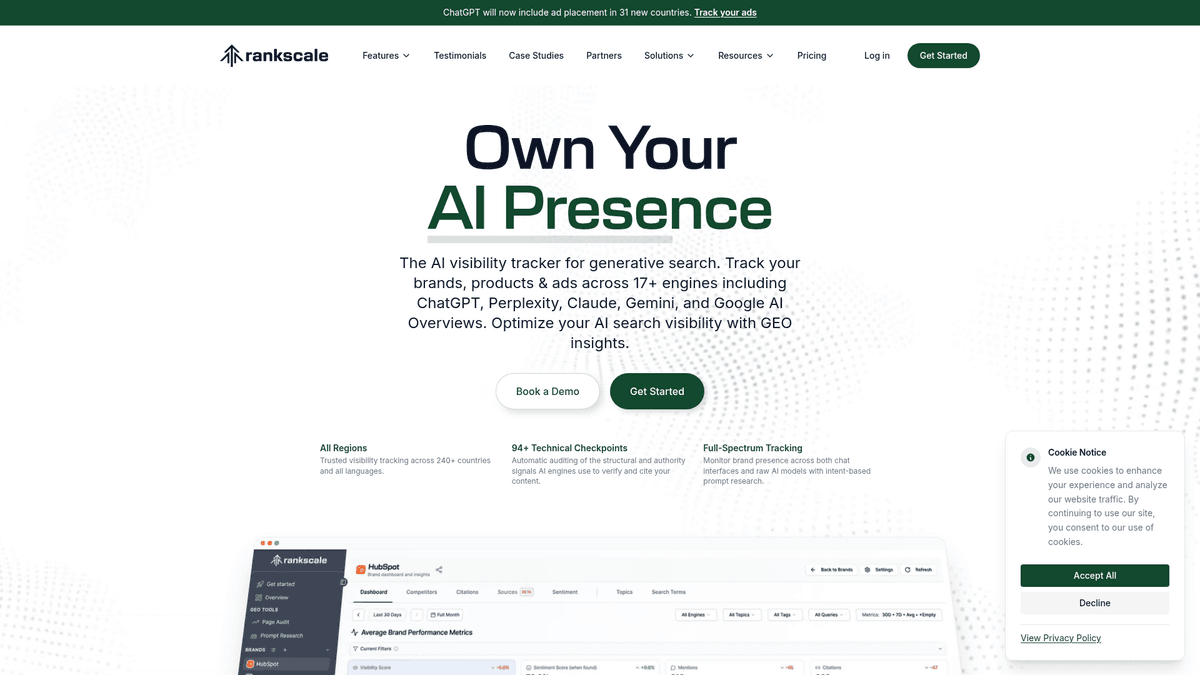
Rankscale is interesting because it often appeals to buyers who want coverage breadth and a more score-driven way to track AI visibility across engines.
That scoring model can be helpful when you want a top-level benchmark to report internally. It gives teams a quick answer to “are we improving?” without forcing them to inspect every prompt one by one first.
The caution here is interpretation. Scores are useful, but they are abstractions. At some point, you still need to understand which prompts matter, which pages get cited, and what content changes are likely to improve results.
Pros
Broad engine mindset
Useful high-level scoring for trend tracking
Can work well for mid-market teams that want a simple benchmark
Cons
Scores can hide nuance if you do not drill into prompts
Cost model may require close review depending on usage
Still not a full execution platform
Pricing
Starts around $20/month at entry level
Usage and model mix can affect the real cost
Best for
Teams that want broad monitoring and a scoreboard-style view of AI visibility.
My honest take on Promptwatch pricing and positioning
Since many people land here after comparing Promptwatch pricing, here is the short version.
Promptwatch looks strongest when you care about:
agent analytics
crawler-log visibility
serious tracking depth
content workflows tied to AI visibility operations
That is a strong package for SEO teams, agencies, and brands treating AI search as a dedicated channel.
But if you are an early-stage operator, the real question is not “which dashboard is most advanced?” It is usually:
Which option helps me actually win more visibility with the least operational drag?
That answer is often different.
A founder does not need the most features on paper. They need the shortest path from insight to published improvement.
What I’d pick in different scenarios
Here is the practical decision framework I would use.
Pick RankSpot if…
You want one tool to handle research, planning, writing, GEO optimization, and publishing
You are replacing an agency or trying to avoid hiring one
You care about both Google traffic and AI answer visibility
You want to save 40+ hours a month and publish consistently without adding headcount
Pick Peec AI if…
You run an agency
Client reporting and competitor comparisons are central to your workflow
You need something presentation-friendly
Pick Profound if…
You are a large company
Budget is less important than depth, governance, and advanced analytics
Multiple stakeholders need enterprise-level reporting
Pick Otterly AI or LLMrefs if…
You want the cheapest way to get started
You mainly need basic monitoring
You are still validating whether AI visibility tracking matters for your business
Pick AthenaHQ or Rankscale if…
You are in the middle
You want stronger insights than entry-level tools
You do not necessarily need a full end-to-end publishing engine
The bigger strategic lesson
The market is still young, but one thing is already clear.
Tracking alone is not enough.
Knowing that a competitor is cited more often in ChatGPT or Google AI Overviews is useful. But it only creates business value when you can turn that insight into:
a better content plan
sharper keyword targeting
more relevant pages
stronger internal linking
faster publishing
better distribution across your site
That is why I think this category is gradually splitting in two:
dedicated AI visibility analytics platforms
execution-first platforms that help you actually capture those gains
For founders, the second category is usually more valuable.
That is also why tools that combine automation, publishing, and AI answer optimization are getting more attention. If your team is already thin, adding one more analytics product is often the wrong move. Replacing your fragmented stack with a system that finds demand, writes high-quality content, and publishes regularly is often the better one.
Final verdict
If you want a pure-play AI visibility platform, the best choice depends on your size and workflow:
Profound for enterprise depth
Peec AI for agency reporting
Otterly AI for low-cost entry
AthenaHQ or Rankscale for mid-market monitoring
LLMrefs for simple prompt tracking
Scrunch AI for a more technical brand-representation angle
But if you want the most practical Promptwatch alternative for a founder or lean team, I would choose RankSpot.
The reason is simple. It does not stop at telling you what is missing. It helps you publish the work that fixes it.
That means fewer tools, fewer handoffs, faster output, and a much better chance that your brand actually gets cited by ChatGPT, Claude, Gemini, and Google AI products over time.
If you want to test that approach without much friction, RankSpot lets you start with your first 3 articles free and no credit card. For most small teams, that is a much better first move than buying another dashboard and hoping execution somehow follows.