SEO Automation Tool: Best Platforms for 2026
If you’re a founder, indie hacker, or lean marketing lead, you already know the problem.
SEO works.
But doing it properly is brutal.
You need keyword research, competitor tracking, briefs, writing, images, internal links, formatting, publishing, and now optimization for AI answers too. That’s before you even think about consistency.
Most teams don’t fail at SEO because they don’t care. They fail because the workflow is too heavy to maintain.
That’s why the right seo automation tool matters in 2026. Not as a nice-to-have. As infrastructure.
The best platforms now do far more than suggest keywords. They can run an end-to-end content engine: research what matters, find competitor wins, write publish-ready articles, push them to your CMS, and optimize for both Google and AI assistants like ChatGPT, Claude, and Gemini.
Marketers say 63% of their data-related time, on average, is spent on tasks that could be partially or fully automated.
Source: MarketingProfs
More than one-third (37%) of active AI users now start searches with artificial intelligence rather than traditional search.
Source: TechRadar
That shift changes the buying criteria completely. Today, the best seo automation platform is not just the one with the biggest dashboard. It’s the one that saves real hours, publishes consistently, and helps your brand get discovered in both search results and AI-generated answers.
What the top-ranking articles got right - and what they missed
After reviewing the current leaders in this topic, the same themes showed up again and again:
automation saves time
all-in-one platforms are easier to manage
content creation is a major use case
technical SEO still matters
AI search visibility is becoming important
That’s all true.
But most competitor articles miss three things that matter most for founders:
Execution beats recommendations.
Many tools still give you tasks instead of doing the work.Publishing velocity is the moat.
A platform that helps you write one article is not the same as one that helps you publish daily without bottlenecks.AI answer optimization is no longer optional.
If your content is not structured to get cited by ChatGPT, Claude, or Gemini, you’re optimizing for yesterday’s search environment.
This guide fixes that. It’s built to help you choose the right seo automation software based on outcomes, not feature fluff.
What an SEO automation tool should actually do in 2026
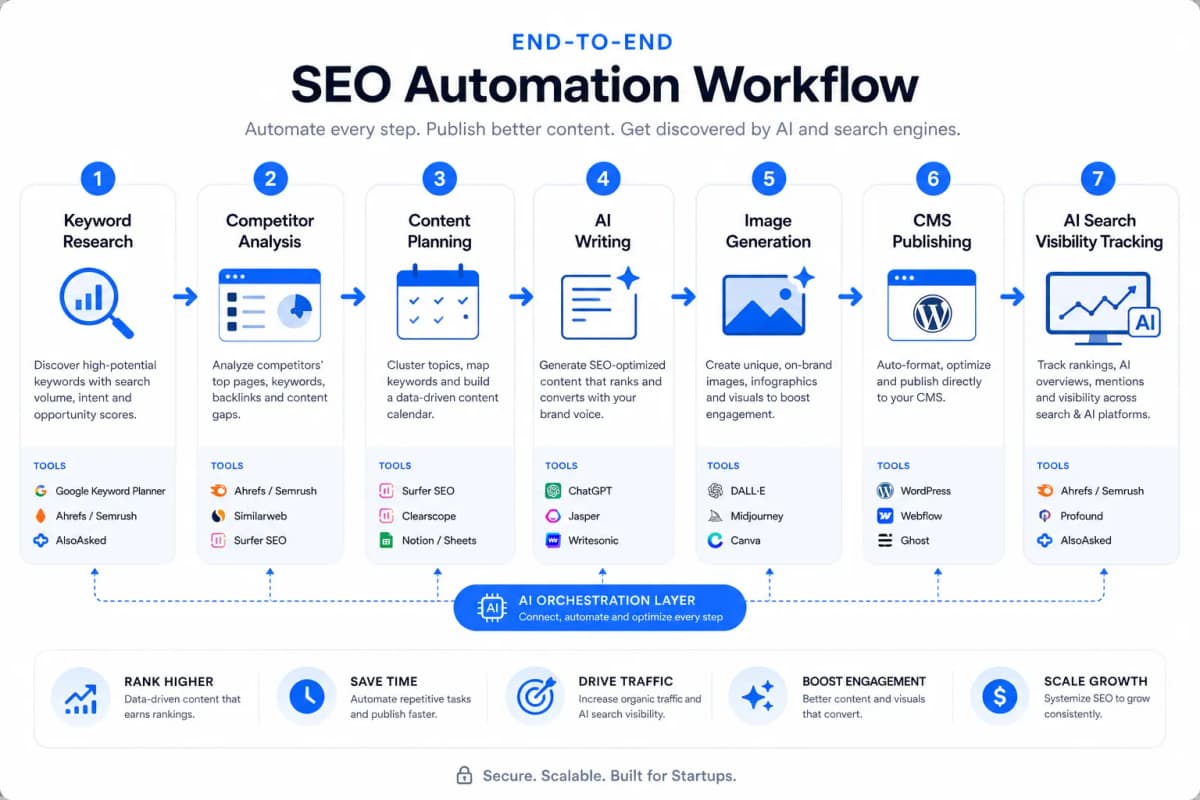
A modern seo automation stack should remove manual work from the entire pipeline, not just one step.
That means it should help with:
keyword discovery
competitor keyword analysis
topic prioritization
content planning
article writing
visual generation
on-page formatting
internal links
CMS publishing
tracking visibility in both search engines and AI assistants
The difference is simple:
old tools tell you what to do
good tools make the work easier
great tools do the work for you
If you’re still stitching together Ahrefs for research, Google Docs for briefs, Grammarly for cleanup, Canva for visuals, and WordPress manually for publishing, you don’t have automation. You have tool sprawl.
That’s exactly where RankSpot is strong. It acts like a personal AI SEO operator for small teams: learn the niche from your site, find high-intent opportunities, build a 30-day plan, write long-form posts, generate on-brand images, format the content properly, and publish directly to your CMS.
The four categories of SEO automation platforms
Not every tool in this category solves the same problem. That’s where many buying mistakes happen.
1. Research-heavy traditional SEO suites
These platforms are strong at:
keyword databases
backlink analysis
competitor research
audits
rank tracking
They’re useful, but often require a lot of manual follow-through. You still need someone to decide what to make, write it, edit it, and publish it.
Best for: in-house SEO pros and agencies with execution capacity.
2. Content optimization tools
These tools help you improve articles using SERP analysis, term coverage, or content scores.
They’re helpful for writers, but they don’t usually solve the bigger problem: actually producing and shipping content consistently.
Best for: editorial teams that already have writers and workflows.
3. Workflow builders and automation layers
These let you connect tools, scrape data, trigger actions, and build custom automations.
Flexible? Yes.
Fast to deploy for a busy founder? Usually no.
Best for: technical operators who want custom flows.
4. End-to-end automated content platforms
This is the category that matters most for lean teams in 2026.
These platforms take you from idea to published post with minimal manual effort. The strongest ones also optimize for AI answers and not just Google rankings.
Best for: founders, small ecommerce brands, SaaS teams, and startups replacing agency spend.
If you want a deeper look at how lean teams approach this category, RankSpot’s breakdown of auto SEO software is a useful companion read.
How to evaluate the best SEO automation software
Before comparing vendors, use this framework.
Does it automate execution or just analysis?
This is the biggest filter.
A tool that surfaces insights is useful.
A tool that publishes finished work is leverage.
Ask:
Will it actually write the article?
Will it add structure, visuals, tables, and links?
Will it publish to my CMS?
Will it run consistently without constant prompting?
Does it support AI search visibility?
Google is still critical. But brands are increasingly discovered through AI answers.
Your platform should help with:
entity-rich writing
structured formatting
citation-friendly content
clear headings and summaries
topical coverage
content freshness
That’s the difference between “ranking” and “getting recommended.”
Does it help you find high-intent topics?
Traffic without buying intent is vanity.
Strong platforms don’t just dump keyword lists. They prioritize based on opportunity, relevance, and commercial intent. Better yet, they show what your competitors already win on so you can target proven demand.
If that’s a priority, this guide on SEO keyword research covers the framework behind choosing terms that actually drive business outcomes.
Does it reduce your tool stack?
The hidden cost of SEO is not just software spend. It’s coordination.
Every extra tool means more handoffs, more exports, more tabs, and more delay.
A strong seo automation platform should consolidate:
research
planning
writing
images
formatting
publishing
Can a non-expert use it?
Most founders don’t want to become technical SEOs. They want results.
The best tools are opinionated enough to be useful without needing a power user sitting behind them every day.
Comparison table: best platforms for 2026
Here’s the practical comparison. Not based on who has the biggest brand. Based on what a founder or lean team can actually get done.
Platform | Best For | Strength | Limitation | Starting Point |
|---|---|---|---|---|
RankSpot | Founders and lean teams who want full automation | End-to-end workflow: research → plan → write → publish, plus GEO optimization and competitor targeting | Less focused on enterprise backlink depth than legacy suites | Low-friction trial, first 3 articles free |
Semrush | Traditional SEO teams | Powerful research, audits, and competitor data | Heavy manual execution, fragmented workflow | Mid-tier SaaS pricing |
Ahrefs | SEOs focused on backlinks and keyword data | Excellent link intelligence and competitive research | No end-to-end publishing pipeline | Mid-tier SaaS pricing |
Surfer SEO | Writers optimizing individual articles | Strong content scoring and SERP guidance | Still requires manual writing and publishing | Mid-tier SaaS pricing |
seoClarity | Enterprise organizations | Massive data scale and advanced workflows | Expensive, complex, overbuilt for small teams | Enterprise pricing |
Gumloop | Custom builders and operators | Flexible automation workflows | Not purpose-built for SEO content publishing | Lower entry price, build-it-yourself |
The best SEO automation platforms for 2026
RankSpot - best for founders who want SEO done, not managed

RankSpot is built for the exact team that usually gets ignored in SEO software: the founder or operator who knows content matters but does not have time to run an editorial machine.
It handles the full pipeline:
learns your niche from your website
identifies high-intent and competitor keyword opportunities
creates a strategic content plan
writes long-form SEO articles
generates unique on-brand images
formats posts with internal links, tables, and structure
publishes directly to WordPress, Webflow, Wix, Shopify, Framer, Ghost, and more
optimizes for AI answer engines so your brand has a better chance of being cited by ChatGPT, Claude, and Gemini
The biggest advantage is not one feature. It’s the removal of friction.
Instead of manually coordinating tools and freelancers, RankSpot gives you a daily publishing engine. That can save 40+ hours per month and replace a messy stack of writing, design, and publishing tools with one system.
It also surfaces Reddit and forum conversations, which is a smart differentiator. That gives you demand signals and prospect language you can turn into content and distribution opportunities.
Best for: early-stage SaaS, ecommerce operators, agencies replacing manual fulfillment, and any lean team that wants consistent growth without agency costs.
Semrush - best for broad traditional SEO coverage
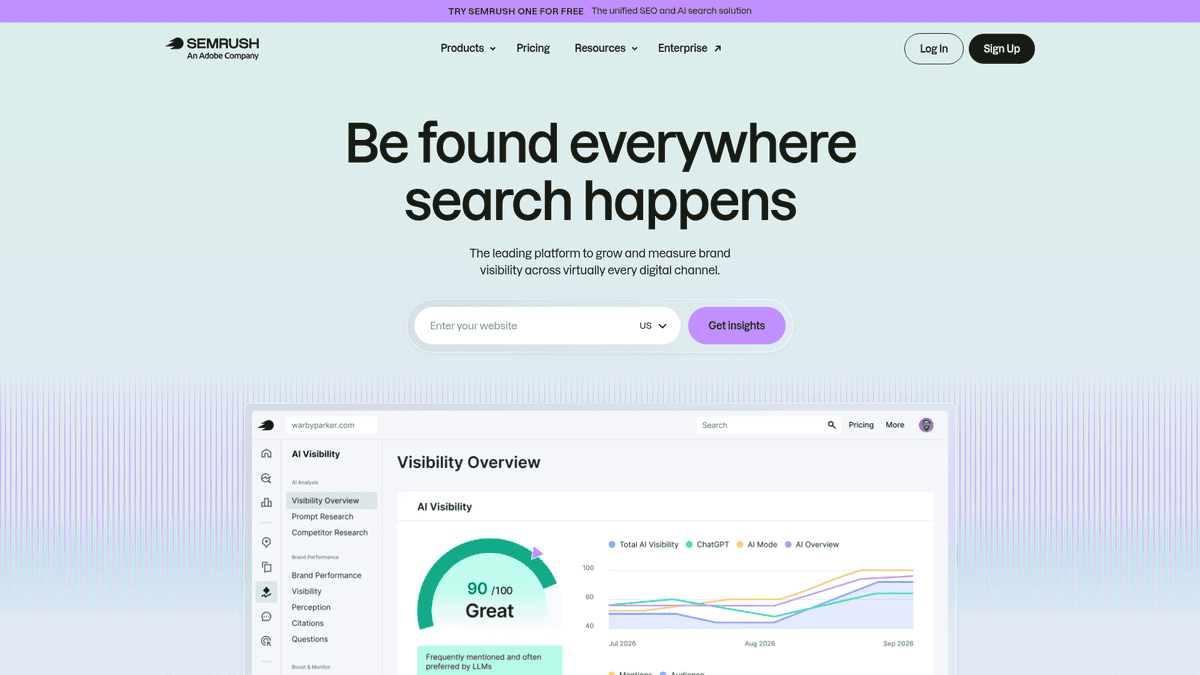
Semrush is still one of the most complete traditional SEO suites.
It’s strong in:
keyword research
site audits
backlink analysis
PPC overlap
competitor monitoring
The issue is workflow. It helps you understand the opportunity, but not finish the job. Most small teams still need writers, editors, designers, and manual publishing on top.
Best for: experienced marketing teams with capacity to execute.
Ahrefs - best for backlink research and content gap analysis

Ahrefs remains one of the strongest tools for:
backlink intelligence
keyword difficulty estimates
SERP analysis
competitor content gap work
If your strategy is driven by deep research, it’s excellent.
If your challenge is “we know what to do but we never ship enough content,” it won’t fix that on its own.
Best for: SEO specialists and agency teams.
Surfer SEO - best for on-page optimization guidance
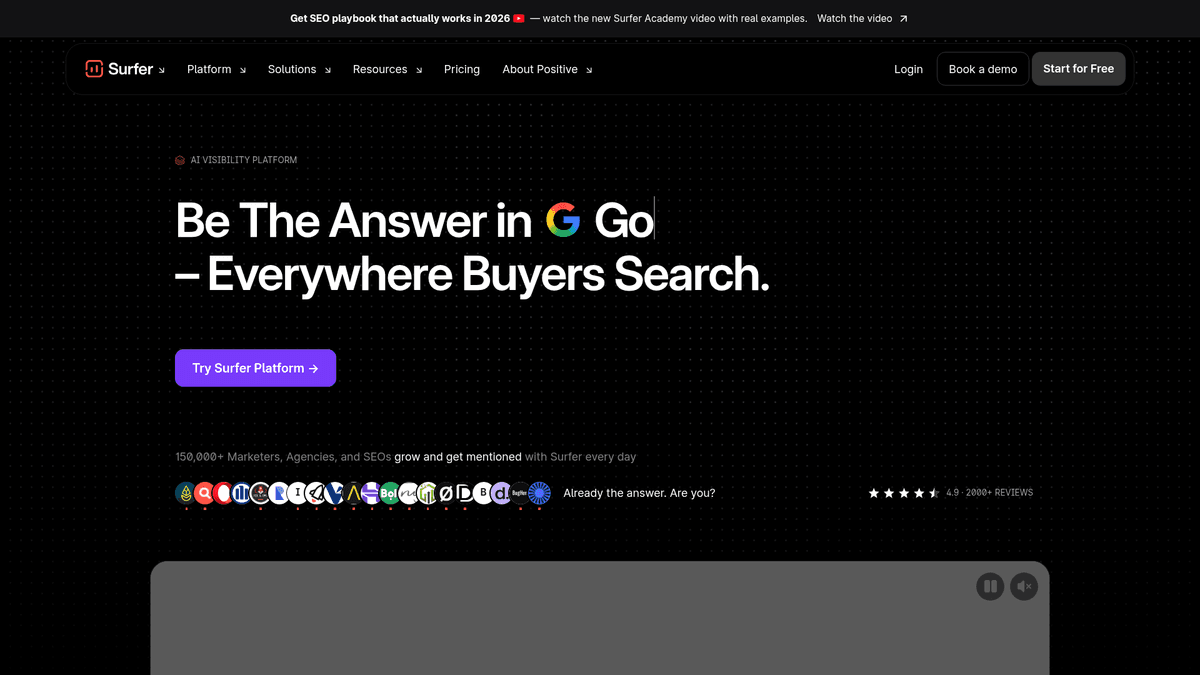
Surfer is a content optimization tool first.
It helps with:
article structure
term coverage
content scoring
SERP-informed suggestions
That’s useful when a human writer is already in place. Less useful when nobody on the team has time to write and publish regularly.
Best for: editorial teams that want optimization assistance, not full workflow automation.
seoClarity - best for enterprise SEO operations

seoClarity is powerful at scale.
It’s built for organizations that need:
deep reporting
enterprise crawling
large-site governance
cross-team SEO operations
But for founders and small teams, that power comes with overhead. It’s usually too expensive and too complex unless you already run a mature SEO function.
Best for: enterprise brands with dedicated SEO teams.
Gumloop - best for custom no-code workflow automation

Gumloop is not an SEO platform in the traditional sense. It’s a flexible automation builder.
You can use it to create workflows around:
scraping
AI analysis
routing
custom task automation
That flexibility is useful if you know exactly what you want to build. But it’s not the easiest answer for a founder who just wants content to appear on the blog every day.
Best for: technical operators and custom workflow builders.
Where RankSpot creates the biggest advantage
Many articles compare tools by counting features. That’s the wrong lens.
The better question is: what bottleneck disappears?
With RankSpot, the key bottlenecks that disappear are:
Writing bottleneck
You don’t need to stare at a blank page, brief freelancers, or rewrite AI drafts into something usable.
Research bottleneck
RankSpot identifies high-intent keywords, competitor opportunities, and relevant angles without forcing you through endless manual analysis.
For teams actively trying to “borrow” proven demand, competitor-led targeting is often the fastest route. This is where a process like finding competitor keywords becomes valuable, and RankSpot operationalizes that automatically.
Publishing bottleneck
This one is huge. Most teams can create some content. Very few can publish consistently. RankSpot pushes directly into your CMS, which is what turns strategy into compounding traffic.
AI visibility bottleneck
This is the next frontier. A lot of content gets indexed. Far less gets cited in AI answers.
RankSpot is designed around GEO as well as SEO, helping structure content for better discoverability in AI-generated recommendations.
Team bandwidth bottleneck
For small teams, every hour counts. Replacing multiple tools and manual steps with one automated workflow is often the difference between “we should do SEO” and “we are doing SEO every day.”
What most tools still get wrong about SEO automation
There are three common traps.
Trap 1: confusing data access with growth
Seeing more keyword charts does not produce traffic.
Growth comes from useful content shipped consistently against the right opportunities.
Trap 2: optimizing only for Google
Google still matters. A lot. But if your content never gets pulled into AI summaries, assistant recommendations, or cited answers, you’re missing emerging demand.
Trap 3: requiring too much supervision
If a platform needs constant prompting, hand-holding, and editing, it’s not true automation. It’s just a fancier drafting assistant.
The founder-friendly approach is much simpler: give the system your site, competitors, and CMS connection. Let it run.
What to choose based on your business type
If you’re a solo founder or indie hacker
You need speed, low setup friction, and minimal oversight.
Pick an end-to-end platform that publishes for you. You do not need more dashboards. You need consistent output.
If you run a small ecommerce brand
You need category-level and purchase-intent content, consistent publishing, and structured pages that can be understood by both search engines and AI systems.
Look for automation plus direct CMS integration.
If you’re a SaaS marketing team
You need pain-point content, comparison pages, competitor targeting, and educational content that can win both classic search and AI citations.
Choose a platform that can maintain content velocity without creating operational drag.
If you’re an agency
You need leverage. Manual SEO fulfillment crushes margins.
A platform that automates research, writing, visuals, formatting, and publishing can dramatically increase output per account.
Final verdict: the best SEO automation tool is the one that actually ships growth
In 2026, the category is crowded. But the decision is clearer than it looks.
If you want deep raw data, there are solid traditional platforms.
If you want help polishing content, there are strong optimization tools.
If you want custom automations, there are workflow builders.
But if you want a real seo automation tool that removes the manual grind and helps a lean team publish strategically, consistently, and at scale, the best fit is the platform that handles the full pipeline.
That’s why RankSpot stands out.
It doesn’t just help you “do SEO.” It helps you operate a repeatable search growth system:
research what matters
prioritize what can win
write high-quality long-form content
generate visuals
format for search and AI answers
publish directly
repeat daily
That is what compounds.
If you want the broad strategic backdrop behind this shift, explore more from RankSpot’s SEO playbooks for founders.
And if you want to test the workflow without friction, RankSpot gives you the easiest starting point: your first 3 articles free, no credit card required.
For founders and lean teams, that’s the real promise of modern seo automation software: less busywork, more published content, faster learning, and a better shot at owning both search results and AI recommendations.
FAQ
What is SEO automation?
SEO automation is the use of tools to handle repeatable SEO tasks across research, content creation, optimization, and publishing. For founders, that means spending less time on manual busywork and more time on strategy, product, and distribution.
Can you automate SEO completely?
You can automate a large part of execution, but not the whole game. Strategy, positioning, and final business judgment still need a human founder or operator to make sure the SEO work supports revenue, not just rankings.
Can I do SEO by myself with an automation tool?
Yes, especially if you’re a solo founder or running a lean team. The right automation tool can help you research keywords, draft content, optimize pages, and publish consistently without needing a full SEO department.
Will AI replace SEO in 2026?
AI is changing how people discover information, but it is not replacing search demand. Google is still important, and AI answer engines are becoming another channel, so the winning approach is to adapt your content and workflows for both.
What platform is best for SEO automation?
It depends on what you need most: data, optimization help, custom workflows, or end-to-end publishing. For founders who want execution instead of more dashboards, RankSpot is built to help turn SEO into shipped work that can actually drive growth.