SEO keyword research is where traffic growth starts.
Not content calendars.
Not AI writing prompts.
Not publishing more random blog posts.
If you want pages that rank, bring in qualified visitors, and create a real pipeline, you need to know what your market is searching for, why they are searching, and which terms are actually worth targeting.
That is the gap most founders run into.
You know SEO matters. But you do not have hours to spend inside spreadsheets, keyword tools, SERP comparisons, and content briefs. You do not want to burn budget on low-intent keywords or pay an agency to hand you a bloated plan that never gets published.
This guide fixes that.
You will learn how SEO keyword research works, how to evaluate terms, which tools matter, how to connect keyword discovery to rankings and traffic, and how to turn research into a publishing system that compounds over time.
What SEO Keyword Research Actually Means
SEO keyword research is the process of finding and evaluating the search terms your audience uses in Google and other discovery platforms.
That includes:
Broad terms
Long-tail phrases
Commercial searches
Comparison searches
Problem-aware searches
Question-based searches
Competitor brand searches
Topic clusters around one core page
A lot of beginner advice makes keyword research sound like “find high-volume terms and put them in an article.”
That is incomplete.
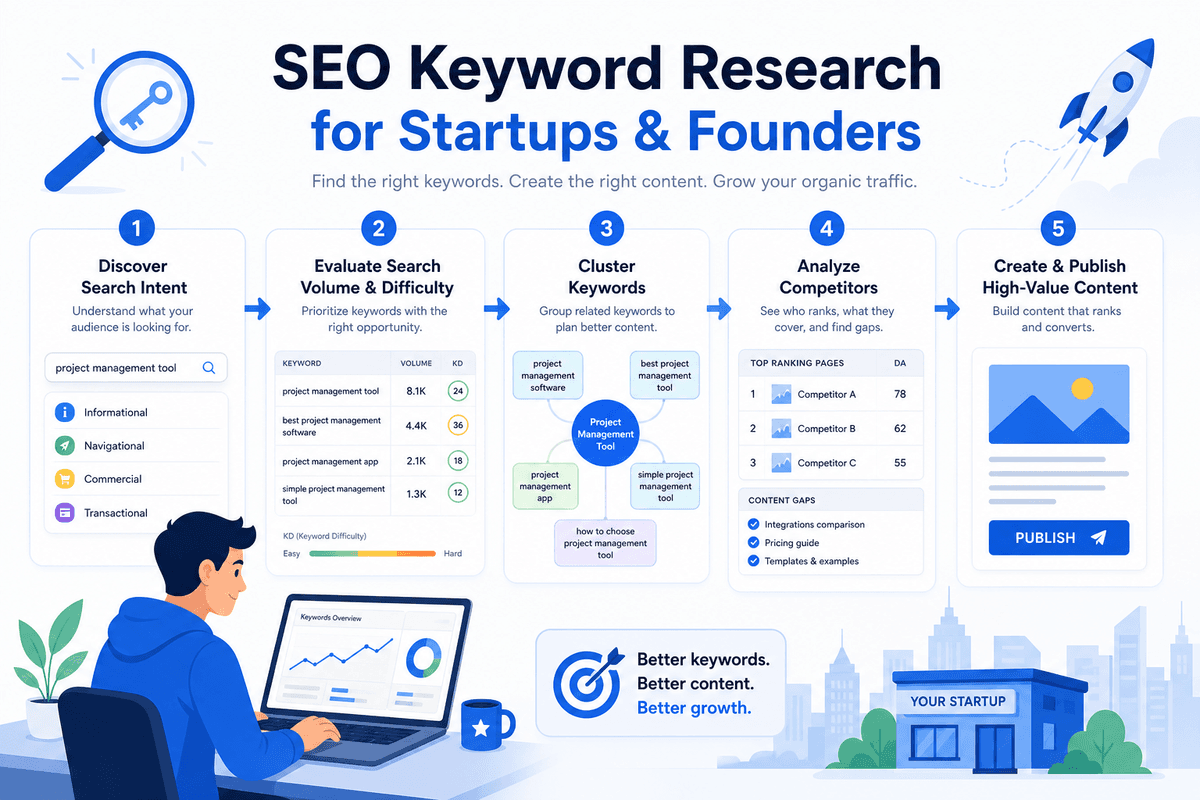
Real keyword research means answering five questions:
What are people searching for?
What intent sits behind that search?
How competitive is the term?
Is the keyword worth ranking for?
What kind of page should target it?
If you skip any of those, you create content that looks optimized but does not produce business results.
Why SEO Keyword Research Matters More Than Ever
Search is still one of the highest-leverage growth channels for startups, SaaS companies, and lean e-commerce teams.
But the game has changed.
Today, you are not only competing for blue links in Google. You are also competing for visibility in:
AI Overviews
Featured snippets
People Also Ask
Reddit and forum threads
ChatGPT, Claude, and Gemini citations
Comparison pages and review pages
Long-tail, intent-rich searches
That means keyword research is no longer just an SEO task. It is a demand discovery system.
"Companies that blog receive 55% more website visitors than those that don't." - Source
"Google processes approximately 16.4 billion searches per day." - Source
The opportunity is massive. But only if you target the right terms.
The Biggest Mistakes Founders Make With SEO Keywords
Most traffic problems are keyword problems in disguise.
Here are the common ones:
Going after vanity keywords too early
Founders often want to rank for broad head terms like:
project management software
CRM
accounting software
SEO tool
These terms are usually crowded, expensive, and dominated by established players.
Early-stage sites need winnable opportunities first.
Ignoring search intent
A keyword may look relevant, but if the SERP shows product pages and you publish a blog post, you probably will not rank.
Intent mismatch kills results.
Chasing volume over value
A term with 300 monthly searches and strong buying intent can outperform a 10,000-volume informational keyword that never converts.
Creating one-off content instead of clusters
Publishing isolated articles makes it harder to build topical authority.
Stopping at research
This is a huge one. Teams collect keywords and never turn them into published, optimized, interlinked content.
That is exactly where automation creates leverage.
How Google-Based Keyword Discovery Works
When people search in Google, they reveal demand.
Every query contains a clue:
a problem
a need
a comparison
a buying signal
a timing signal
a location signal
a level of awareness
Your job is to turn those clues into a strategy.
The main keyword sources
A practical SEO keyword search process usually pulls from these places:
Source | What it reveals | Best use |
|---|---|---|
Google autocomplete | Popular query variations | Seed keyword expansion |
People Also Ask | Question-based demand | FAQ angles, subheadings |
Related searches | Adjacent topic opportunities | Cluster building |
Competitor pages | Terms already driving traffic in your market | Fast opportunity discovery |
Keyword tools | Volume, difficulty, CPC, intent | Prioritization |
Search Console | Existing impressions and near-rank keywords | Quick-win optimization |
Reddit/forums | Real pain language from buyers | Content angles and GEO optimization |
Most competitor guides cover tools and metrics. Fewer explain how to connect Google-based keyword discovery to what your audience actually cares about. That is where stronger content plans come from.
The Core Keyword Metrics You Need to Understand
You do not need 25 metrics. You need the few that change decisions.
Search volume
This estimates how many times a keyword is searched each month.
Use it to understand demand, not as the only decision-maker.
Keyword difficulty
This estimates how hard it will be to rank.
Lower difficulty can mean faster wins, especially for newer domains.
Search intent
This tells you what the user is trying to accomplish.
The four main buckets:
Intent Type | What the user wants | Example |
|---|---|---|
Informational | Learn something | what is seo keyword research |
Navigational | Reach a specific website or brand | semrush keyword tool |
Commercial | Compare options before buying | best seo keyword research tool |
Transactional | Take action now | buy keyword research software |
CPC
Cost per click is a paid-search metric, but it is useful in SEO too.
High CPC often signals commercial value.
Trend
Some keywords are seasonal. Others are rising. Some are fading.
Trend data helps you avoid building content around shrinking demand.
How to Judge Whether a Keyword Is Worth Targeting
This is where smart operators separate from busy operators.
A good keyword is not just “easy.”
It should be a fit across five dimensions:
Criterion | What to ask |
|---|---|
Relevance | Does this topic connect directly to your product or audience pain? |
Intent | Can you satisfy the user with the type of page you plan to create? |
Attainability | Can your site realistically compete on this term? |
Business value | Could this keyword influence trials, demos, leads, or sales? |
Expansion potential | Can it become part of a larger topic cluster? |
A keyword with moderate volume, low difficulty, and strong product relevance usually beats a high-volume vanity term.
Short-Tail vs Long-Tail SEO Keywords
One of the biggest content gaps in many keyword guides is practical prioritization.
Here is the simple version:
Short-tail keywords
These are broad, high-volume terms.
Examples:
seo tool
email marketing
running shoes
Pros:
Big traffic potential
Cons:Very competitive
Often vague intent
Harder to convert
Long-tail keywords
These are more specific phrases.
Examples:
best seo keyword research tool for startups
how to find low competition keywords for saas
seo keyword research google search console workflow
Pros:
Clearer intent
Easier to rank
Better conversion potential
Cons:
Lower individual volume
For most early-stage companies, long-tail keywords are the fastest route to traction.
Search Intent: The Metric That Decides Rankings
If there is one thing to get right, it is this.
Google ranks pages that best match the likely goal of the searcher.
So before targeting any keyword, search it manually and review the results.
Ask:
Are the top results blog posts, landing pages, or category pages?
Are they beginner guides or advanced comparisons?
Is Google showing videos, snippets, forums, tools, or product pages?
Is the user likely researching, comparing, or buying?
Example of intent mismatch
If the keyword is “seo keyword research tool” and the SERP is full of tool pages and software comparisons, a generic educational post may struggle.
You might need:
a comparison article
a product-led landing page
a use-case page
a tool page with embedded functionality
This is why keyword research should always be paired with SERP analysis.
A Simple SEO Keyword Research Process That Actually Works
Here is a practical workflow for founders and lean teams.
1. Start with seed topics
List your core business themes.
For RankSpot, for example, those might include:
SEO automation
AI content generation
keyword research
content planning
blog publishing
competitor keyword analysis
GEO / AI answer optimization
2. Expand into keyword variations
Use Google autocomplete, related searches, and a SEO keyword research tool to generate variants.
Look for:
questions
modifiers
comparisons
alternatives
use cases
audience-specific versions
3. Analyze intent and SERP format
Manually inspect the results page.
4. Score opportunities
Rate keywords by:
relevance
business value
difficulty
volume
speed to rank
5. Group keywords into clusters
Do not create one page per tiny variation.
Group close variants that can be satisfied by the same page.
6. Map clusters to page types
Page Type | Best keyword fit |
|---|---|
Blog post | Informational and early commercial keywords |
Product page | Transactional terms |
Comparison page | Alternative and versus keywords |
Landing page | High-intent feature keywords |
Resource hub | Broad topical clusters |
7. Publish consistently
This is where most teams fail.
Research only compounds when it turns into content.
That is why platforms like RankSpot matter: they turn keyword opportunity into an actual publishing engine, not another backlog.
The Best Places to Find SEO Keywords
Google autocomplete and related searches
Free and fast. Great for discovering how real searches are phrased.
Google Search Console
Perfect for finding terms where you already have impressions but not strong rankings.
These are often your quickest wins.
Competitor analysis
One of the highest-leverage moves.
If a competitor is already ranking for high-intent terms in your niche, that is a market signal. You do not need to guess demand.
You need to identify what is already working and build a better page.
Forums and Reddit
This is the hidden advantage many keyword guides ignore.
Forum threads reveal:
exact language customers use
objections and frustrations
unanswered questions
problem framing before people search in Google
RankSpot bakes this into the workflow by surfacing Reddit and forum opportunities, helping brands spot real conversations that can turn into both content ideas and direct demand capture.
Popular SEO Keyword Research Tools Compared
You do not need every tool. You need enough data to make confident decisions.
Semrush
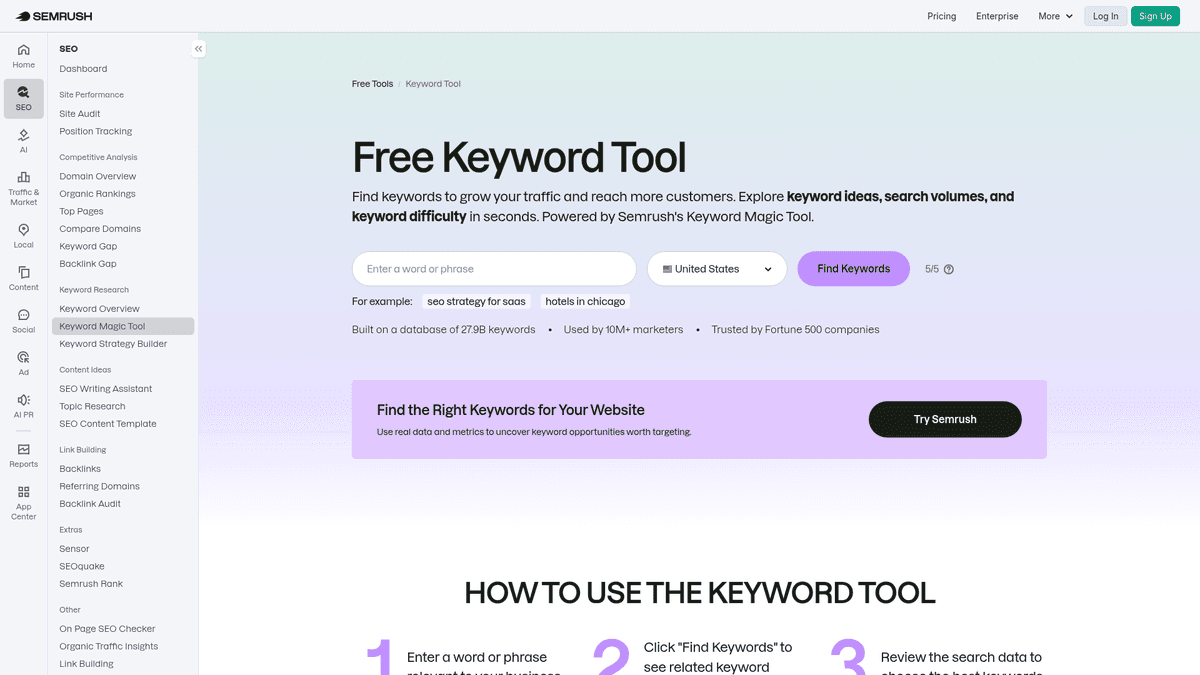
Strong for:
huge keyword databases
volume and difficulty data
competitor analysis
keyword clustering and filtering
Best for teams that want depth.
WordStream
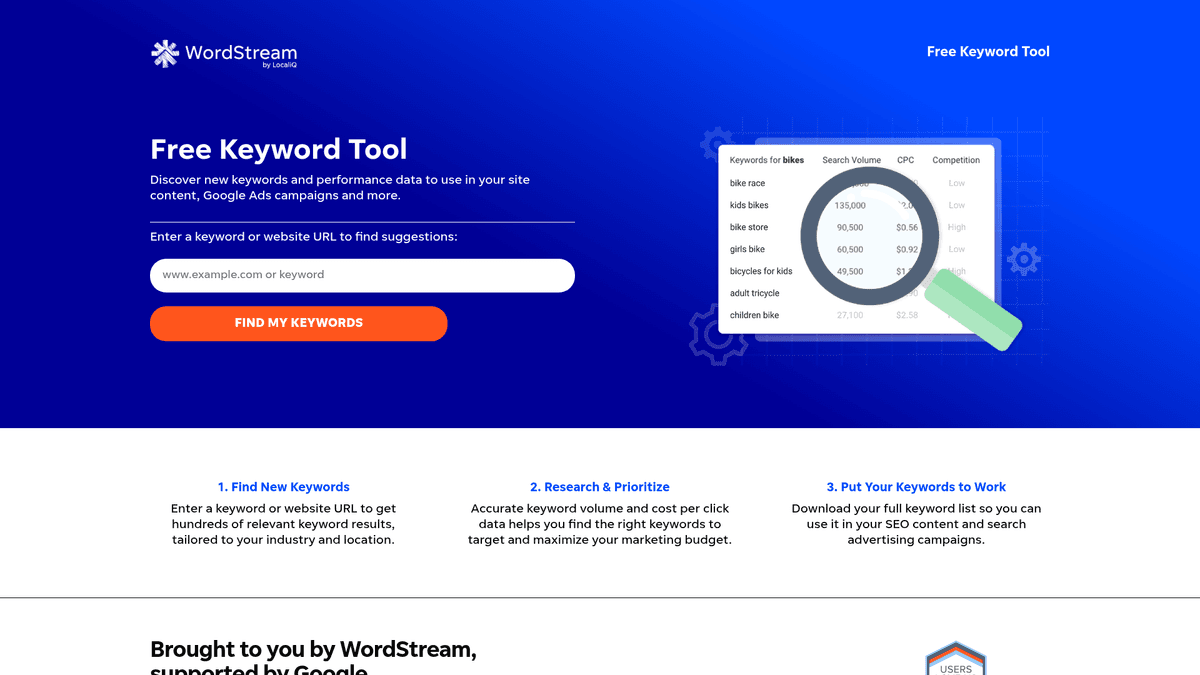
Strong for:
accessible free keyword discovery
CPC and PPC-oriented insights
quick idea generation
Best for marketers who want lightweight research and paid-search crossover.
Wordtracker
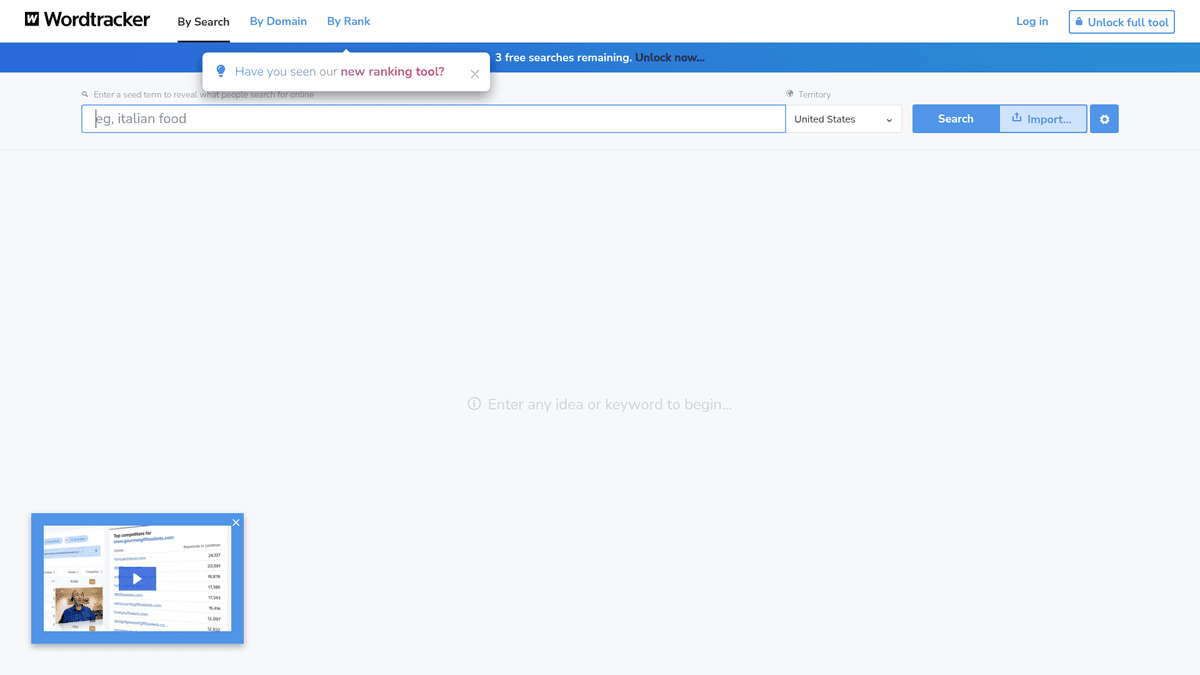
Strong for:
related keywords
SEO competition metrics
competitor keyword discovery
Best for users who want straightforward keyword and domain research.
So which tool should you choose?
Here is the honest answer:
Need | Best fit |
|---|---|
Free and simple discovery | WordStream |
Deep keyword database and SERP analysis | Semrush |
Direct keyword and competitor exploration | Wordtracker |
End-to-end execution from research to publishing | RankSpot |
The missing piece in most tools is execution.
They help you find keywords.
They do not consistently turn them into optimized, published content.
That is the difference.
What Competitor Articles Usually Miss
After reviewing the typical keyword tool and keyword research content in this space, most articles cover the basics well:
what keywords are
why they matter
core metrics
how to use a tool
But they usually miss the parts founders care about most:
They do not connect research to publishing velocity
A list of keywords is not growth.
A system that turns research into live articles every week is growth.
They underplay competitor copying as a strategy
Not blindly copying wording.
Copying what is already proven to attract traffic in your market.
This is one of the fastest ways to reduce risk.
They rarely talk about AI answer engines
Modern keyword strategy is not only about ranking in Google. It is also about being cited by ChatGPT, Claude, and Gemini.
That changes how you structure content:
clearer headings
factual completeness
stronger entity coverage
concise definitions
direct answers
better formatting
They ignore operational constraints
Founders do not need more manual work.
They need fewer moving parts.
That is why an automated system matters more than a bigger keyword export.
How SEO Keyword Research Connects to Rankings
A lot of people ask about SEO keyword rankings as if rankings are separate from keyword selection.
They are not.
Rankings are the downstream result of making the right calls upstream.
Rankings improve when:
you target terms your site can realistically compete for
the page format matches intent
the topic is covered comprehensively
the content is internally linked
the article is well structured
the site publishes consistently in a topic area
the page actually deserves to rank better than what is already there
Keyword research affects every one of those.
Bad keyword selection leads to slow rankings, weak traffic, and low conversions.
Good keyword selection creates momentum.
How to Turn Keyword Research Into a Content Plan
A winning keyword strategy should end in a calendar, not a spreadsheet.
Here is a simple model:
Tier 1: Quick wins
Low-difficulty, high-relevance, long-tail keywords.
Goal: get early rankings and traffic.
Tier 2: Commercial intent pages
Keywords tied to product evaluation and buying behavior.
Goal: drive trials, demos, and revenue.
Tier 3: Authority clusters
Broader educational topics supported by multiple sub-articles.
Goal: build topical authority and internal link depth.
Tier 4: Competitor and alternative pages
Keywords around competitor names, comparisons, and alternatives.
Goal: capture solution-aware traffic.
This is where RankSpot is built to save teams serious time.
Instead of manually researching, organizing, drafting, formatting, and uploading, RankSpot handles the workflow end to end:
learns your niche from your website
identifies high-intent and competitor keywords
builds a strategic 30-day content plan
writes long-form SEO/GEO-optimized content
generates unique on-brand images
formats posts with SEO best practices
publishes directly to your CMS
That is not a keyword tool.
That is a growth system.
SEO Keyword Help for Founders With Limited Time
If you are a founder, indie hacker, or small team, this is the practical approach:
Focus on commercial adjacency
Target keywords one or two steps away from your product, not ten.
Prefer relevance over raw volume
The right 300 searches beat the wrong 3,000.
Build clusters, not isolated posts
Each article should strengthen another page.
Use competitor data aggressively
If another company is ranking for a term you could win, that belongs on your list.
Publish more consistently than bigger competitors expect
This is where small teams can win.
Large companies often move slowly.
A lean team with automation can out-publish and out-focus them in specific niches.
Manual SEO Keyword Research vs Automated SEO Content Systems
Factor | Manual Workflow | Automated with RankSpot |
|---|---|---|
Keyword discovery | Multiple tools and tabs | Built in |
Competitor keyword tracking | Manual exports | Built in |
Content planning | Spreadsheet-heavy | Automatic 30-day plan |
Writing | Time-intensive | Long-form drafts generated |
Formatting | Manual cleanup | Built-in structure and on-page SEO |
Images | Separate design workflow | Unique article images generated |
Publishing | Manual CMS upload | Direct CMS integrations |
AI answer optimization | Usually ignored | Built for GEO visibility |
Time required | High | Saves 40+ hours/month |
This is the real business case.
Not just “faster writing.”
Fewer tools.
Less context switching.
More published content.
Better consistency.
More chances to rank and get cited.
How to Use SEO Keywords on the Page
Finding keywords is step one. Placement still matters.
Put your primary keyword in:
title
intro
H2 or H3 where natural
URL slug
meta title and description
image alt text when relevant
Use supporting terms in:
subheadings
body copy
comparison tables
definitions
examples
internal anchor text
Do not stuff exact matches everywhere.
Google is good at understanding variations and entities. Write naturally, but cover the topic fully.
The New Layer: GEO and AI Search Optimization
This is where modern content strategy moves ahead of old-school SEO guides.
If you want your brand surfaced in AI-generated answers, your content needs to be:
structured clearly
easy to extract
factually dense
directly useful
topically comprehensive
aligned with real search intent
This is often called GEO: generative engine optimization.
It is not separate from SEO. It builds on it.
RankSpot is designed for this new reality by optimizing content for both:
traditional search engines
AI answer engines like ChatGPT, Claude, and Gemini
That matters because tomorrow’s discovery is not just “10 blue links.” It is recommendations, summaries, and citations.
A Practical Keyword Example
Let’s say you run an SEO automation SaaS.
A weak keyword target might be:
content marketing
A better keyword set might be:
seo keyword research tool for startups
automated blog publishing for saas
competitor keyword tracking software
ai seo content platform
how to find low competition keywords for b2b saas
Why these work better:
clearer intent
tighter audience fit
easier to map to product value
stronger conversion potential
That is the core principle: choose terms that connect traffic to outcomes.
Final Verdict: Keyword Research Is Only Valuable If It Leads to Published, Rankable Content
SEO keyword research is the foundation.
It tells you:
what demand exists
what your buyers care about
where competitors are already winning
what content should be created next
But research alone does not drive traffic.
Execution does.
If you are still doing keyword research manually, writing briefs by hand, jumping between tools, and struggling to publish consistently, you are creating friction where growth should compound.
RankSpot removes that friction.
It helps founders and lean teams go from research → plan → write → publish without the usual mess:
automated high-intent keyword discovery
competitor-based targeting
daily SEO-optimized publishing
GEO optimization for AI answers
direct CMS integrations
unique branded images
support for 100+ languages
first 3 articles free, no credit card required
If you want SEO keyword help that ends in actual traffic, rankings, and content velocity, not another unfinished spreadsheet, RankSpot is the smarter move.
Start with the first 3 articles free and turn your keyword research into a real growth engine.