You don’t have an SEO problem. You have a keyword selection problem.
Most founders type a few phrases into a keyword tool, pick the highest volume terms, publish content… and end up with:
More impressions
More “traffic”
Zero meaningful leads
Because “search keywords SEO” isn’t about finding more keywords. It’s about finding the right keywords - ones that match intent, have winnable SERPs, and map cleanly to revenue.
Embed this video and keep reading. If you follow the framework below, you’ll stop publishing “hope SEO” and start building compounding demand.
The 2026 reality: clicks are harder to win (so every keyword must earn its spot)
In 2026, you’re not just competing with 10 blue links. You’re competing with AI answers, Reddit threads, and comparison aggregators.
"When AI Overviews are present, organic CTRs have dropped by approximately 61%." - Search Engine Land
Translation: your content strategy can’t be “publish a lot and pray.” It has to be:
high-intent (commercial/transactional where it matters)
SERP-aware (what Google is actually ranking)
conversion-mapped (what page should rank for this query?)
The keyword framework: Intent → SERP reality → Business value → Feasibility
Here’s the exact flow we use at RankSpot to turn “search keywords SEO” into a practical operating system.
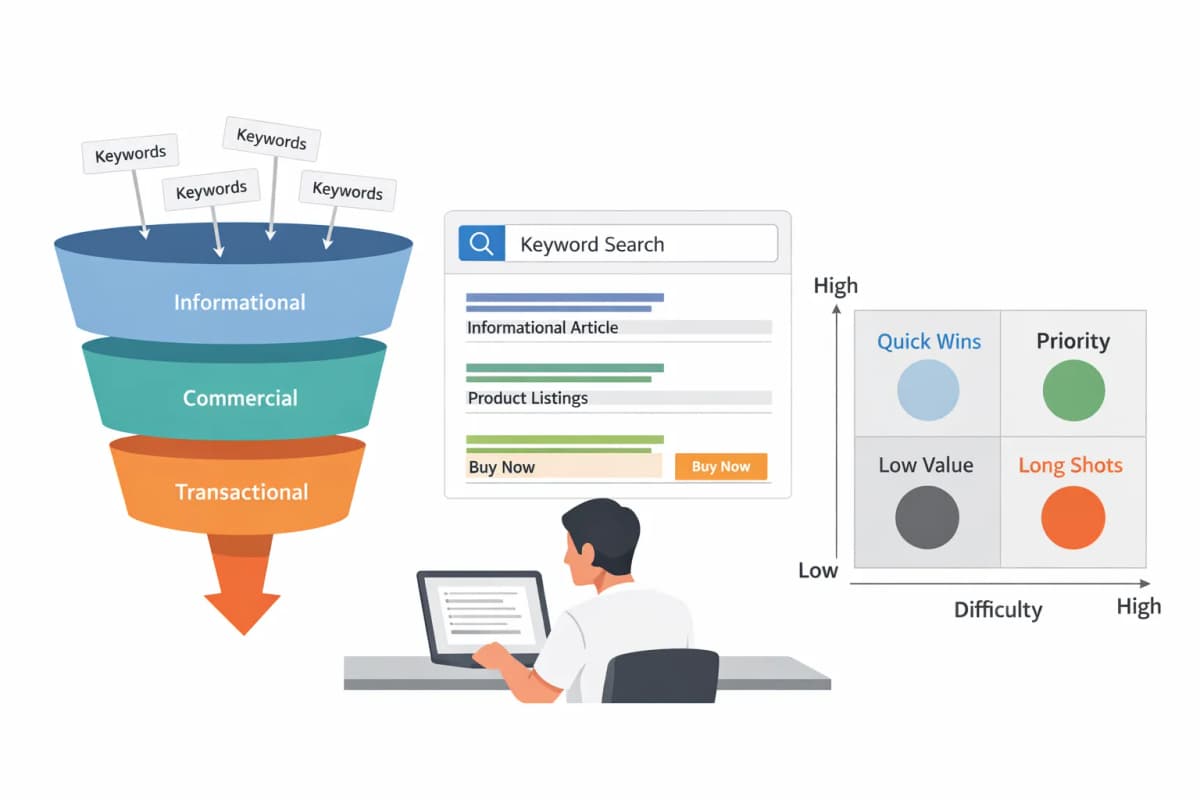
Step 1) Classify intent (this is the biggest lever)
Every keyword has an underlying job-to-be-done. That job tells you:
what type of page should rank
what CTA should appear
what “success” looks like (traffic vs demo vs signup)
Use this quick taxonomy:
Intent type | What the searcher wants | Keyword modifiers | Best content type |
|---|---|---|---|
Informational | Learn / understand | how to, what is, guide, tutorial | Blog post, glossary, playbook |
Navigational | Reach a specific site | login, pricing (brand), docs | Product/help pages |
Commercial | Compare options | best, vs, review, top, alternatives | Comparison pages, “best” lists, landing pages with proof |
Transactional | Take action now | pricing, buy, sign up, demo | Pricing, demo, product pages |
Founder rule: if you need pipeline in <90 days, overweight commercial + transactional keywords.
Step 2) Do a 2-minute SERP reality check (most people skip this)
Before you commit to a keyword, open an incognito window and look at the first page.
You’re answering two questions:
What format is Google rewarding?
listicles/comparisons → commercial intent
product pages/pricing → transactional intent
guides/PAA-heavy → informational intent
Who is ranking?
If it’s dominated by mega-sites (G2, HubSpot, Zapier), your fastest path may be a more specific angle.
Quick “winnability” checklist:
Are there smaller brands ranking in top 10? (good sign)
Are results outdated/thin? (content gap opportunity)
Is the SERP mixed? (you can win with a hybrid page: comparison + pricing section, etc.)
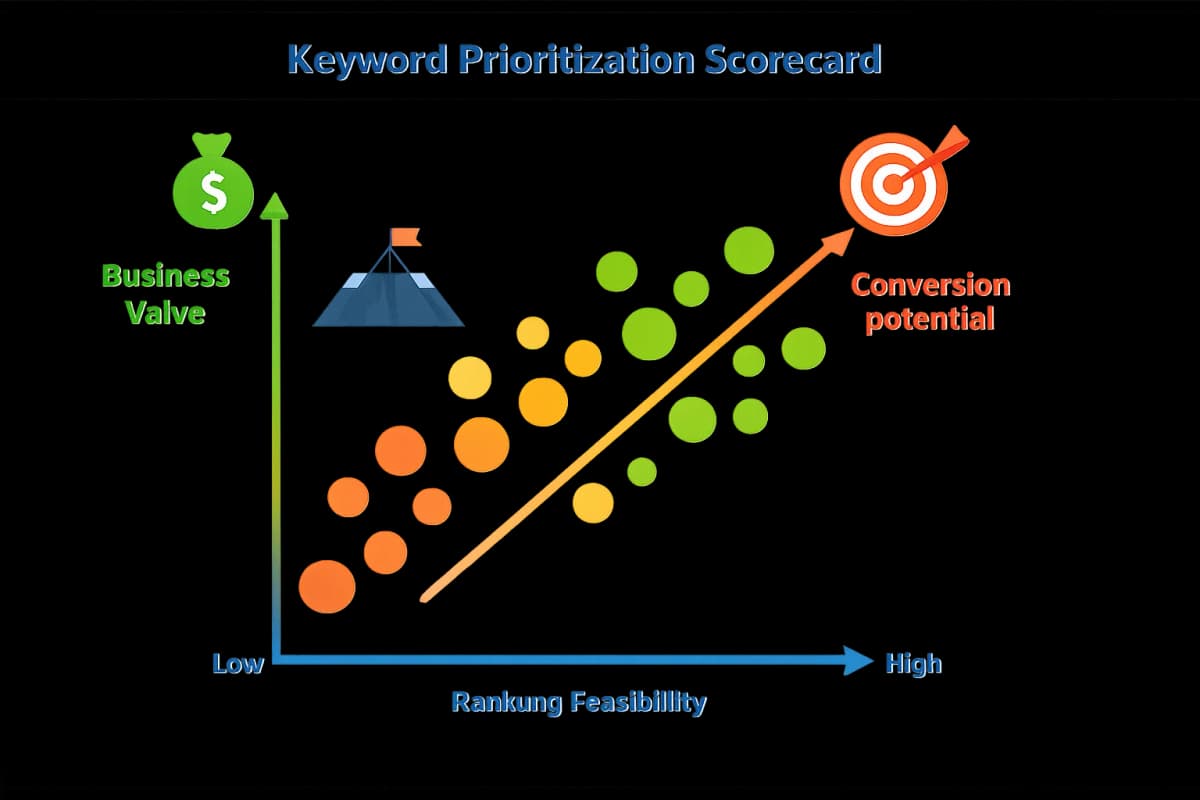
Step 3) Score keywords with a simple prioritization model (so you stop guessing)
You don’t need a complex spreadsheet. You need a consistent scoring method.
Use a 1–5 score for each dimension:
Business Value (BV): will this keyword produce the right type of visitor?
Conversion Potential (CP): can this visitor reasonably convert on the page?
Feasibility (F): can you rank with your current authority + effort?
Then compute:
Priority Score = (BV + CP) × F
Here’s a mini example:
Keyword | Intent | BV (1–5) | CP (1–5) | F (1–5) | Priority score |
|---|---|---|---|---|---|
“what is SEO” | Info | 2 | 1 | 1 | 3 |
“SEO automation tool” | Commercial | 4 | 4 | 3 | 24 |
“RankSpot pricing” | Transactional | 5 | 5 | 5 | 50 |
This is how you avoid wasting quarters on content that can’t pay you back.
How to find keyword ideas fast (without paying for 5 tools)
This is the repeatable “keyword discovery loop” that works for lean teams.
1) Google Autocomplete (high-signal, low-effort)
Type your seed term and note modifier patterns:
“best…”
“…for startups”
“…pricing”
“…alternatives”
“…vs…”
These modifiers often reveal commercial and transactional demand hiding under generic terms.
2) People Also Ask (free topic expansion)
PAA tells you what sub-questions Google thinks matter.
Use it to:
expand your outline
discover long-tail keywords
structure content for AI answers (clear Q→A sections)
3) Google Search Console (your lowest-hanging fruit)
If you already have some impressions, GSC is gold.
Look for queries where:
positions are 8–20 (you’re close)
impressions are high but CTR is low (title/description mismatch)
the page ranking is the wrong type (blog ranking for “pricing,” etc.)
4) Competitor pages (copy what works - but improve it)
Don’t “invent” demand. Steal it.
Find competitors ranking for terms you want, then extract:
headings (what they cover)
comparisons they include
proof assets (what you’re missing)
internal linking patterns
Content gap plays that consistently win:
pricing breakdowns (even if it’s “what to expect”)
decision frameworks (how to choose)
use-case mapping (who it’s for / not for)
implementation steps + time-to-value
5) Reddit & forums (demand discovery that keyword tools miss)
Founders buy what they complain about.
Search:
“tool + worth it”
“alternative to X”
“how do I… without…”
These threads give you:
exact language for titles and intros
objection handling
feature priorities people actually care about
At RankSpot, we surface these Reddit/forum conversation opportunities automatically so you can build content that matches real demand - not just keyword tool abstractions.
Turn keywords into topic clusters (so you don’t publish random posts)
Founders often publish isolated posts. Google rewards connected coverage.
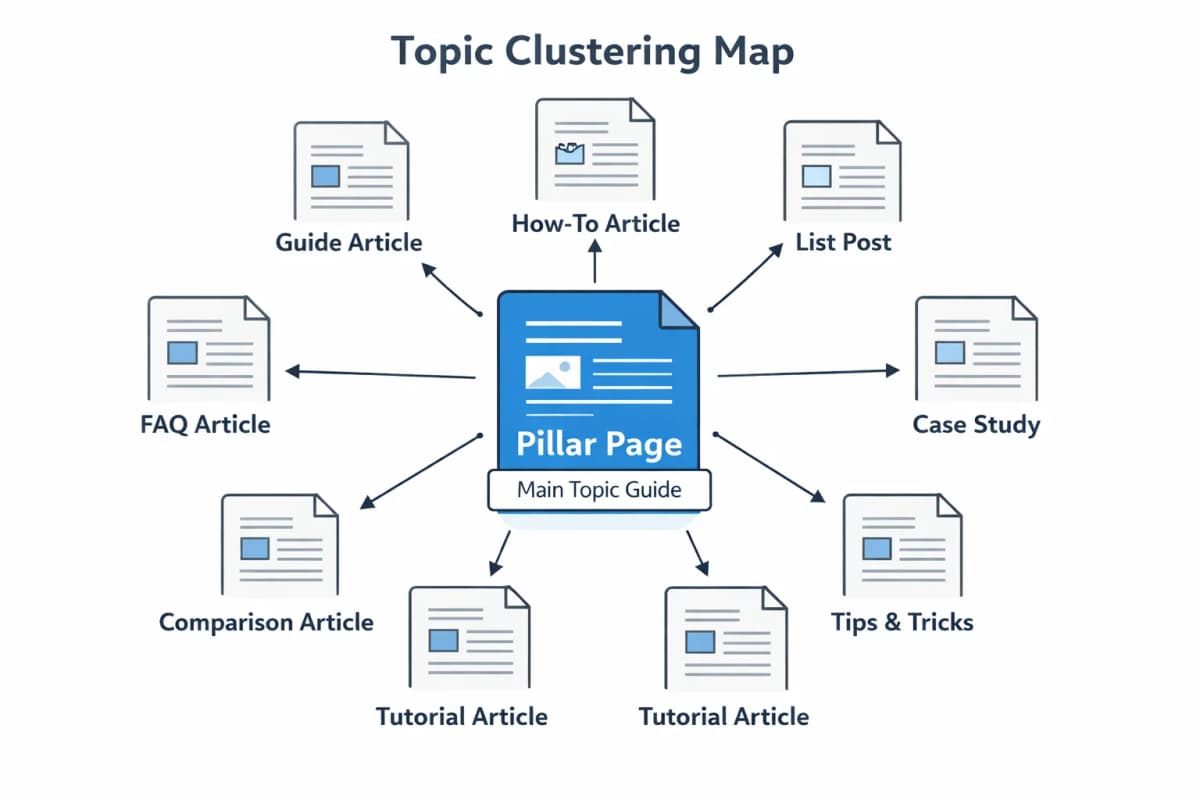
A cluster is simple:
1 pillar page (broad, authoritative)
6–12 supporting posts (long-tail, specific)
strong internal links between them
Practical cluster example (for “search keywords SEO”)
Pillar: Keyword Research for SEO (2026)
Cluster posts:
“High-intent keywords: how to identify buying intent”
“SERP analysis checklist (with examples)”
“Keyword difficulty vs feasibility: what to trust”
“How to build a content brief that ranks”
“Commercial vs informational SEO: when each matters”
“How to track keyword wins without vanity metrics”
Map intent to the right page type (this is where revenue shows up)
Most “keyword research” guides stop at ranking. But you’re here for outcomes.
Use this mapping:
Keyword intent | Page goal | Page type | What to include to convert |
|---|---|---|---|
Informational | Trust + capture demand | Blog/how-to | Clear next step, internal links to BOFU pages |
Commercial | Shortlist | Comparison/review | Alternatives table, proof, “who it’s for,” CTA to demo/trial |
Transactional | Action | Pricing/demo/signup | Objection handling, social proof, FAQs (on-page), fast UX |
And remember: buyers increasingly want to decide without talking to anyone.
"61% of B2B buyers prefer a buying experience without sales representative involvement." - Gartner
So your “transactional” pages can’t be thin. They need to do the selling.
The “search keywords SEO” checklist (copy/paste operating system)
Discovery (30–60 minutes)
Pick 3 seed problems your product solves
Pull 20 Autocomplete phrases per seed
Pull 15 PAA questions per seed
Export GSC queries (positions 8–20)
List 5 competitors and copy their best-performing pages/topics
Evaluation (60 minutes)
For each keyword:
classify intent
do a 2-minute SERP review
score with (BV + CP) × F
choose the correct page type (blog vs landing vs comparison)
Planning (30 minutes)
build 1 pillar + 6–12 cluster topics
add internal links intentionally (pillar ↔ cluster ↔ product)
assign CTAs based on intent
This is enough to generate a 30-day content plan that’s coherent and revenue-mapped.
How RankSpot turns this into daily growth (without hiring writers or agencies)
If you’re a founder or small team, the hard part isn’t knowing the framework.
It’s executing it every day:
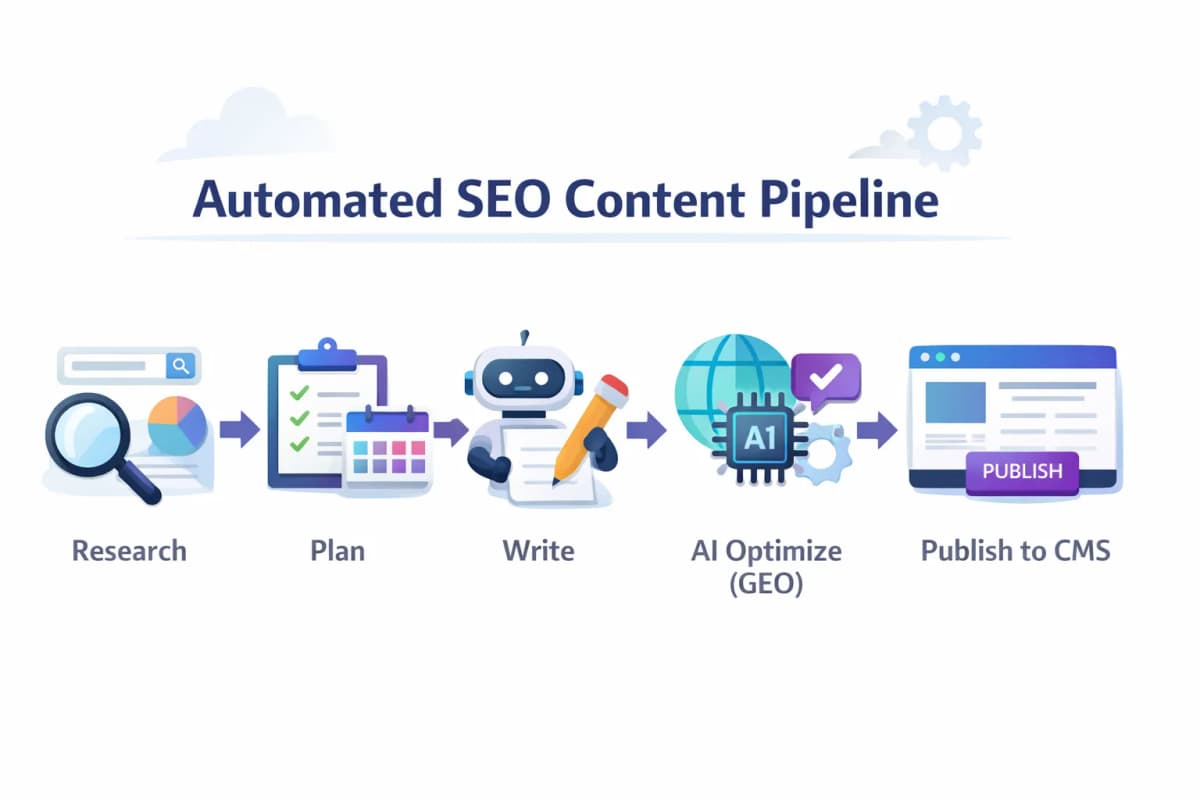
research
planning
writing
formatting
on-page SEO
image creation
publishing
updating as SERPs change
RankSpot is built to remove that entire workload.
What RankSpot automates end-to-end
High-intent keyword discovery + opportunity-based prioritization
Competitor keyword tracking (“copy what works” targeting, without guessing)
Daily SEO-optimized publishing (not “once a month content theater”)
GEO optimization so your content is structured to get cited in ChatGPT/Claude/Gemini
On-brand image generation per article
Built-in formatting + on-page SEO (headings, tables, internal links, quotes)
Direct CMS integrations (WordPress, Webflow, Wix, Shopify, Framer, Ghost, and more)
Replaces multiple tools (keyword research, writing, design, basic optimization)
Saves 40+ hours/month by removing manual research, writing, and publishing
Conclusion: stop collecting keywords - start building a keyword machine
“Search keywords SEO” isn’t about finding one magical term.
It’s about running a repeatable system that:
targets intent that can pay you back
matches what Google actually ranks
ships clusters, not random posts
converts with the right page type
publishes consistently enough to compound
If you want this done for you - research → plan → write → publish - RankSpot is the fastest way to turn SEO into a growth channel without hiring, agencies, or tool sprawl.
Try RankSpot free (first 3 articles free, no credit card) and see what daily, high-intent publishing feels like when you’re not the bottleneck.