.webp)

.webp)
Keyword Research SEO Strategies for 2026
Keyword research is not dead. Lazy keyword research is.
If you’re a founder, indie hacker, SaaS operator, or lean ecommerce team, you already know the problem. You should be doing SEO. You know content can compound. You know organic traffic is cheaper than paid in the long run. But the actual workflow is brutal: research, clustering, briefs, writing, images, formatting, publishing, internal links, updates.
That’s why most teams never get past a spreadsheet full of keywords.
In 2026, winning at keyword research SEO means more than finding phrases with search volume. You need to identify intent, evaluate business value, spot weak competitors, build topical authority, and optimize for both Google and AI answer engines like ChatGPT, Claude, and Gemini.
This guide breaks down exactly how to do that.
"As of early 2026, approximately 60% of Google searches in the U.S. conclude without a click to any external website." - Source
"As of 2026, organic search remains a dominant driver of website traffic, accounting for approximately 53.3% of all visits." - Source
That is the reality. Fewer clicks on low-value queries. Massive upside on the right ones.
The opportunity is still huge. But your keyword strategy has to be sharper.
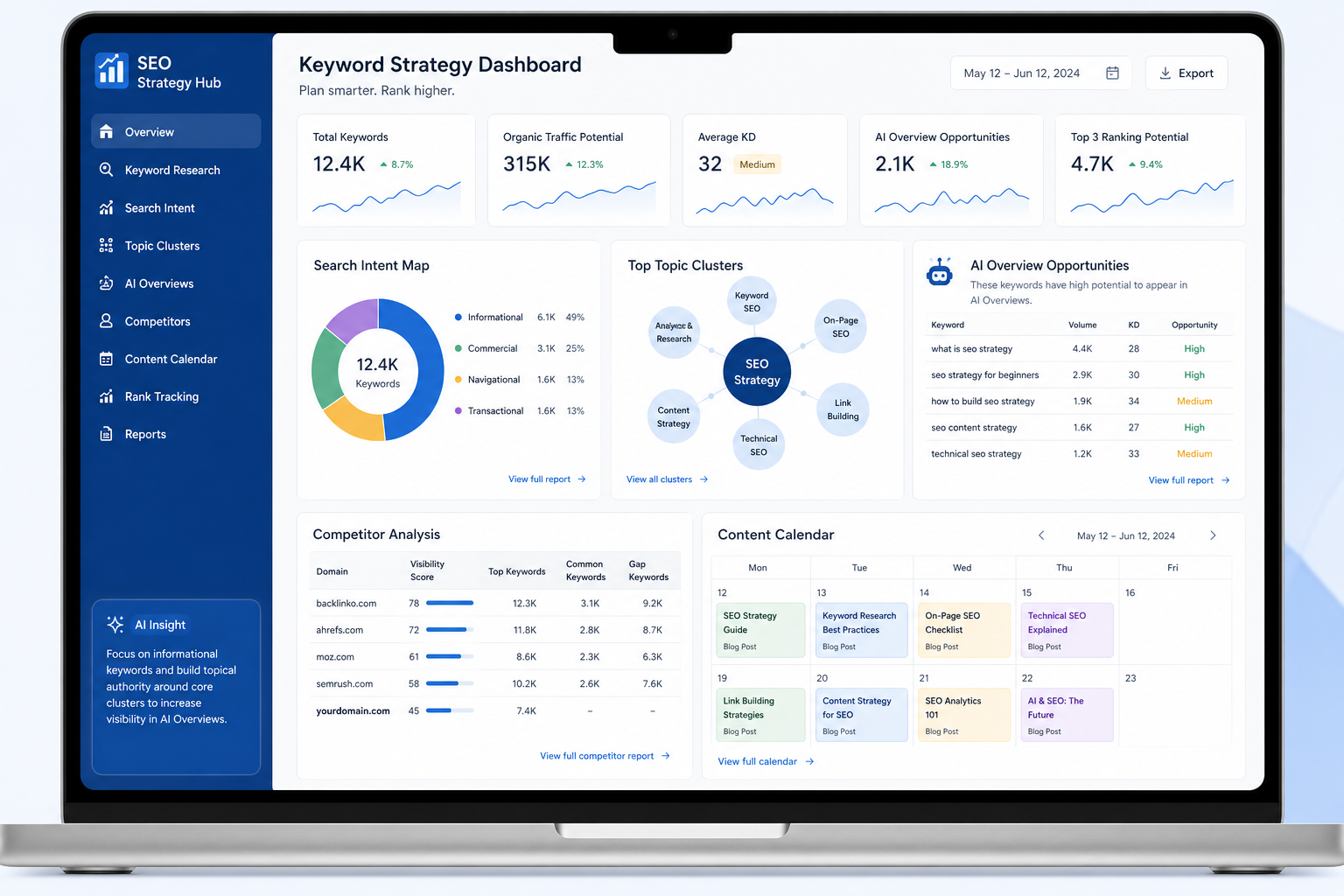
What keyword research means in 2026
Traditional keyword research asked:
What are people searching?
How many searches does it get?
How hard is it to rank?
That still matters. But it is not enough anymore.
Modern keyword research SEO asks:
What is the intent behind the query?
Is there commercial or transactional value?
Can this topic drive pipeline, signups, or sales?
Is Google likely to show AI Overviews?
Can our brand realistically become the cited source?
Can we build a full topic cluster around it?
Can we publish enough supporting content to win?
The shift is simple:
Research finds keywords. Strategy turns them into traffic and revenue.
Where competitor articles get it right - and where they stop short
The best-ranking competitor articles usually cover the basics well:
keyword types
search intent
short-tail vs long-tail
Semrush/Ahrefs workflows
competitor gap analysis
basic prioritization
That’s useful. But most of them stop at the tooling layer.
They rarely show you how to:
prioritize keywords by business value, not just volume
filter out zero-click dead ends
build a content engine that publishes consistently
optimize for AI citations, not just blue-link rankings
operationalize keyword research when you don’t have an SEO team
That’s the gap.
And that’s exactly where most founders lose momentum.
The biggest keyword research mistake founders make
They chase volume.
A keyword with 10,000 searches and vague intent looks exciting. But if it attracts the wrong audience, you get vanity traffic. No demos. No purchases. No qualified leads.
A keyword with 150 searches and clear buyer intent can be worth 100x more.
Here’s the better lens.
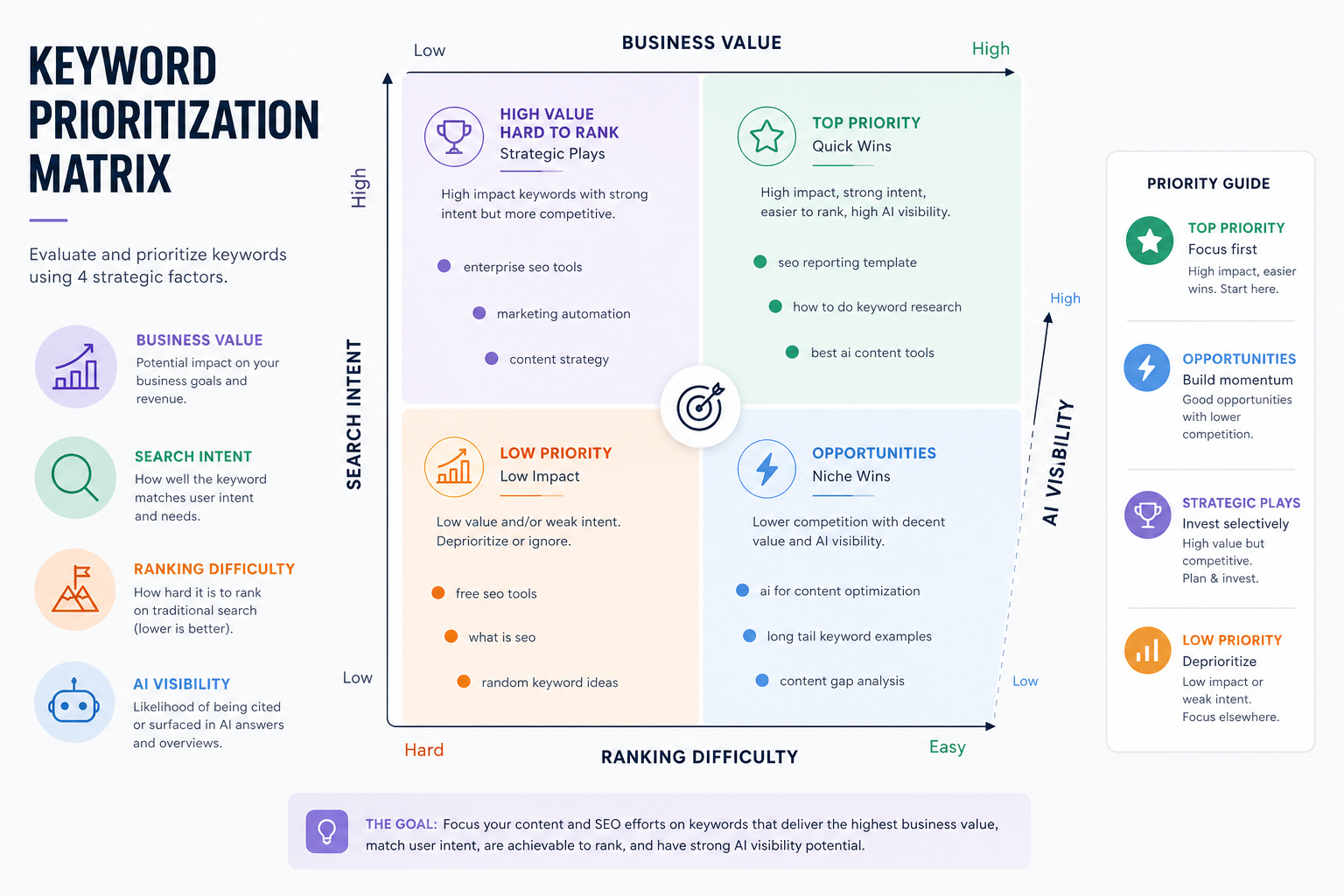
The 4 filters every keyword should pass
Before a keyword makes it into your content plan, run it through these four filters:
Filter | What to ask | Why it matters |
|---|---|---|
Intent | Does the searcher want to learn, compare, or buy? | Intent determines conversion potential |
Business fit | Does this topic connect to your product or service? | Traffic without relevance is wasted effort |
Rankability | Can your domain realistically compete? | Prevents wasting months on impossible targets |
AI visibility | Is this a query where AI may summarize and cite sources? | Helps you win visibility beyond standard SERPs |
If a keyword fails two or more of these, skip it.
Search intent matters more than search volume
There are four classic intent buckets:
Informational
The user wants an answer.
Examples:
what is keyword research
how to do keyword research
SEO strategy for startups
Commercial
The user is comparing solutions.
Examples:
best keyword research tools
Ahrefs alternatives
SEO content platform comparison
Transactional
The user is ready to act.
Examples:
buy SEO tool
SEO agency pricing
AI blog writer for SaaS
Navigational
The user wants a specific brand or website.
Examples:
RankSpot pricing
Semrush login
Ahrefs blog
If you’re a lean team, commercial and transactional terms usually deserve more attention than broad informational terms.
That doesn’t mean you ignore informational keywords. It means you use them strategically to support clusters and capture earlier-stage demand.
The best keyword opportunities in 2026
Not all keywords are equal anymore. Some are much more defensible and much more valuable.
1. High-intent long-tail keywords
These are still the fastest wins for smaller sites.
Examples:
keyword research for SaaS startups
SEO keyword strategy for ecommerce brands
how to find competitor keywords for Shopify
Why they work:
lower competition
clearer intent
stronger conversion potential
easier to align with a specific offer
2. Competitor-alternative keywords
These catch buyers already in-market.
Examples:
Semrush alternative
Ahrefs alternative for startups
Surfer SEO alternative for small business
These often convert because the searcher is actively evaluating options.
3. Problem-aware keywords
These hit pain before solution.
Examples:
no time for SEO content
how to publish blog content consistently
why my blog gets no organic traffic
This is where founder-focused content performs extremely well.
4. Workflow keywords
These connect directly to tools and automation.
Examples:
automated keyword research
AI SEO workflow
SEO content pipeline software
These are especially valuable for MarTech and AI SaaS brands.
5. Topic cluster support keywords
These are not always your biggest conversion pages. But they strengthen your authority.
Examples:
keyword clustering methods
how to map keywords to landing pages
topical authority for SEO
Keywords that are losing value
Some keywords are getting increasingly cannibalized by AI summaries and zero-click search results.
Usually:
simple definitions
one-line answers
generic facts
low-complexity educational queries
That doesn’t mean never target them. It means don’t build your entire strategy around them.
If a query can be answered instantly by Google or ChatGPT, you need one of two things to justify covering it:
it supports a bigger topic cluster
it gives you a path to a higher-intent next step
A practical keyword research process for lean teams
Here is a founder-friendly process that actually works.

Step 1: Start with your revenue categories
Do not start with random SEO ideas.
Start with the core themes tied to your business.
For RankSpot, that might include:
keyword research SEO
SEO automation
AI content generation
GEO optimization
competitor keyword tracking
blog publishing automation
programmatic content workflows
These become your seed topics.
Step 2: Expand into real search language
Now turn those into actual keyword variants using:
Google Search Console
Google autocomplete
People Also Ask
Reddit and forum threads
Semrush
Ahrefs
customer sales calls
support tickets
competitor page titles
This is where many teams miss demand hiding in plain sight.
People often search in simpler language than brands use internally.
They search:
“how do I automate SEO content” not
“end-to-end search content orchestration”
Step 3: Analyze the SERP, not just the metric
Never trust volume and difficulty alone.
Search the keyword and inspect:
What pages rank?
Are they giant domains?
Are they outdated?
Are they forum threads?
Are there weak listicles?
Is Google showing AI Overviews?
Are product pages ranking, or blog posts?
This tells you the real competition.
A keyword can have “medium” difficulty in a tool but still be highly winnable if the ranking pages are weak or mismatched to intent.
Step 4: Score each keyword against opportunity
Use a simple scoring model.
Factor | Score 1-5 |
|---|---|
Business relevance | 1-5 |
Search intent quality | 1-5 |
Ranking feasibility | 1-5 |
AI citation potential | 1-5 |
Content cluster potential | 1-5 |
Then total the score.
Keywords with strong business relevance and decent ranking feasibility usually beat keywords with huge volume and weak fit.
Step 5: Build clusters, not isolated posts
One article rarely wins a topic.
You need a pillar and supporting content.
Example cluster around keyword research SEO:
Pillar Topic | Supporting Articles |
|---|---|
Keyword Research SEO Strategies for 2026 | How to find high-intent keywords |
How to analyze competitor keywords | |
Keyword clustering for SEO | |
How to prioritize low-volume keywords | |
Keyword research for AI search and GEO | |
Common keyword cannibalization mistakes |
This is how authority compounds.
Step 6: Match content format to intent
Do not force every keyword into a blog post.
Different intent needs different page types.
Intent | Best content type |
|---|---|
Informational | educational blog post, guide, glossary |
Commercial | comparison page, alternatives page, listicle |
Transactional | landing page, product page, demo page |
Navigational | homepage, feature page, branded page |
If the SERP is filled with comparison pages, don’t try to rank a generic guide.
Step 7: Publish consistently enough to matter
This is where most keyword strategies die.
The research is fine. The execution fails.
Founders get stuck in:
manual briefs
inconsistent writing
design bottlenecks
formatting cleanup
delayed publishing
That is exactly why automation matters now.
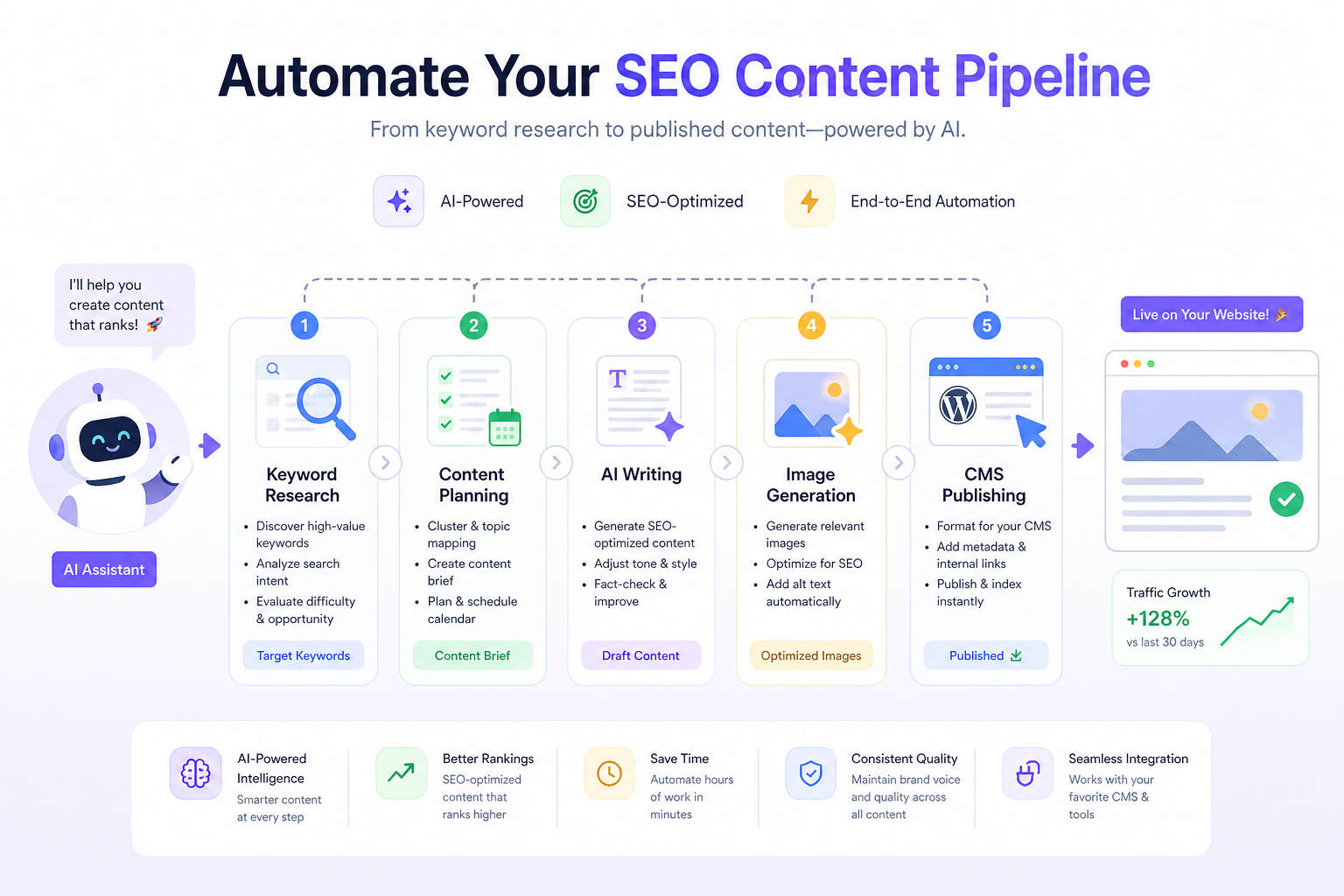
With RankSpot, you can go from website URL to a strategic 30-day SEO plan, discover high-intent and competitor keywords, generate long-form articles, create on-brand visuals, format posts correctly, and publish directly to WordPress, Webflow, Wix, Shopify, Framer, Ghost, and more.
That means the bottleneck disappears.
Instead of publishing “when there’s time,” you can publish daily.
And daily publishing changes the math.
How to evaluate keyword difficulty the smart way
Keyword difficulty tools are helpful. But they are directional, not absolute.
Use this three-part model instead.
Domain competition
Are you competing against huge sites with massive authority?
Content quality gap
Are the current top pages weak, thin, generic, or outdated?
Intent match
Do the current results actually satisfy the search?
Sometimes the top results are strong sites but poor matches. That opens the door.
Quick difficulty checklist
A keyword is usually more attractive if:
top results are old
top results are generic
some ranking pages are from forums or UGC
search intent is underserved
there are few product-led or experience-led pages
you can bring stronger examples, visuals, and structure
How to spot high-intent keywords faster
A few patterns reliably signal value.
Look for modifiers like:
best
vs
alternative
software
tool
platform
for startups
for ecommerce
pricing
services
agency
templates
examples
These often indicate comparison or purchase intent.
Examples:
best keyword research tool for startups
SEO automation software
competitor keyword research platform
AI SEO writer with WordPress integration
These are the keywords that can bring buyers, not just browsers.
Competitor keyword research: copy what works, skip what doesn’t
This is one of the fastest ways to compress time.
If a competitor is already winning with certain keywords, the market has validated them.
The goal is not to clone their site. The goal is to identify:
what they rank for
which pages drive likely traffic
where they have weak content
where they are missing important subtopics
which high-intent angles they’ve already proven
What to extract from competitors
Review competitor blogs and landing pages for:
recurring topics
ranking page titles
comparison pages
use case pages
integration pages
industry-specific pages
alternatives pages
Then ask:
Which keywords are driving likely pipeline?
Which pages are thin enough to beat?
Which adjacent topics have they ignored?
RankSpot makes this easier by learning your niche and competitors from your site, then surfacing opportunity-based keyword targets instead of dumping raw keyword lists on you.
That is the difference between software and strategy.
The missing channel most keyword guides ignore: Reddit and forums
Search demand does not start in Google.
It often starts in communities.
Founders ask questions on Reddit. Buyers compare tools in forums. Operators complain about pain points in threads. That language becomes tomorrow’s search queries.
This is a major content gap in most keyword research guides.
If you want better topics, mine:
Reddit
Quora
niche forums
Facebook groups
Slack communities
G2 reviews
support conversations
Look for:
repeated frustrations
exact wording
comparison requests
objections before purchase
feature gaps people care about
RankSpot surfaces Reddit and forum conversation opportunities automatically, which helps you discover demand before it gets saturated in traditional keyword tools.
That is a serious edge.
Keyword clustering: how to turn raw terms into a content system
Clusters are what transform scattered content into topical authority.
A simple clustering model
For each primary topic, organize keywords into:
Pillar keyword: the broad core topic
Supporting informational keywords: education and subtopics
Commercial keywords: comparisons and alternatives
Transactional keywords: solution-ready pages
Adjacent trust-building topics: methodology, case studies, examples
Example for an SEO automation company:
Cluster Type | Example Keyword |
|---|---|
Pillar | SEO automation |
Informational | how to automate SEO content |
Informational | SEO workflow for startups |
Commercial | best SEO automation tools |
Commercial | RankSpot vs Surfer |
Transactional | automated SEO content platform |
Trust-building | how daily publishing affects rankings |
This makes internal linking cleaner, publishing easier, and rankings stronger over time.
How to optimize for AI answers and GEO
This is the layer most 2026 keyword research content barely touches.
If you want visibility in AI-driven discovery, your content needs to be easy to extract, summarize, and cite.
What AI-friendly keyword targeting looks like
Choose topics where:
users ask nuanced questions
one-line answers are not enough
experience and examples matter
tools, frameworks, or comparisons help
recency matters
AI needs trusted external sources
Structure content so it can be cited
Use:
clear headings
concise definitions
step-by-step frameworks
comparison tables
examples
direct answers near the top of sections
consistent terminology
strong internal links
This improves traditional SEO and GEO at the same time.
RankSpot is built for this. It doesn’t just target search rankings. It creates content structured to be referenced by AI answer engines too, helping brands get cited in ChatGPT, Claude, and Gemini.
That matters more every quarter.
A modern keyword prioritization framework
Here is a better way to prioritize than “highest volume first.”
Tier 1: Fast wins
Low-to-medium competition. High relevance. Clear intent.
Tier 2: Strategic growth
Medium competition. Strong cluster potential. Good long-term value.
Tier 3: Authority plays
High competition. Broad category terms. Requires supporting content.
Example
Tier | Keyword Type | Priority Reason |
|---|---|---|
Tier 1 | competitor alternatives | strong buying intent |
Tier 1 | workflow pain-point keywords | direct fit for solution |
Tier 2 | category education keywords | build cluster depth |
Tier 2 | use-case keywords | attract qualified segments |
Tier 3 | broad head terms | long-term authority goal |
This lets you build momentum instead of waiting 12 months for one impossible keyword.
What a 30-day keyword content plan should look like
Most content plans are too vague.
A useful plan maps topics to outcomes.
Here’s a simplified example:
Week | Focus | Content Goal |
|---|---|---|
Week 1 | Pillar + 2 support posts | establish core topical relevance |
Week 2 | competitor + alternatives content | capture commercial demand |
Week 3 | workflow and pain-point posts | target founders with active problems |
Week 4 | integration + use case content | attract high-fit buyers |
This is where RankSpot saves serious time.
Instead of spending days building spreadsheets, briefs, outlines, and schedules, the platform generates a strategic 30-day plan automatically, then writes and publishes content from that roadmap.
That is how small teams compete with larger ones.
The hidden cost of manual keyword research
Founders often underestimate the operational drag.
Manual keyword research is not just “finding terms.”
It includes:
tool hopping
export cleanup
SERP checking
clustering
brief writing
writing
editing
image creation
formatting
publishing
internal linking
CMS QA
That easily burns 40+ hours per month.
And that is before consistency breaks.
RankSpot replaces much of that stack in one workflow:
keyword discovery
competitor tracking
article generation
on-brand images
SEO formatting
publishing integrations
GEO-friendly structure
In practical terms, that means fewer tools, less context switching, and much faster execution.
Common keyword research mistakes to avoid in 2026
Mistake 1: targeting keywords with no business fit
Traffic that never converts is expensive, even if it is “organic.”
Mistake 2: relying only on keyword difficulty scores
SERP reality matters more than any single metric.
Mistake 3: publishing one-off articles
Without clusters, your content rarely compounds.
Mistake 4: ignoring AI search behavior
If your content is not structured for extraction and citation, you miss a growing visibility layer.
Mistake 5: not tracking competitors
You do not need to reinvent demand. You need to identify where proven demand is under-served.
Mistake 6: failing to publish consistently
The best keyword plan in the world does nothing if it sits in Notion.
What a strong keyword research stack looks like now
You can still use a patchwork of tools. Many teams do.
But here’s what that often means:
Ahrefs or Semrush for keywords
Docs for briefs
Grammarly for editing
Canva for images
CMS manual uploads
spreadsheets for planning
separate tools for internal links and publishing
That stack works. It is also slow.
A platform like RankSpot compresses the workflow into one system:
finds keyword opportunities
tracks competitor topics
generates content plans
writes articles
creates unique images
formats content with best practices
publishes directly
supports 100+ languages for global SEO
For founders, that matters. Simplicity wins.
Final verdict
Keyword research in 2026 is no longer about building giant lists.
It is about finding the right opportunities:
high intent
strong business fit
realistic competition
topic cluster potential
AI citation upside
The brands that win will not be the ones with the fanciest spreadsheets.
They will be the ones that turn keyword insights into consistent publishing faster than everyone else.
That is the real advantage.
If you want to stop juggling research tools, writing drafts, image apps, formatting cleanup, and delayed publishing, RankSpot is the shortcut. It gives you an end-to-end SEO and GEO content pipeline built for founders and lean teams: research, plan, write, optimize, generate visuals, and publish - without the usual bottlenecks.
You can start with your first 3 articles free, no credit card required.
If you want compounding traffic without hiring an agency or burning your own time, that’s the smartest place to start.