.webp)

.webp)
AI Tools for SEO: Best Picks for Faster Growth
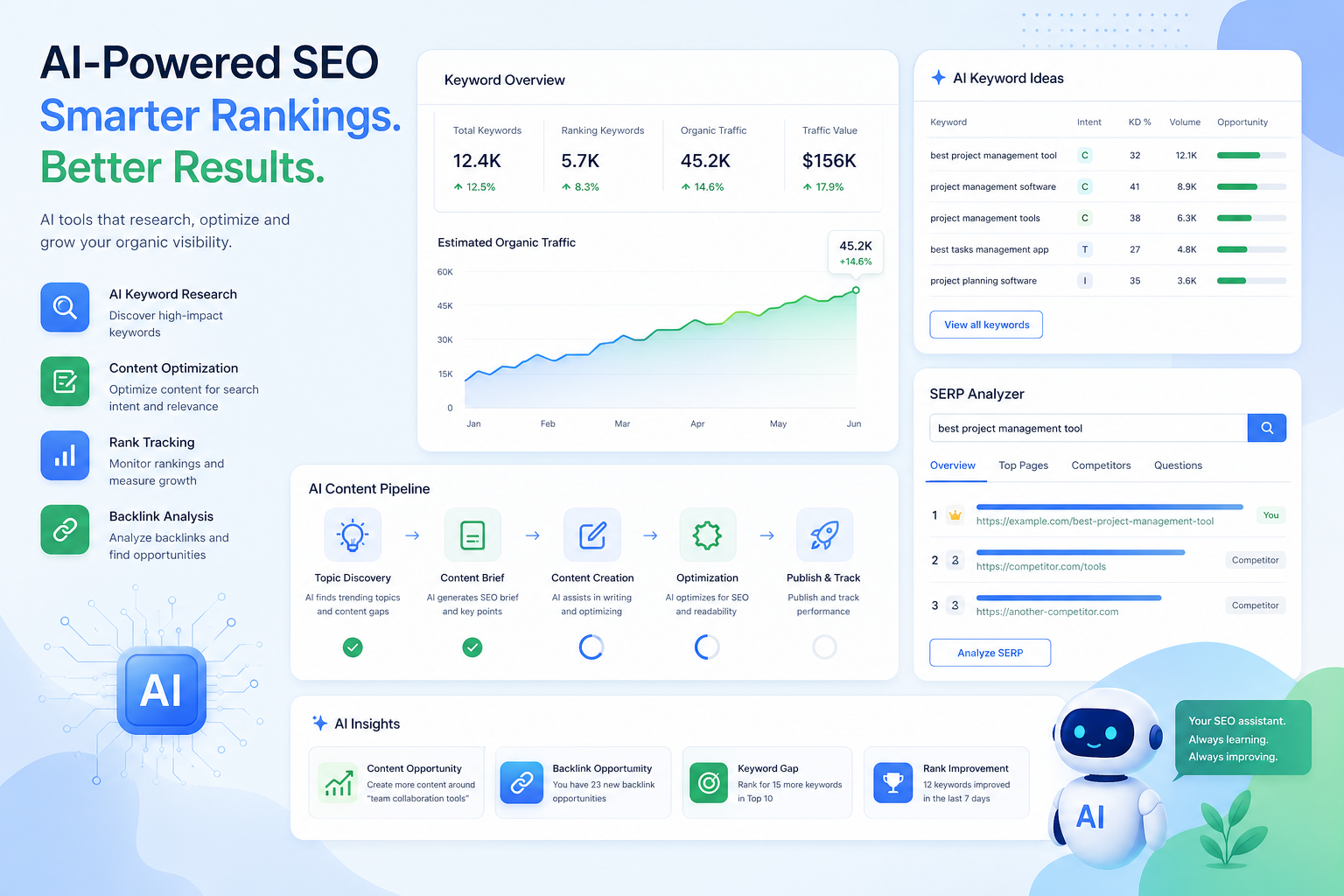
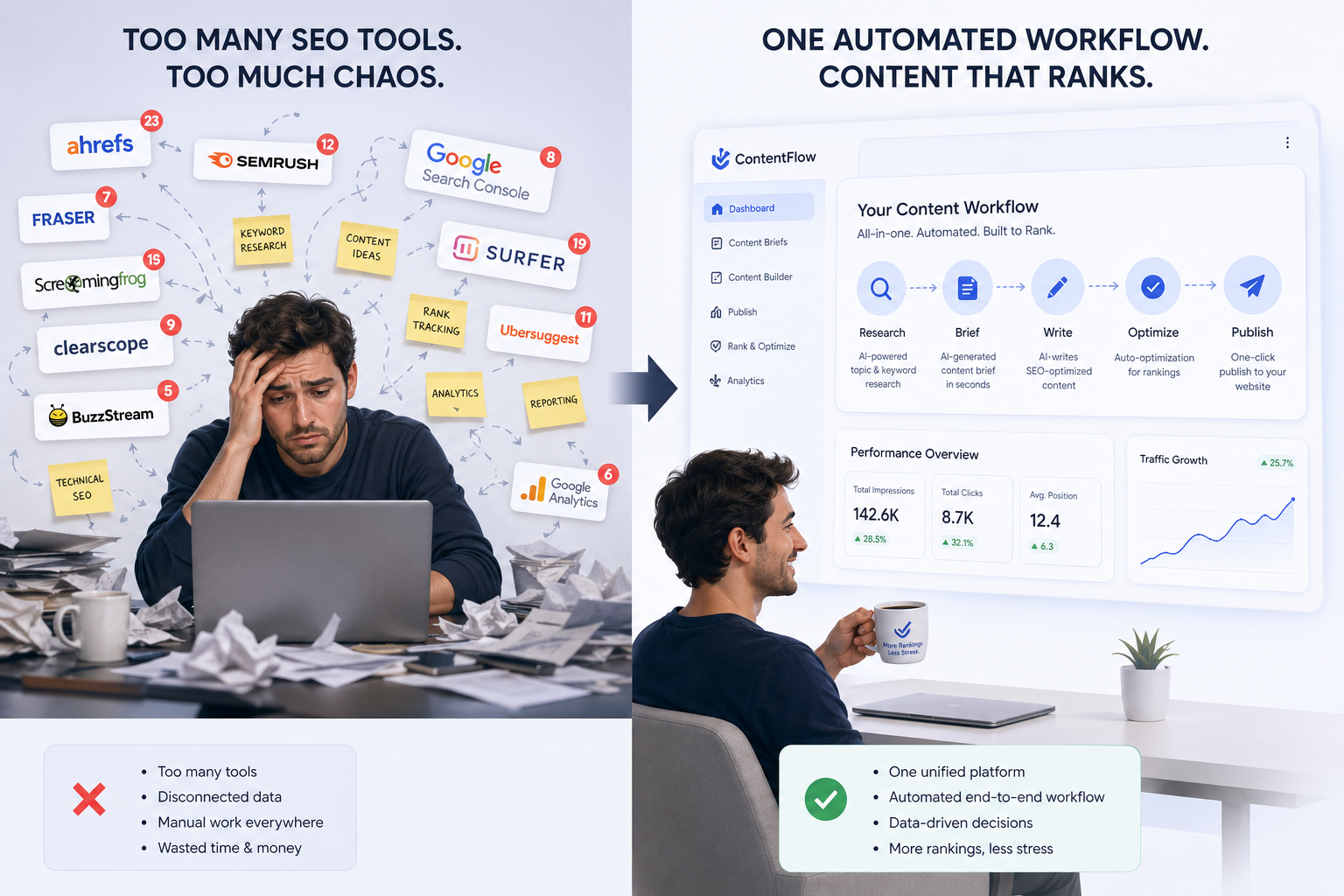
AI tools for SEO are everywhere. Most promise more traffic, faster content, and less manual work. Most also leave you stitching together five tools, three dashboards, and one messy workflow.
That is the real problem.
Founders, indie hackers, SaaS teams, and small store owners do not need more software. They need a stack that actually gets content researched, written, optimized, and published without eating the week.
This guide breaks down the best tools for SEO today, where AI tools in SEO actually help, where they waste time, and how to choose a setup that drives growth without overspending.
If you are comparing top tools for SEO, here is the short version:
Use AI for speed, prioritization, and consistency.
Do not use AI as a substitute for strategy.
If you want a full end-to-end system, the biggest win is consolidation.
If you are still manually researching, writing, editing, formatting, designing, and publishing every article, you are moving too slowly.
"As of 2026, 86% of SEO professionals and digital marketers in the U.S. have integrated AI tools like ChatGPT into their workflows." - eMarketer
"Companies that blog receive 55% more visitors and 97% more inbound links than those that don't." - Searchlab
What AI Tools in SEO Actually Do
The phrase "AI tools for SEO" gets used too loosely.
Some tools just add AI writing on top of old workflows. Others help with rankings, audits, or AI visibility. A few actually reduce the total amount of work.
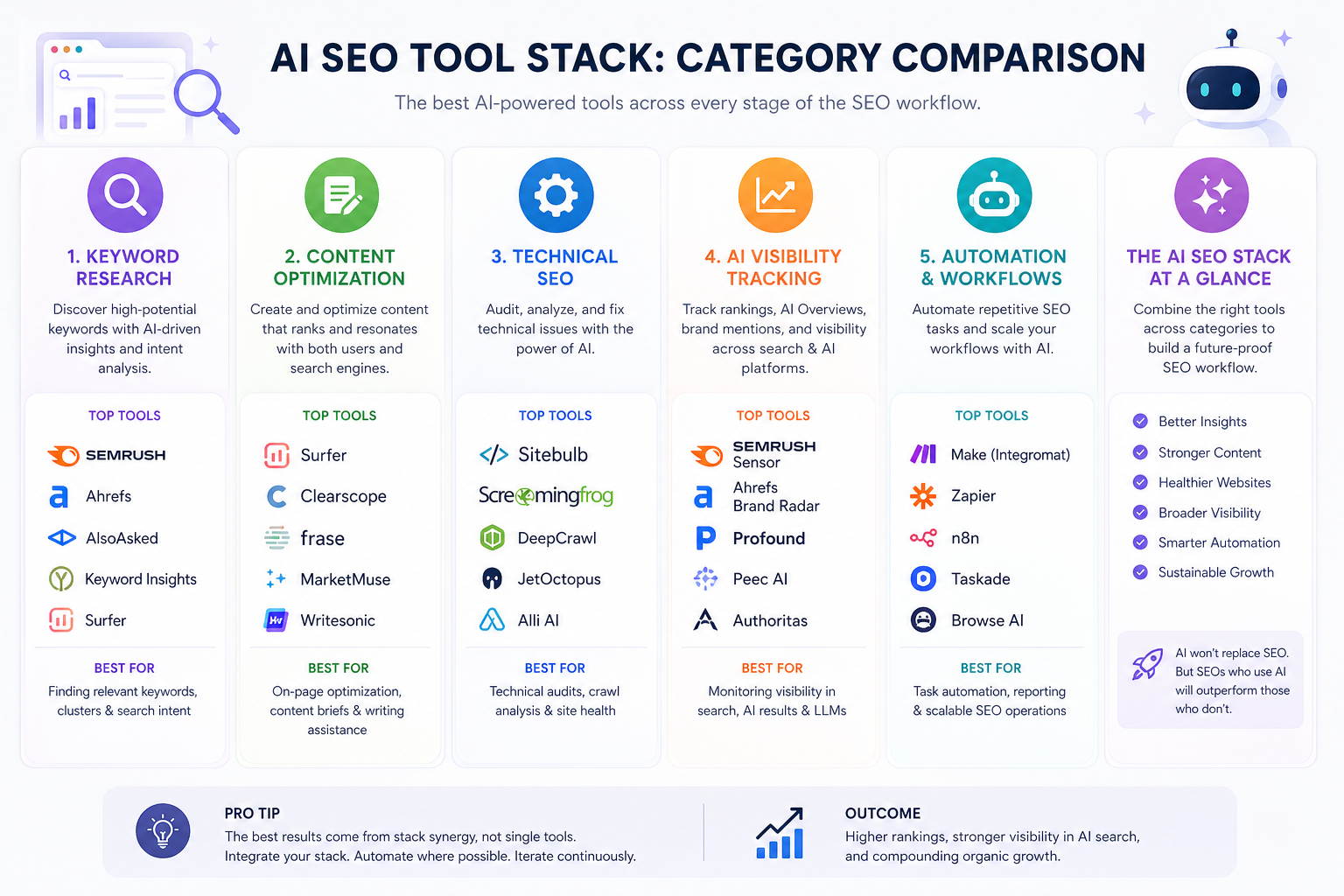
The useful categories are:
Category | What it does | Best for |
|---|---|---|
Keyword research tools | Find demand, difficulty, gaps, and competitor terms | Planning what to target |
Content optimization tools | Improve structure, relevance, coverage, and on-page SEO | Upgrading or briefing content |
AI writing tools | Draft articles, briefs, outlines, and copy faster | Speeding production |
Technical SEO tools | Crawl sites, find errors, improve indexation and performance | Site health |
AI visibility tracking tools | Track presence in ChatGPT, Perplexity, Gemini, AI Overviews | GEO and answer-engine visibility |
End-to-end automation platforms | Handle research, planning, writing, images, formatting, and publishing | Lean teams that need output |
Where competitors mostly stop short
After reviewing leading articles on this topic, the same pattern shows up again and again:
They list tools.
They compare features.
They rarely explain the operating model behind the tools.
They gloss over the hidden cost of tool sprawl.
They do not clearly separate “analysis tools” from “execution tools.”
They underplay GEO: optimizing for citations in ChatGPT, Claude, Gemini, and AI search.
That last point matters a lot now.
Getting rankings is no longer the only goal. You also want your brand and content surfaced in AI answers. That means clearer structure, sharper entity signals, consistent publishing, and content built for answer extraction.
The Smartest Way to Build an SEO Stack in 2026
Most teams should not buy every tool category.
They should choose one of these three models:
Model 1: Specialist stack
Best for experienced marketers.
Example:
Ahrefs for keyword research
Surfer for content optimization
Jasper for drafts
Profound or SE Ranking for AI visibility
CMS plugin for publishing
This is powerful. It is also fragmented.
Model 2: All-in-one SEO suite
Best for teams that want broad coverage and can still execute manually.
Example:
SE Ranking
Semrush
Search Atlas
This reduces tool switching, but content execution still usually requires extra work.
Model 3: End-to-end automation
Best for founders and lean teams.
Example:
RankSpot
This is the most pragmatic option if your real bottleneck is not “insight” but “getting high-quality content live consistently.”
Best AI Tools for SEO Right Now
Below are the best picks across the current landscape. This is a listicle, so every tool includes a visual, what it does well, where it falls short, and who it is best for.
1. RankSpot
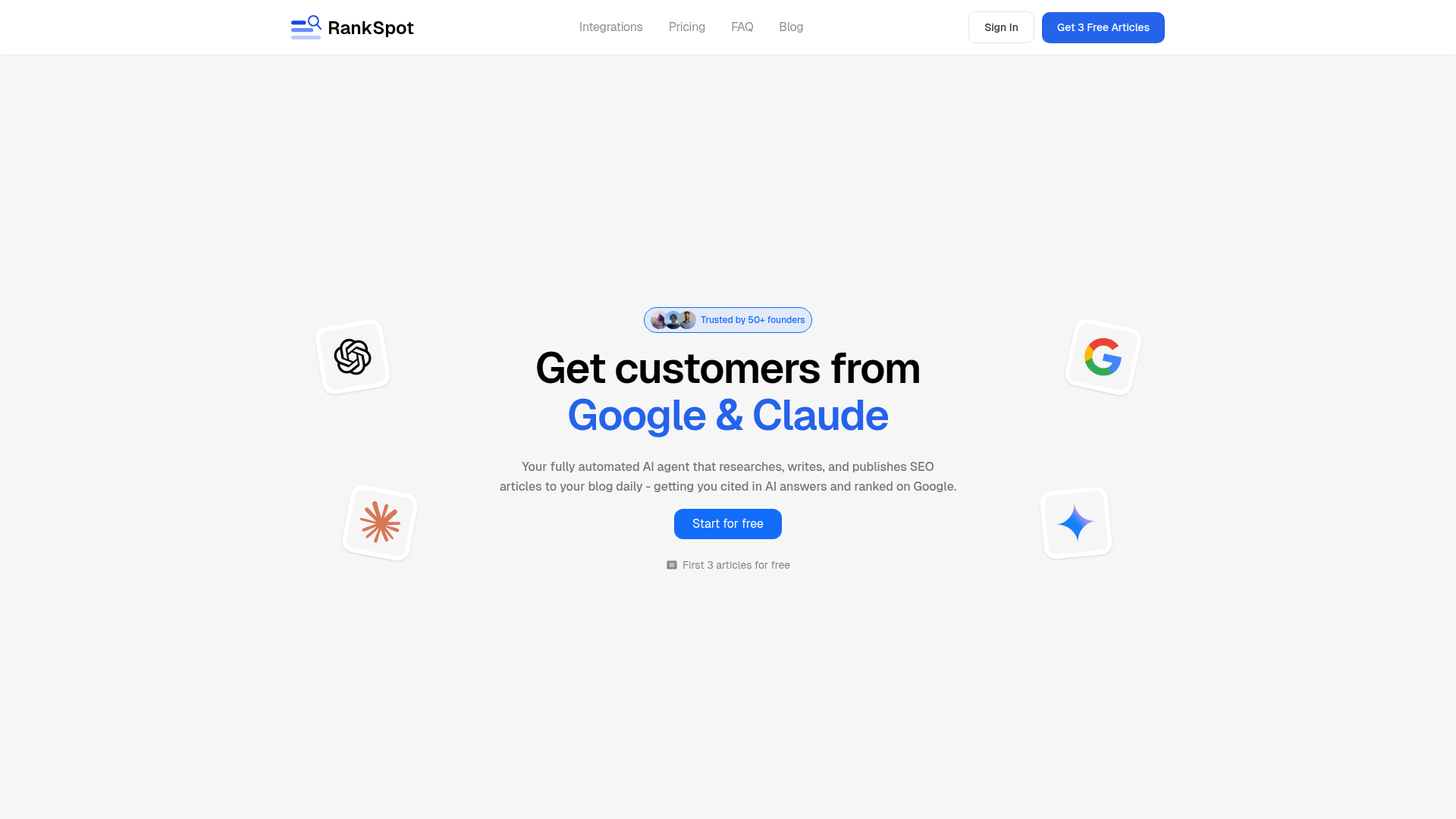
RankSpot is the best fit for founders and small teams that want SEO results without building a complicated stack.
It is not just another AI writer. It is a full automated SEO and GEO content engine.
You give it your website. It learns your niche, your competitors, and your positioning. Then it handles the whole pipeline:
Keyword research
Opportunity-based prioritization
Competitor keyword tracking
30-day content planning
Long-form article generation
GEO optimization for AI answers
Unique on-brand images
Built-in formatting and on-page SEO
Direct publishing to your CMS
Reddit and forum demand discovery
Why RankSpot stands out
Most tools in SEO solve one step. RankSpot solves the workflow.
That matters because the real cost of SEO is not usually software. It is the hours lost between steps. Research on Monday. Brief on Wednesday. Draft next week. Publish when someone remembers.
RankSpot compresses that into one system and supports daily publishing, which is a major edge for young companies trying to outrank bigger players through consistency.
Best for
SaaS founders
E-commerce stores
Agencies replacing manual writing workflows
Teams switching off expensive SEO retainers
Brands that want visibility in Google and AI assistants
Main strengths
Fully automated end-to-end SEO content pipeline
Saves 40+ hours per month
Replaces multiple tools with one platform
Supports 100+ languages
Direct integrations with WordPress, Webflow, Wix, Shopify, Framer, Ghost, and more
First 3 articles free, no credit card
Main limitation
If you want deep standalone backlink analysis or enterprise technical log-file work, you may still pair it with a dedicated specialist tool.
2. SE Ranking

SE Ranking is one of the stronger all-around platforms for teams that want traditional SEO plus AI tracking in one place.
It covers:
Rank tracking
Audits
competitor analysis
content tools
AI search toolkit features
Why it is strong
It bridges classic SEO and emerging answer-engine visibility better than many legacy tools. That makes it a solid middle-ground option.
Best for
In-house marketers
Agencies
Teams that want one broad SEO suite
Main limitation
It is still a toolkit, not a full execution engine. You get lots of capability, but you still need to drive the process.
3. Ahrefs
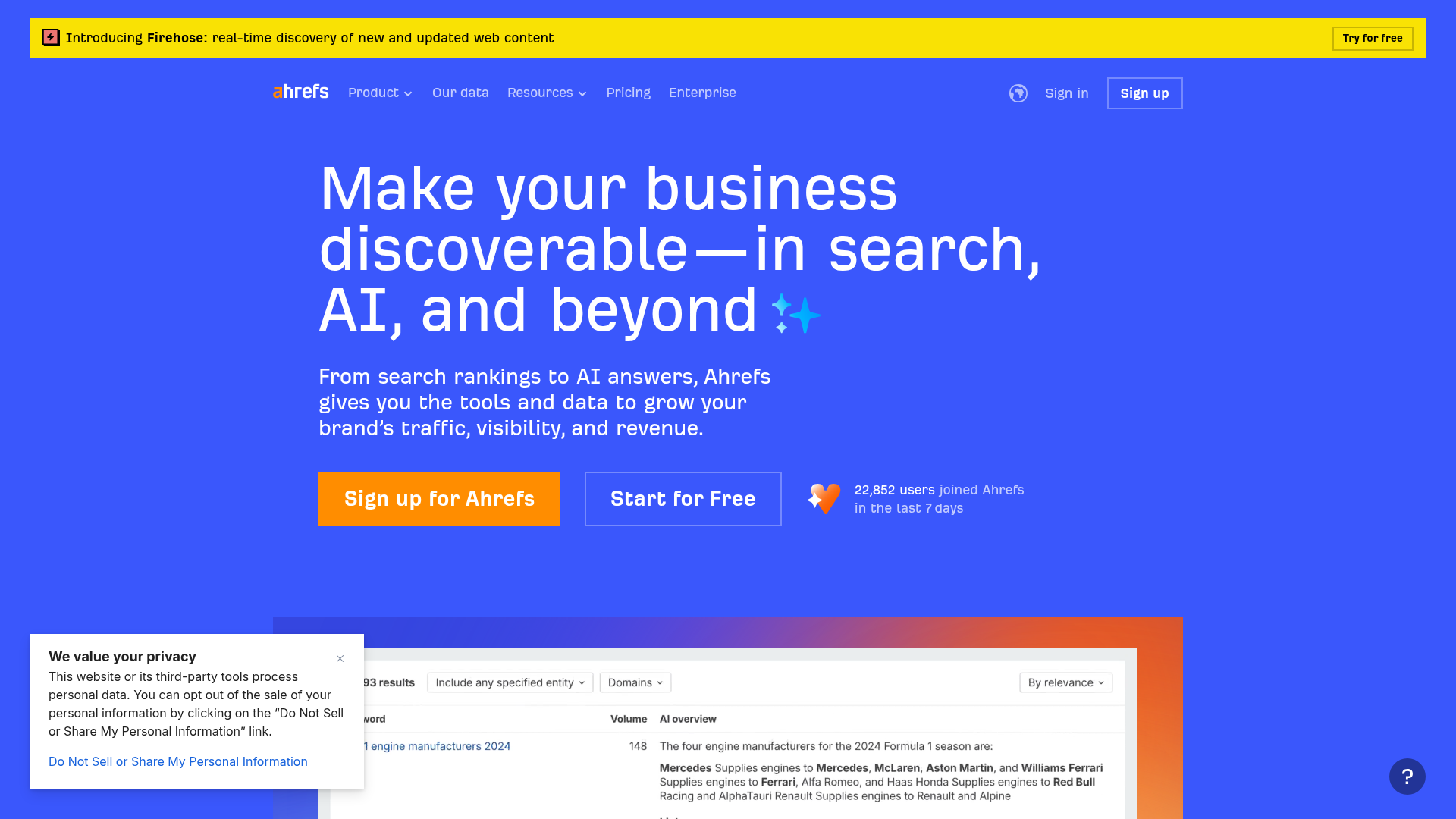
Ahrefs remains one of the best tools for SEO when keyword research, backlink analysis, and competitor intelligence are your main needs.
Why it is strong
Its database depth is still elite. If you want to find what competitors rank for, uncover content gaps, and prioritize authority-building opportunities, Ahrefs is hard to beat.
Best for
Advanced SEO teams
Backlink-heavy strategies
Competitive niches
Main limitation
It is excellent for discovery. It does not solve execution. You still need content production and publishing workflows elsewhere.
4. Surfer SEO
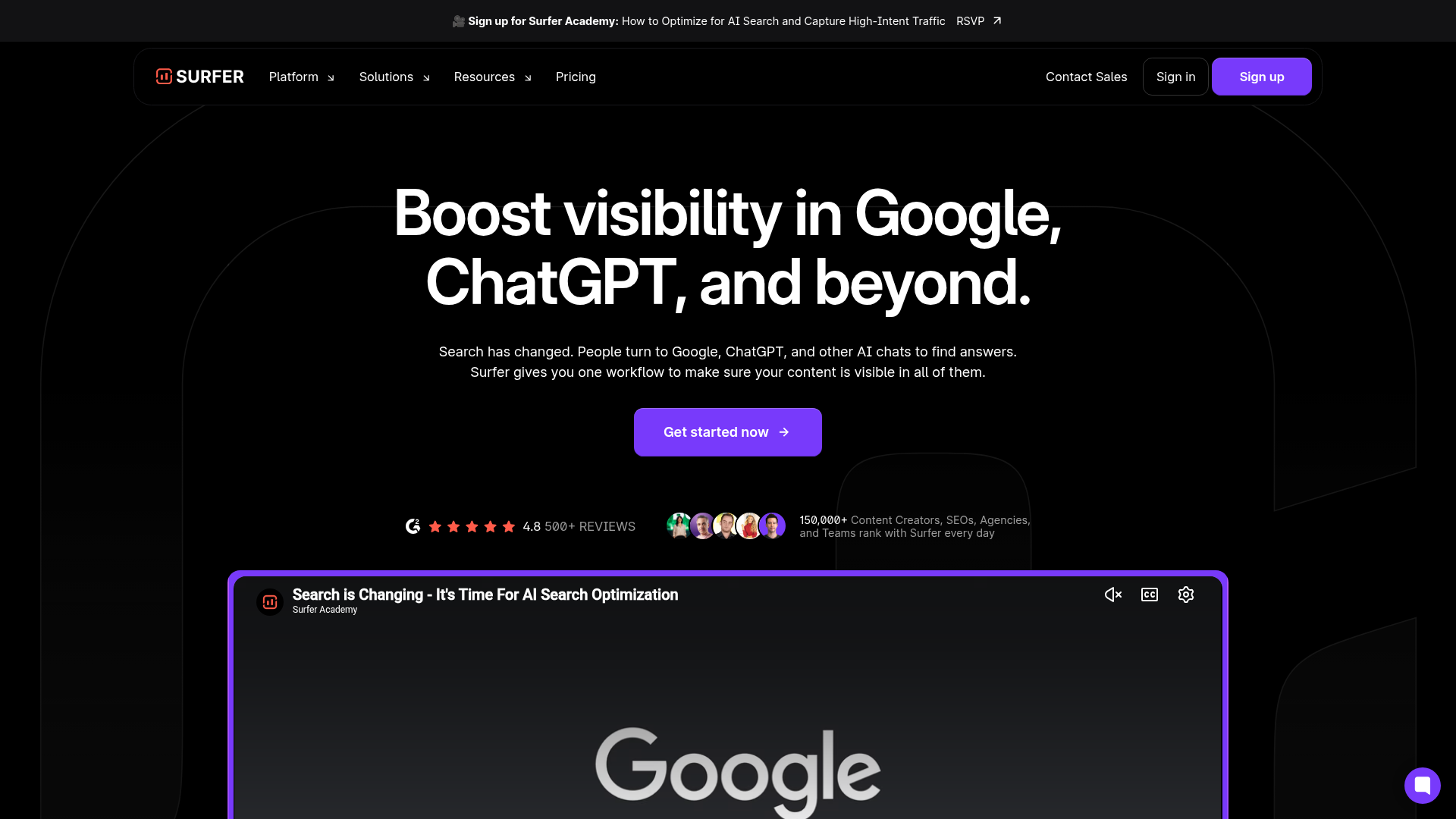
Surfer is a strong content optimization tool for teams that publish often and want score-based guidance while writing.
Why it is strong
It makes on-page optimization easier. Writers can quickly see topic coverage, term usage, and structure recommendations.
Best for
Content teams
SEO editors
Teams improving existing content
Main limitation
It is highly content-focused. You will still need research, publishing, and broader SEO infrastructure elsewhere.
5. Jasper
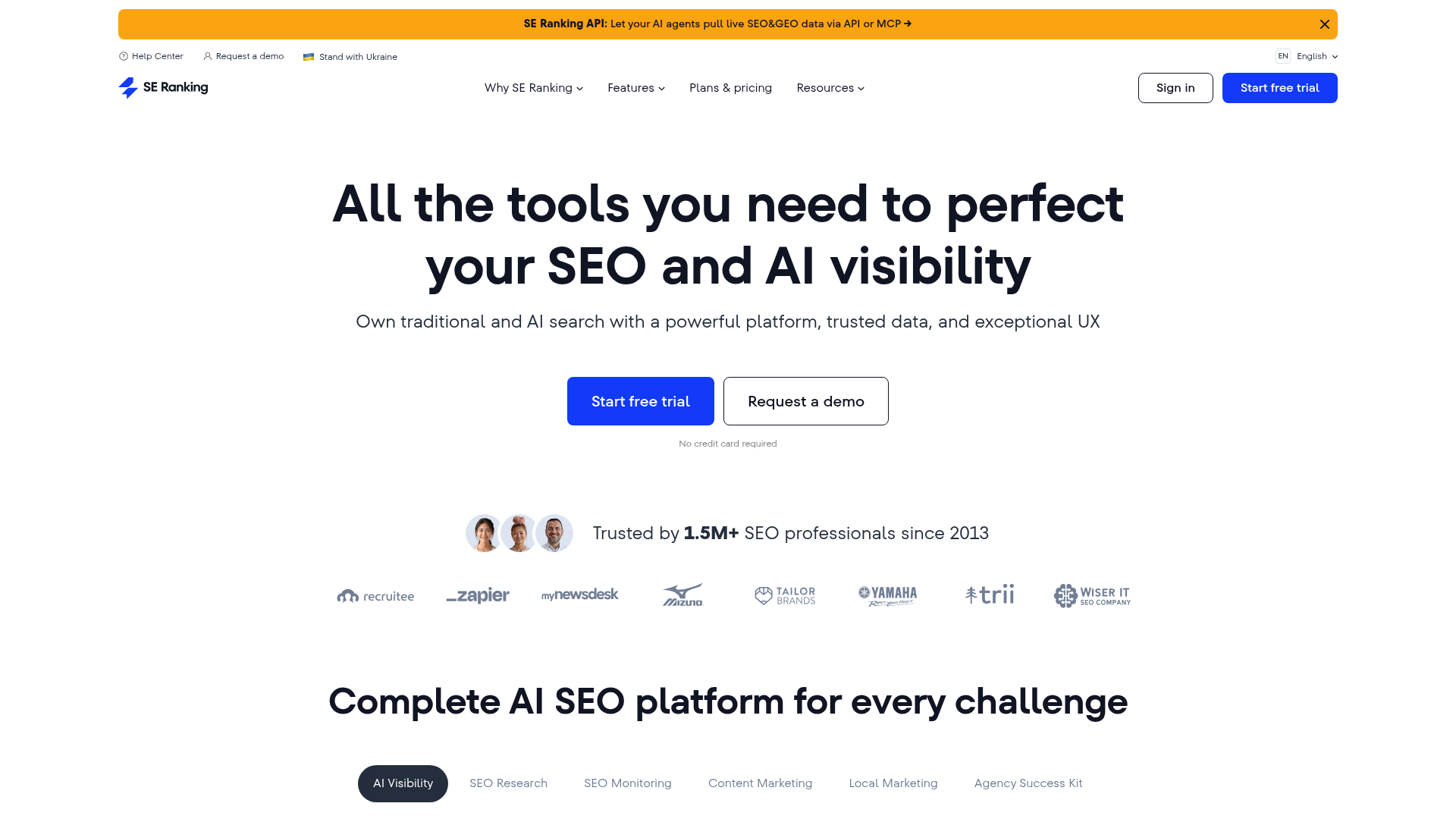
Jasper is one of the better AI writing platforms for teams that care about brand voice and campaign consistency.
Why it is strong
It helps accelerate drafts and can support repeatable content production with templates and workflows.
Best for
Marketing teams
Brand-sensitive organizations
Campaign content production
Main limitation
It is not a real SEO operating system. You still need keyword strategy, optimization, and publishing handled elsewhere.
6. Profound
Profound is built for AI visibility tracking and answer-engine optimization.
Why it is strong
It helps teams understand how brands appear across AI engines, where citations come from, and how visibility changes over time.
Best for
GEO-focused teams
Enterprise brands
Brands monitoring AI search presence
Main limitation
It is specialized. You will still need other tools for content production and broader SEO execution.
7. Diib
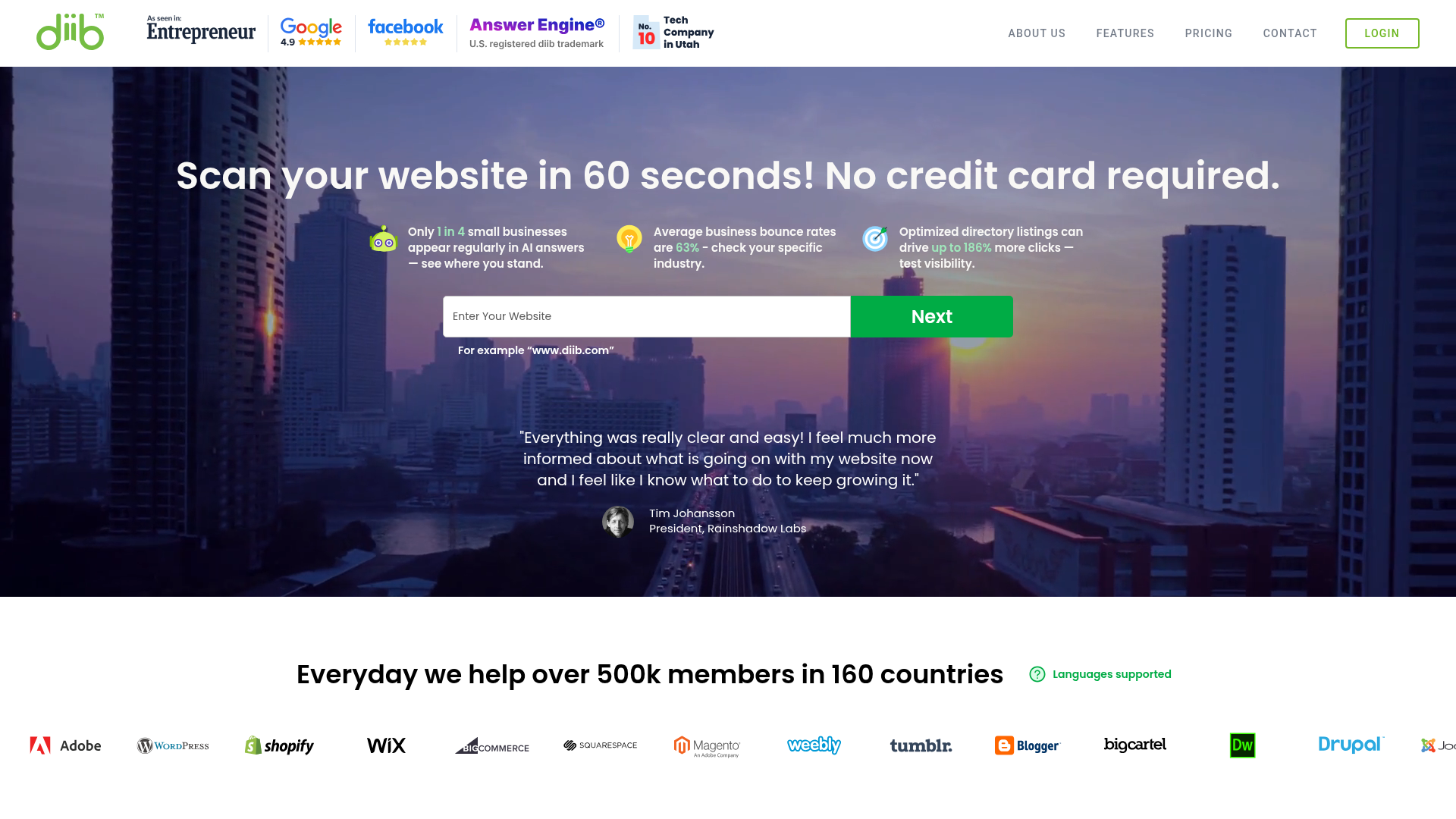
Diib is positioned as a simpler, more guided SEO platform for smaller businesses.
Why it is strong
It focuses on usability and recommendations instead of overwhelming dashboards. That helps beginners take action faster.
Best for
Small businesses
Beginners
Teams that want a lighter learning curve
Main limitation
It is more guidance-oriented than execution-complete. If you need automated publishing and deep content throughput, you may outgrow it.
Quick Comparison: Top Tools for SEO
Tool | Best for | Biggest strength | Biggest weakness |
|---|---|---|---|
RankSpot | Founders and lean teams | Full end-to-end automation | Not a specialist backlink suite |
SE Ranking | All-in-one SEO workflows | Broad coverage incl. AI tracking | Still requires manual execution |
Ahrefs | Research and backlinks | Best-in-class data depth | Content workflow is external |
Surfer SEO | On-page optimization | Fast optimization guidance | Narrow scope |
Jasper | AI writing | Brand-aware draft acceleration | Not full SEO strategy |
Profound | AI visibility tracking | GEO and citation monitoring | Needs companion tools |
Diib | Beginner-friendly SEO | Simple recommendations | Less robust for scaling content |
What the Best AI SEO Tools Have in Common
Winning tools usually do three things well:
1. They reduce decision fatigue
The best platforms do not just report. They prioritize.
2. They cut execution time
Good AI tools in SEO remove repetitive work:
keyword sorting
outlining
content drafting
formatting
internal linking
publishing
3. They help you publish more consistently
This is the hidden growth lever.
Most small teams lose not because they chose the wrong keywords. They lose because they publish too slowly and too inconsistently.
The Big Content Gap Most Tool Lists Ignore
Here is the missing truth:
Publishing velocity is now strategic.
If your team can produce one solid article a week manually, and a competitor can publish optimized articles daily, that competitor compounds faster. They cover more topics, build more internal links, match more long-tail searches, and create more opportunities to be cited by AI systems.
That is why the best tool is not always the one with the most filters or fanciest dashboard.
It is the one that gets more high-intent content live with less drag.
How AI Improves Core SEO Workflows
Keyword research
AI helps cluster terms, identify intent, and surface high-opportunity keywords faster.
But the biggest gain is prioritization.
Instead of exporting giant keyword lists, newer tools can help you focus on:
high-intent terms
competitor gaps
easier wins
topics with commercial relevance
RankSpot is particularly strong here because it ties keyword discovery directly into a publishable plan instead of stopping at analysis.
Content planning
This is where many stacks break.
Most tools can tell you what to write. Fewer can turn that into a coherent calendar. Even fewer can execute the plan automatically.
A real content system should:
map opportunities into a sequence
mix bottom-funnel and topical authority content
build internal link logic over time
align output with business goals
Writing and optimization
AI writing tools can speed up drafts, but raw speed is not enough.
The best output comes when the system combines:
search intent
semantic relevance
entity coverage
structure for readability
formatting for snippets and AI extraction
RankSpot builds these in by default, including tables, quotes, headings, and on-page best practices.
Publishing and workflow automation
This is the most underrated step.
A polished draft sitting in Google Docs has zero traffic value.
Direct CMS integrations matter. So does scheduled publishing. So does not having to copy-paste every post manually.
That is one reason RankSpot is so useful for operators: it removes the last-mile work that usually kills consistency.
GEO and AI answer optimization
Many older articles still treat SEO as Google-only.
That is outdated.
You also want content that AI systems can cite and summarize. That means:
direct, answer-friendly formatting
clear topical authority
clean structure
source-worthy clarity
strong entity alignment
This is where GEO becomes part of the content workflow, not a separate layer.
When You Need a Specialist Tool vs an Automated Platform
Choose specialist tools if:
You have a dedicated SEO lead
You run advanced backlink campaigns
You need enterprise-level audits
Your team likes custom workflows
Choose an automated platform if:
You are the founder doing marketing yourself
Your team is small
You need content shipped consistently
You want one subscription instead of five
Your bottleneck is execution, not data access
A Better Way to Evaluate Tools for SEO
Do not just compare feature lists. Score each option on these five criteria:
Criteria | What to ask |
|---|---|
Time-to-output | How fast can this tool help you publish useful content? |
Consolidation | Does it replace multiple tools or add another tab? |
SEO quality | Does the output include solid on-page structure and keyword alignment? |
GEO readiness | Does it help content show up in AI answers and citations? |
Operational simplicity | Can a founder or lean team actually use it consistently? |
A lot of “best tools for SEO” score high on features and low on usability.
That trade-off is expensive.
What a Lean, High-ROI Stack Looks Like
If you are budget-conscious, these are the practical setups:
Option A: Research-heavy stack
Ahrefs
Surfer
Jasper
Manual CMS workflow
Strong, but labor-intensive.
Option B: Broad suite stack
SE Ranking
Separate writer or editor
Manual publishing
More consolidated, still manual.
Option C: Automation-first stack
RankSpot
Best for speed, simplicity, and compounding output.
Why RankSpot Is the Best Overall Choice for Faster Growth
RankSpot fits the real-life needs competitors only hint at.
It is built for teams that want:
SEO without a full internal SEO department
daily publishing without managing freelancers
AI-generated content that is actually structured for rankings and AI answers
competitor keyword targeting without manual analysis loops
direct publishing without copy-paste ops work
a system that finds demand not just in Google, but in Reddit and forums too
That last point matters more than most people realize.
Forum and community demand often shows you what prospects are actively struggling with before it appears in traditional keyword workflows. RankSpot turns that into content opportunities automatically.
Final Verdict
There are plenty of top tools for SEO. Very few solve the full growth problem.
If you want deep analysis, pick a specialist. If you want broad coverage, pick a suite. If you want content published consistently, optimized for both Google and AI answers, without spending your week inside five tools, pick the platform built for execution.
That platform is RankSpot.
It gives founders and lean teams the thing they actually need: a fully automated SEO and GEO content engine that researches, plans, writes, formats, illustrates, and publishes for you.
The result is simple:
more output
less manual work
better visibility across search and AI
faster compounding growth
If you want to stop managing SEO and start benefiting from it, try RankSpot.
Your first 3 articles are free. No credit card. Low friction. Real output.